

 Find a book


Title
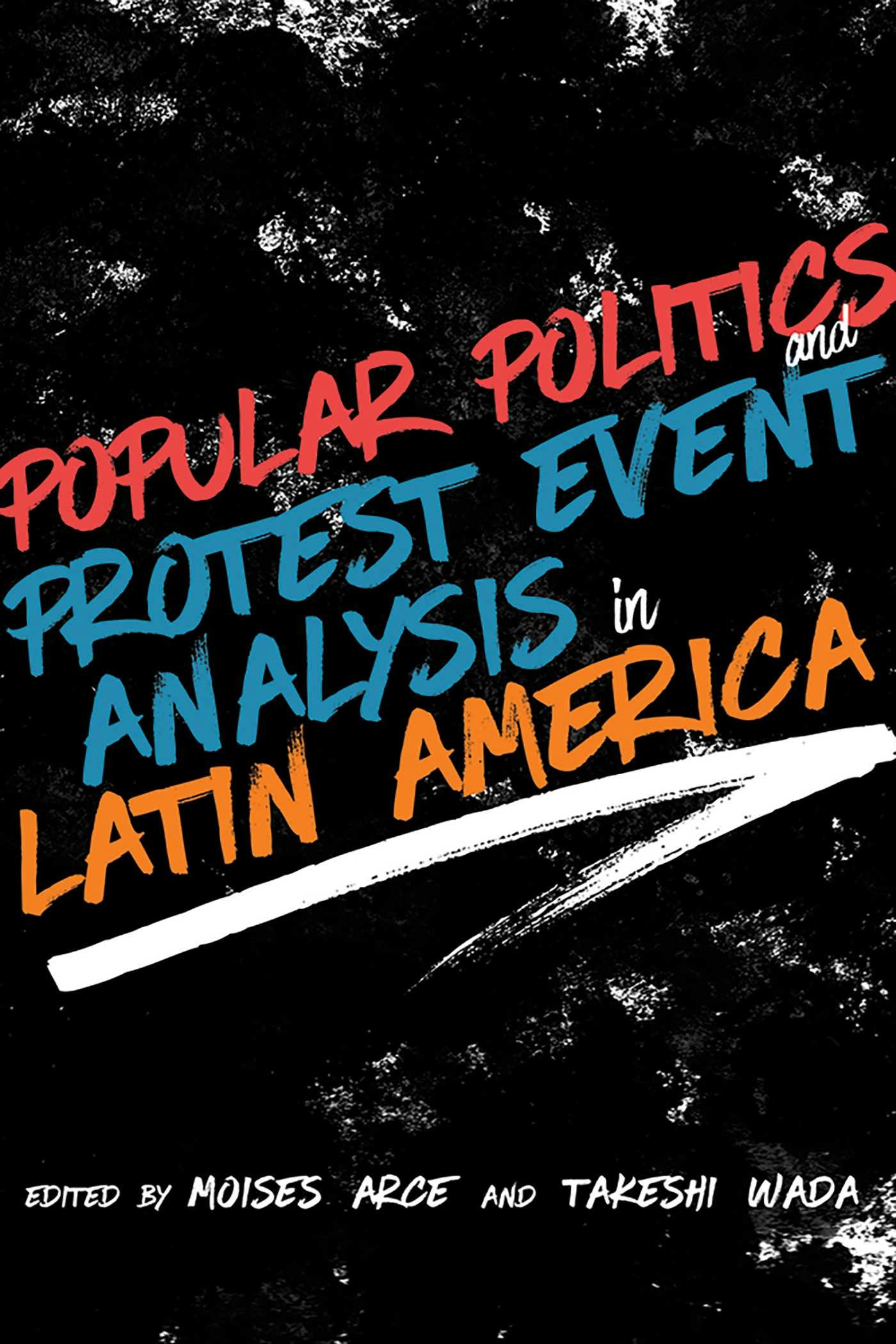
Popular Politics and Protest Event Analysis in Latin America
Size
352 pages, 6x9 inch, hardcover
Language
English
Released
April 01, 2024
ISBN
9780826365682
Published by
University of New Mexico Press
Book Info
See Book Availability at Library
Popular Politics and Protest Event Analysis in Latin America
Japanese Page
This book, Popular Politics and Protest Event Analysis in Latin America, examines how the twin processes of economic globalization and political democratization fundamentally reshaped popular protests in the region. Co-edited by political scientist Moisés Arce from Tulane University and sociologist Takeshi Wada from the University of Tokyo, the volume results from a unique international and interdisciplinary collaboration among sixteen eminent scholars from both the Global North and the Global South.
The central originality of this work resides in its overarching hypothesis regarding a transition between two broad patterns of mobilization: reactive and proactive. Reactive mobilization typically emerges in response to economic threats instigated by liberalization and globalization policies, including the loss of social benefits. These protests are often characterized by labor strikes and material economic demands. Proactive mobilization, by contrast, responds to the expanding political opportunities afforded by democracy. This pattern involves a “rainbow of social actors”—comprising civic associations and urban dwellers—who advocate for political, environmental, and cultural rights through demonstrations and marches. By analyzing ten different countries—including Bolivia, Brazil, Chile, Mexico, and Peru—the authors demonstrate how these two patterns coexist and mutually enhance each other depending on specific national contexts.
A defining feature of this study is its application of a unifying methodology called “Protest Event Analysis.” Unlike studies that rely on broad international datasets or limited case studies, this volume employs country-specific event datasets systematically extracted from non-English domestic news sources. This approach allows for a “bird’s-eye view” of long-term trends while providing detailed insights into the demographics of protesters, where they are active, their demands, and their interactions with the state. To render these complex dynamics accessible, the book incorporates innovative visual tools such as heatmaps, social network diagrams, and geopolitical maps.
From a social-significance standpoint, this volume holds exceptional importance. Given the global strain on the foundations of democracy, understanding how social movements reshape the dynamics between the state and society is critical. This book identifies which actors are strengthened or weakened by globalization and how new forms of mobilization emerge under varying democratic conditions. The book offers vital insights not only for Latin American studies but also for anyone interested in the future of global democracy and development.
This book is also characterized by a strong pedagogical orientation. Each chapter includes devices that allow students and researchers to visually understand the trends and continuities of protest politics. For students of political science, sociology, history, and area studies, this volume serves as an essential guide for cutting-edge research methods and as a window into the realities of an ever-evolving global landscape.
(Written by WADA Takeshi, Professor, Graduate School of Arts and Sciences / 2026)
Table of Contents
PART I: A “BIRD’S-EYE” VIEW ON THE TRANSFORMATION OF POPULAR POLITICS
Chapter 2. A Historical and Spatial Analysis of Popular Protests in Mexico, 1955–2018 (Takeshi Wada)
Chapter 3. Globalization, Democracy, and Conflict Events in Bolivia, 1970–2019 (Roberto Laserna)
Chapter 4. State Debt with a Social Agenda, Constructed amid Social Protests in Colombia, 1975–2019 (Mauricio Archila Neira and Martha Cecilia García Velandia)
Chapter 5. Protesting in Good and Bad Times: Peru, 1980–2015 (Moisés Arce and Renzo Aurazo)
Chapter 6. Popular Protests, Deglobalization, and Authoritarianism in Venezuela, 1983–2012 (Margarita López Maya)
PART II. A “MAGNIFYING GLASS” VIEW ON SPECIFIC PROTEST CAMPAIGNS
Chapter 7. Local-Level Popular Protests in Central America at the Early Onset of Neoliberalism (Paul Almeida, Luis Rubén González Marquez, and María De Jesus Mora)
Chapter 8. A Group-Based Approach to Analyze the Protest Landscape in Chile at the Height of Neoliberalism and Democracy (Nicolás M. Somma and Rodrigo M. Medel)
Chapter 9. Protests and Citizens’ Revolution in Ecuador under Post-Neoliberalism (Santiago Ortiz)
Chapter 10. Dynamics of Political Contention in Brazil: From Deepening to Debacle of Neo-Developmentalism (Luciana Tatagiba and Andréia Galvão)
Chapter 11. Conclusion: Protest, Politics, and Event Count Analysis in Latin America (María Inclán)
Related Info
Reviewed by Richard Feinberg "This illuminating compilation of case studies examines protest movements in ten Latin American countries over the last half century. The surprising findings run counter to the pessimistic notion that the region is characterized purely by rising authoritarianism and democratic backsliding." (Foreign Affairs March/April 2026, 105(2), 191. Feb 17, 2026)
https://www.foreignaffairs.com/reviews/popular-politics-and-protest-event-analysis-latin-america
Reviewed by Carew Bouldig, author of NGOs, Political Protest, and Civil Society
A must-read for scholars of Latin America, social movements, and protest and for anyone interested in understanding how democracy and globalization have affected popular movements in Latin America.
Reviewed by Alberto Lioy “Popular Protests and Protest Event Analysis in Latin America . . . has the potential to rapidly become a reference point for the discipline. It applies the methodology of protest event analysis to successfully cover a daunting amount of ground. After a technical and theoretical introduction, the book is divided into two macro-sections, where the first focuses on longitudinally tracing the national evolution of protests for a series of countries and the second casts a narrower gaze at the process of specific protest cycles. Wonderfully cohesive for an edited volume, it gathers evidence from a multitude of sources and analyzes it under a unitary methodological umbrella.” (Latin American Politics and Society Volume 67, Issue 1, p.133–139 Feb 2025)
https://doi.org/10.1017/lap.2024.37
Events:
Presentación del Libro / Book Launch event (Departamento de Ciencia Política y Estudios Internacionales, Universidad Di Tella, Buenos Aires, Argentina June 18th, 2024)
https://www.utdt.edu/ver_evento_agenda.php?id_evento_agenda=11323&id_item_menu=443
Book Presentation (LASA2024 The World Congress of the Latin American Studies Association, Bogotá, Perú June 15th, 2024)
https://lasaweb.org/en/lasa2024/