

 Find a book


Title
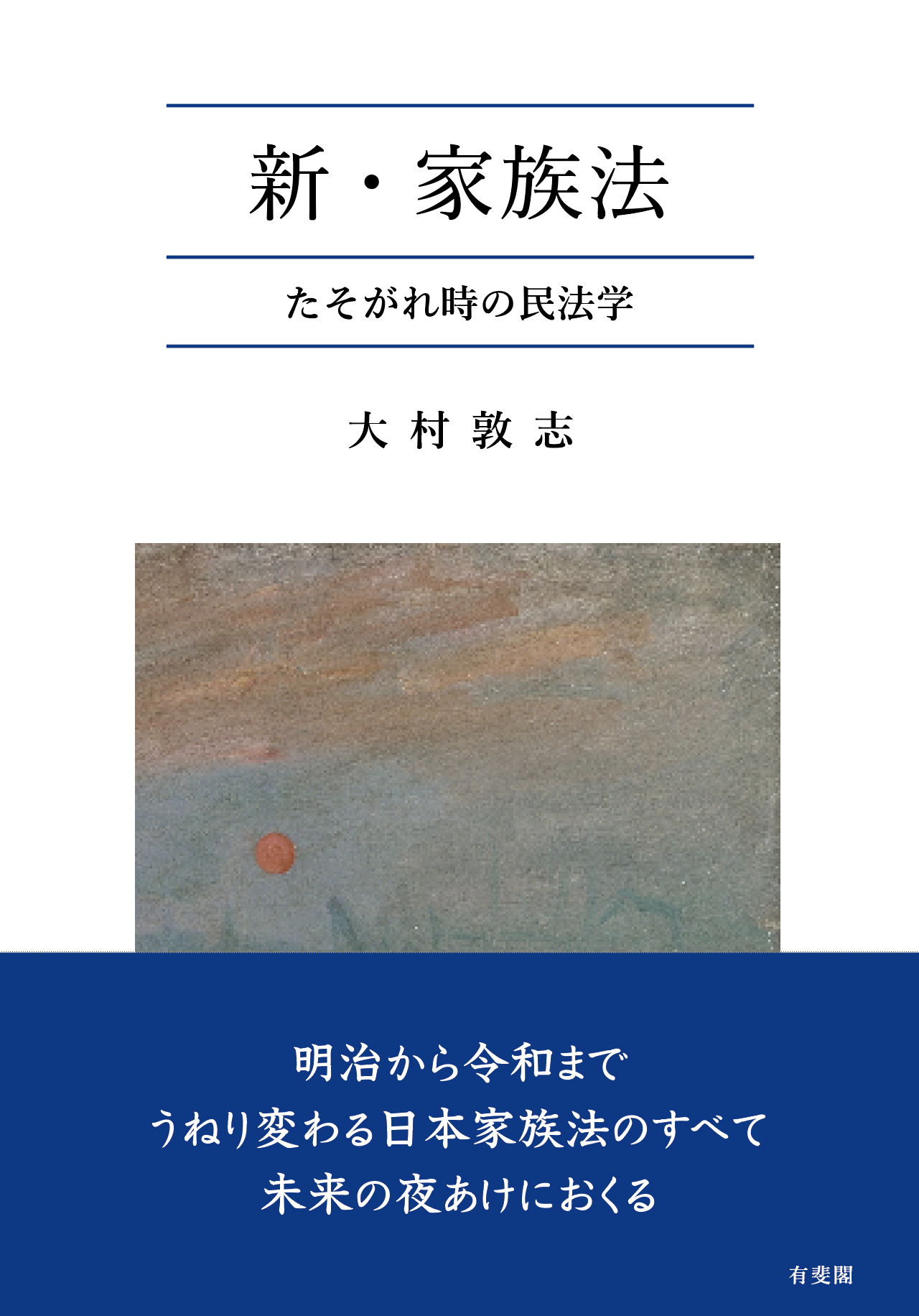
Shin Kazokuhō (New Family Law - At the Twilight of Civil Law)
Size
662 pages, A5 format, hardcover
Language
Japanese
Released
July, 2025
ISBN
978-4-641-23317-1
Published by
Yuhikaku Publishing Co., Ltd.
Book Info
See Book Availability at Library
Japanese Page
 eBook
eBook
In Japan, family law generally refers to the last two parts of Japan’s Civil Code (Part IV. Relatives and Part V. Succession). These parts on family law were completely revised in 1947 following the enactment of the current Constitution. Family law prior to this comprehensive revision was referred to as the Meiji Civil Code, while after the revision was sometimes called the Showa Civil Code. My 1999 book, Kazokuhō (Family Law; excluding the part on succession) focused on the Showa Civil Code which had undergone three minor revisions at that time, but had not really changed in a major way.
Thereafter, further revisions were made, starting with the 1999 revision of laws on adult guardianship, followed by the amendments to the parental authority laws in 2011, the succession laws in 2018, the special adoption laws in 2019, the natural filiation and parental authority laws in 2022, and the post-divorce child custody laws in 2024. Further revisions include parts of the laws on marriage due to the 2018 lowering of the age of majority, and parts of the laws on succession due to changes made in 2021 to the provisions for real estate properties with unknown owners. These successive revisions of recent years have led to major changes in Japanese family law. At the same time, additional amendments to law of obligations, the General Provisions of the Civil Code, and some of the provisions regarding property rights suggest that a whole new Third Civil Code (Heisei Civil Code) has emerged. This 2025 publication, Shin Kazokuhō (New Family Law; including some sections of the Civil Code provisions on succession) refers to the Heisei Civil Code.
The two books, Kazokuhō and Shin Kazokuhō, differ not only in content but in how they are organized as well. While Kazokuhō focused on a comparison of laws concerning married and non-married families, Shin Kazokuhō expounds on the nature of family relations and how they are formed and dissolved, starting with laws protecting minors. This shift in emphasis from “marriage” to “children,” reflects the major change of direction in the Heisei Civil Code.
The main body of Shin Kazokuhō is “Part II, The System of Family Law.” “Part I, The Origins of Family Law” which proceeds it explains the process by which the family law provisions of the Heisei Civil Code came into being and incorporates insights based on my experience as a legislative assistant continuously involved in the Heisei family law reforms, from the 1999 amendments through to the 2024 amendments. Reading Part I first will help you to better understand how the family law provisions in the Heisei Civil Code, explained in greater detail in Part II, were developed.
Finally, allow me to touch upon the subtitle of this book. Tasogaredoki no minpōgaku
(At the Twilight of Civil Law) is actually the theme for a scheduled series of four books, the first of which is Shin Kazokuhō. It is my hope that you will understand this theme as indicative of how the study of Japanese civil law is approaching a major turning point.
(Written by OMURA Atsushi, Professor Emeritus, Graduate Schools for Law and Politics / 2025)