

 Find a book


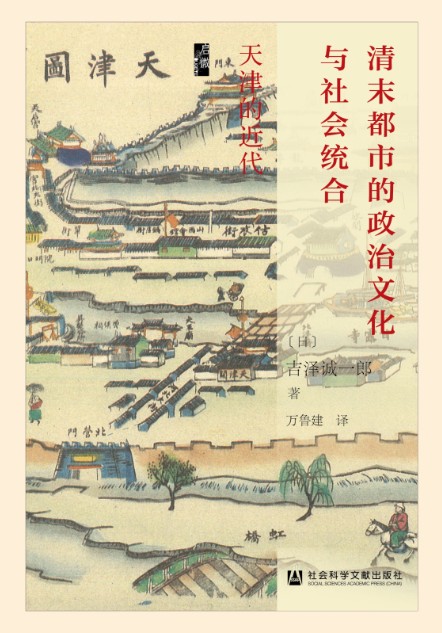
Title
Qingmo dushi de zhengzhi wenhua yu shehui tonghe: Tianjin de jindai 清末都市的政治文化与社会統合: 天津的近代 (In Search of Modernity in Tianjin History: Political Culture and Social Integration in a City during the late Qing Period)
Size
476 pages
Language
Chinese
Released
August, 2022
ISBN
978-4-8158-0423-7
Published by
Social Sciences Academic Press
Book Info
See Book Availability at Library
Japanese Page
I must admit I am slightly reluctant to discuss my own book, which was published years ago. Nevertheless, it may be worthwhile to consider the release of the Chinese version twenty years after its original publication.
This book is based on my doctoral dissertation. It evokes numerous memories: reading century-old newspapers in a cold, unheated room in Tianjin during the depths of winter, transcribing them by hand; reading Chinese historical documents attached to 19th-century diplomatic reports in the British National Archives, only to be asked by an elderly woman seated next to me, “Why can you read Chinese characters?” and finding myself at a loss for words.
One objective of this book is to reconsider modern Chinese history from the perspective of a single city, Tianjin. For instance, it is well known that during the Second Opium War (the Arrow War), British and French fleets sailed up the river to Tianjin and concluded the Treaty of Tianjin with the Qing Dynasty in 1858. What kind of experience was this incident for the people of Tianjin?
At the time, the local leaders of Tianjin organized a self-defense militias to strengthen defenses, following official orders. However, when foreign troops landed and tensions rose between them and the Chinese inhabitants, the militias worked to prevent conflict. Interestingly, this memory was passed down within the community and resurfaced during the Boxer Rebellion in 1900.
In 2022, the Social Sciences Academic Press, a prominent Beijing publisher, published the Chinese edition of this book, which was translated by Professor Wan Lujian. I am grateful that many people in China now have easy access to it.
I will briefly explain the importance of publishing a Chinese edition. First, the market for Chinese-language books is much larger than that for Japanese-language books. Furthermore, given the high level of interest in Chinese history in China, it is reasonable to assume that there is greater demand for my book in the Chinese-speaking world. While I do not know the exact figures, I suspect that the print run of the Chinese edition exceeds that of the original Japanese edition. Generally speaking, of course, English books probably have broader distribution channels. However, it is unlikely that many Westerners are interested in academic books on Chinese history. In addition, Western experts on China can read Chinese-language books.
Publishing in Chinese is therefore highly meaningful in the field of Chinese studies. Most importantly, my research is motivated by Chinese readers’ desire to experience a book written by a Japanese author that may offer a unique perspective.
This may be analogous to how an American scholar feels about wanting to write an excellent book on European history. If an English-language book by an American scholar on, for example, French history were also published in French, it would undoubtedly be a source of pride.
While this attitude and desire may be indicative of a very small academic world, I believe it will likely continue in the future.
(Written by YOSHIZAWA Seiichiro, Professor, Graduate School of Humanities and Sociology / 2025)
Table of Contents
第一部分 支撑地域防卫的价值观和记忆
第一章团练的组建
一 鸦片战争与天津团练的起源
二 防备太平军
三 第二次鸦片战争时期的地区防卫
四 第二次鸦片战争的结束和张锦文的活动
第二章火会与天津教案
一 事件概要
二 火会对天津教案的参与
三 地方社会中的教案
第三章 光绪初年的旱灾与广仁堂
一 游民和善堂
二 华北大旱灾和广仁堂的设立
三 广仁堂的历史地位
第四章 义和团的活动与团练神话
一 天津的地方官与义和团
二 义和团的活动与天津居民
三 社会记忆的再现
第二部分 行政机构的革新与社会管理
第五章 巡警的创设与城市行政的演变
一 巡警的创设过程
二 巡警的职能特征
三 城市行政的结构性改变
第六章捐与城市管理
一 捐在天津的起源
二 都市民众与捐
第七章在善堂与习艺所之间
一 习艺所的诞生
二 善堂的演变
第三部分 爱国主义所形成的社会统合
第八章 抵制美货运动与“中国”的团结
一 移民问题与抵制运动的开始
二 天津的运动开展过程
三 抵制与启蒙
第九章 电车与公愤:围绕市内交通的政治
一 国际性契机
二 电车的运营
三 围绕电车的暴力事件
第十章 体育与革命:辛亥革命时期天津的尚武理念和治安问题
一 重视军事论与体育理念的流行
二 体育社的成立
三 革命的动荡与各团体的形成
四 从兵变到袁世凯政权
补论 风俗的变迁
一 风俗的内涵
二 改良风俗
结 语
参考文献
后 记
译后记
Related Info
Tenshin no Kindai (published by The University of Nagoya Press, on Feb 20, 2002)
https://www.unp.or.jp/ISBN/ISBN4-8158-0423-0.html