

 Find a book


Title
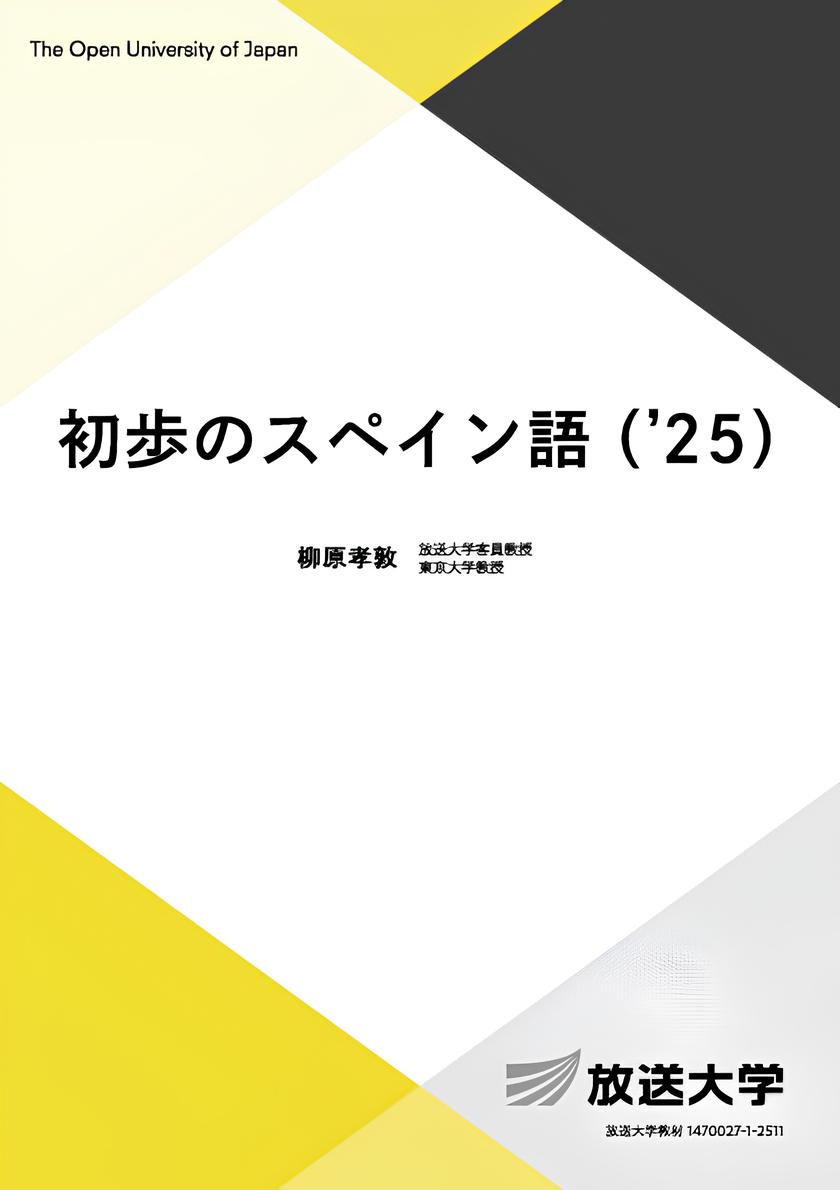
Open University of Japan Teaching Materials Shoho no Spain-go ('25) (Introductory Spanish 2025)
Size
212 pages, A5 format
Language
Japanese, Spanish
Released
2025
ISBN
978-4-595-32535-9
Published by
Foundation for the Promotion of The Open University of Japan
Book Info
See Book Availability at Library
Japanese Page
This textbook covers the Open University of Japan’s 2025 broadcast lecture course in introductory Spanish.
The Open University of Japan began offering a Spanish course in 2017 as one of its foreign language courses. I (Takaatsu Yanagihara) wrote the textbook, which is for the 2025 course, while Nina Hasegawa (Honorary Professor at Sophia University), who was a speaker in the lecture broadcasts, supervised in the selection of example sentences and the dialogues at the start of each lesson and reading materials, etc.. To give learners a flavor of the considerable linguistic diversity in Spanish, which is spoken in some 20 countries and regions of the world, the texts and compositions at the start of each lesson were read out by Spanish speakers from an array of Spanish-speaking countries: Nina Hasegawa from Mexico, Antonio Doñas (Sophia University) from Spain, Gregory Zambrano from Venezuela, and Valeria Fiszelew (Sophia University, among others) from Argentina.
This textbook does not come with a CD. While it was once common for language textbooks to come with a CD containing the audio data for the dialogues, texts, and example sentences, this practice is increasingly redundant considering that learners nowadays access the audio content online and may not even own a CD player. Under the format of a textbook of the Open University of Japan, the course content is transmitted on television and radio, but it can also be accessed at any time from the Open University’s online system. While technically offered in the form of a radio program, the audio content can be played on a television too. A new feature introduced in this 2025 version is the use of subtitles for television.
The textbook consists of: 1) a main section, which includes dialogues and reading materials, 2) grammatical exposition, 3) exercises, 4) columns, and 5) answers to the exercises. While I have adopted the same structure and format of a typical language-learning textbook, have added certain content to make the textbook more topical to the present day.
For example, in the main section, chapter 12 contains introductory passages from five Spanish-language novels and chapter 13 contains excerpts from the Spanish, Mexican, and Argentine constitutions. For grammatical exposition, I took care to represent linguistic diversity as with the audio content for the main section. Within the vast Hispanosphere, many regions (especially the regions of Argentina and Uruguay by the Río de la Plata) use “vos” as the informal second-person singular, while other regions use “tú” for such. Verb conjugation differs between the two pronouns. While most textbooks for learning Spanish show only the conjugations for “tú,” this textbook shows the conjugations for “vos” too. Helpfully, (as listed above) Argentinian-born Valeria features in the audio data for the main section, so listeners can hear her natural pronunciation of conjugations for the “vos” pronoun.
Among the in-depth articles are those on Hispanosphere culture (sport, music, film, literature, art, and drama). Other topics include the ongoing legacies of the Spanish Civil War and that of the Latin America juntas, along with women’s issues and feminism. With feminist movements having made striking progress in Latin America of late, I included topical examples illustrating this, including content on the election of Mexico’s first woman president.
(Written by YANAGIHARA Takaatsu, Professor, Graduate School of Humanities and Sociology / 2026)