


 Find a book


Title
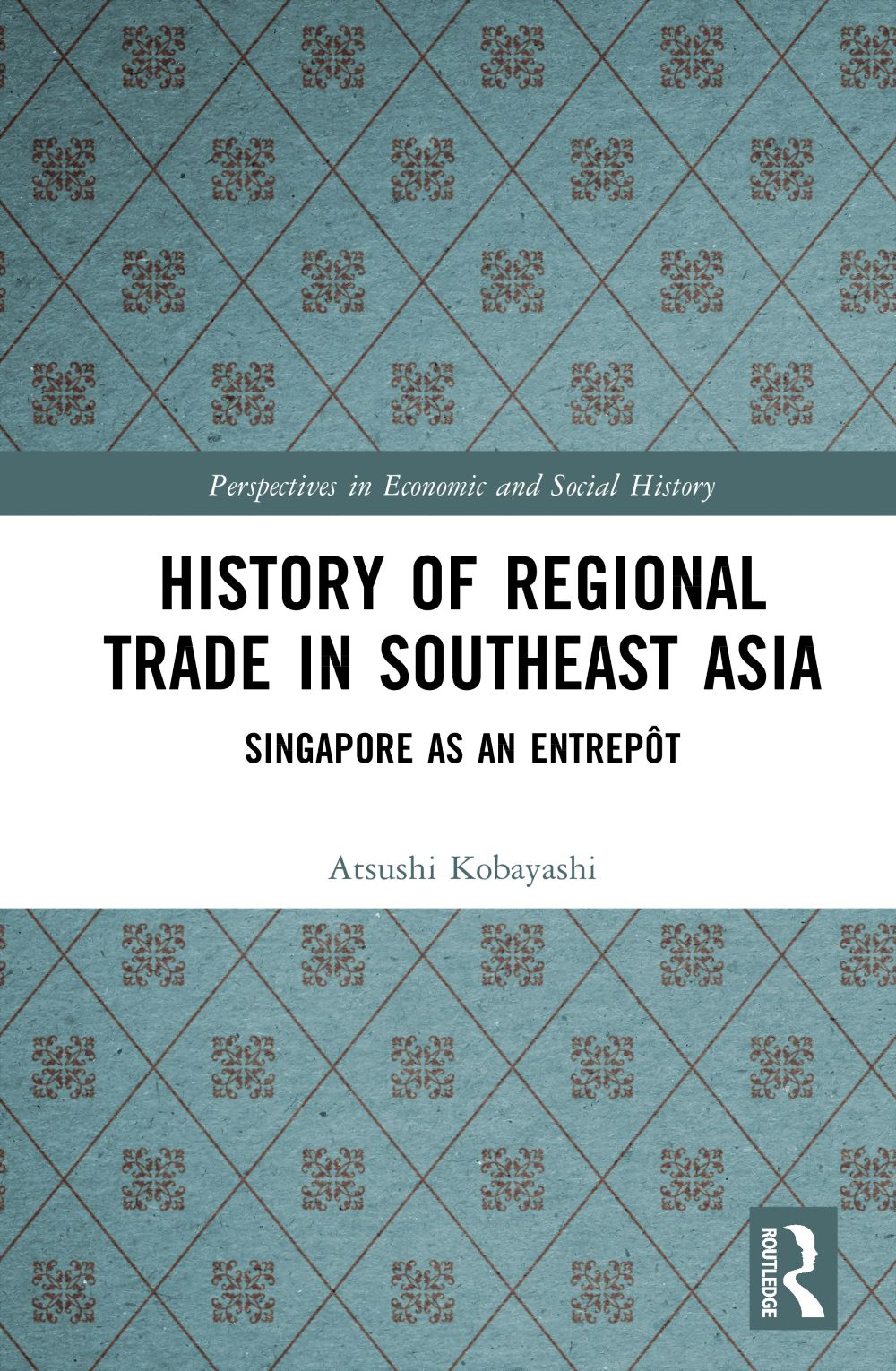
Perspectives in Economic and Social History History of Regional Trade in Southeast Asia Singapore as an Entrepôt
Size
216 pages, hardcover
Language
English
Released
December 31, 2025
ISBN
9781041092230
Published by
Routledge
Book Info
See Book Availability at Library
Misc.
Copyright 2026 by Routledge.
Reproduced by permission of Taylor & Francis Group.
Japanese Page
Southeast Asia today comprises eleven diverse nation-states, yet continues to pursue regional integration through the Association of Southeast Asian Nations (ASEAN). Traditionally, the region’s modern development has been framed as a “rupture” caused by nineteenth-century Western colonialism. More recent scholarship, however, has drawn attention to the dynamism of Southeast Asian political and economic systems in the early modern era, particularly during the sixteenth and seventeenth centuries under the influence of global trade. This book engages with this historiographical tension between “rupture” and “continuity” by re-examining Southeast Asia’s long-term economic development from the late eighteenth to the early twentieth century. It does so through the lens of intra-regional trade, focusing on the pivotal role of Singapore as a global entrepôt.
Departing from earlier studies that focused primarily on long-distance exports of primary goods to Europe after the mid-nineteenth century, this study shifts the analytical spotlight to intra-Southeast Asian trade networks. It highlights the hub function of Singapore, which inherited the roles of early modern Southeast Asian port cities and became central to the development of intra-regional trade during the nineteenth century. Moreover, by adopting the temporal framework of the “long nineteenth century,” the book challenges the conventional periodization defined by the onset of colonialism. Methodologically, the book combines quantitative and qualitative analysis, drawing on historical trade statistics, colonial reports, and commercial newspapers. This multi-sourced approach enables a detailed reconstruction of trade patterns, price movements, and monetary flows across the region.
The empirical analyses demonstrate that intra-regional trade centred on Singapore not only grew consistently throughout the nineteenth century but also laid the groundwork for the subsequent export boom to Western markets. Asian merchants played leading roles in circulating staple commodities such as rice, sugar, and cotton textiles, while monetary flows—including silver coinage and bills of exchange—were channeled through Singapore’s financial and commercial institutions. One of the book’s key contributions lies in revealing that Southeast Asia, despite being politically partitioned under colonial rule, sustained and expanded its internal economic linkages via Singapore. These networks were far from peripheral; rather, they formed the infrastructural backbone of the region’s integration into the global economy. Singapore functioned not merely as a colonial port but as a premier entrepôt that systematically connected regional and global markets over the long run.
Ultimately, this study offers a fresh perspective: Southeast Asia was not simply a passive object of colonial exploitation but actively shaped its own economic trajectory through resilient regional trade. In doing so, the book challenges Eurocentric models of modernization and presents a compelling case for understanding Southeast Asia as a historically coherent and economically integrated space.
(Written by KOBAYASHI Atsushi, Associate Professor, Graduate School of Economics / 2026)
Table of Contents
Part I Emergence of the Lion City and Intra-Regional Trade
1 Origins of Singapore’s Prosperity: Entrepôt for the Pre-1820 Intra-Asian Trade
2 Emerging Singapore: Quantification of Southeast Asian Trade, 1828–73
3 Evolution of Intra-Regional Trade Centred on Singapore, 1874–1913
Part II Commodity Circulation, Merchants’ Businesses, and Market Integration
4 Formation of Entrepôt System in Singapore: Trade of Cotton Goods and Southeast Asian Products, 1830–70
5 Intra-Regional Market Integration via Singapore: Development of Rice Trade, 1828–70
6 From Entrepôt to Staple Port: Macroeconomic Transformation and Mercantile Adaptation
Part III Money Flows, Settlement Systems, and Macroeconomic Adjustment
7 Entrepôt Settlement System: Development of Money Supply and Foreign Exchange in the Mid-Nineteenth Century
8 Bimetallic Exchange Rates in Singapore: Adjustment for the Balance of Payment and Bullion Market in the Mid-Nineteenth Century
9 Money, Price, and Gains of Intra-Regional Trade: Purchasing Power Parity and Terms of Trade
Conclusions: The Rise of Global Entrepôt
Related Info
Perspectives in Economic and Social History
https://www.routledge.com/Perspectives-in-Economic-and-Social-History/book-series/PESH
Related articles:
The 13th Asia Pacific Research Prize (Iue Prize) “Commendation” winner: Dr. Atsushi Kobayashi
Title of Dissertation: “Development of Intra-Southeast Asian Trade in the Nineteenth Century: With Reference to the Role of Singapore” (Asia Pacific Forum, Awaji Conference Japan 2014)
https://www.hemri21.jp/awaji-conf/english/project/commendation/13th/awards/winner03.html
Reconstructing Intra-Southeast Asian Trade, c.1780s-1870: Evidence of Regional Integration under the Regime Colonial Free Trade
The Role of Singapore in the Growth of Intra-Southeast Asian Trade, c.1820s-1852
Atsushi Kobayashi (Southeast Asian Studies Volume 2, Issue 3, p.443-474 Dec 26, 2013)
https://doi.org/10.20495/seas.2.3_443