

 Find a book


Title
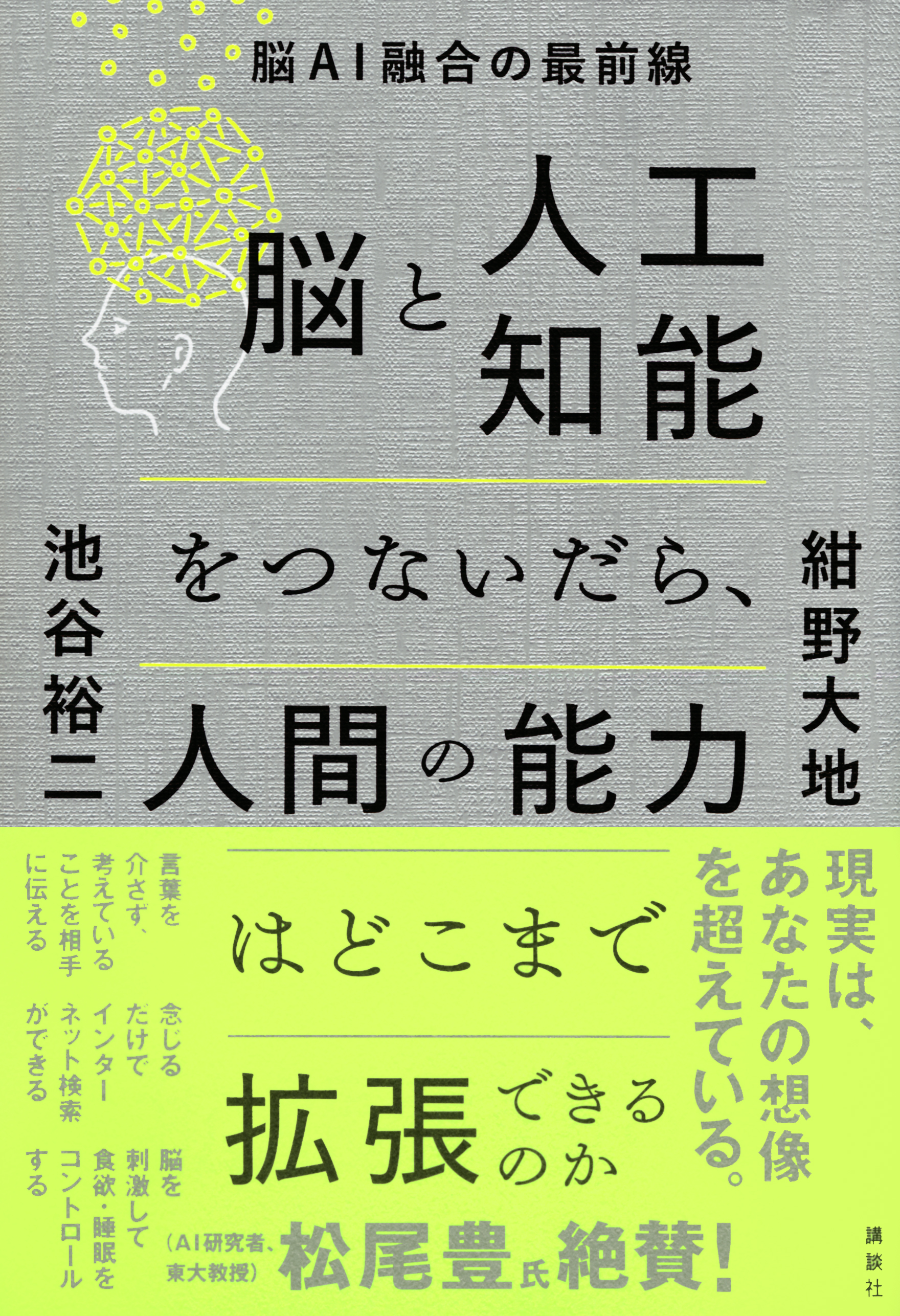
Nou to jinkochino wo tsunaidara, ningen noryoku ha dokomade kakutyo dekirunoka (How Far Can Human Capabilities Be Expanded by Connecting the Brain and Artificial Intelligence? - The Frontline of Brain-AI Integration)
Size
290 pages
Language
Japanese
Released
December 16, 2021
ISBN
9784065265154
Published by
Kodansha Ltd.
Book Info
See Book Availability at Library
Nou to jinkochino wo tsunaidara, ningen noryoku ha dokomade kakutyo dekirunoka
Japanese Page
This book was published together with Daichi Konno, a physician and member of my lab at the time. The impetus for writing this book came when I was appointed research director of the JST (Japan Science and Technology Agency) "ERATO Ikeya Brain-AI Integration Project." Our slogan for this project is to prove the hypothesis that "the brain has immeasurable potential, but its true potential is blocked by the constraints of the body." Humans don't have wings, and we can't hear ultrasound. But if we could free the brain from the constraints of the body using a new "tool" called AI, how far could it evolve? This book tackles this very question, a report from the forefront of science.
The greatest appeal of this book is that it doesn't simply predict the future; it packages "live data" obtained through our own hard work in the lab, as well as the atmosphere of "hot battlefields" occurring simultaneously around the world.
For example, in our lab, we conducted an experiment in which we implanted geomagnetic sensors in the brains of blinded rats. Rats are not naturally able to sense the earth's magnetic field. However, after implanting a chip in their brains, the rats were able to use geomagnetic information to solve mazes within just a few days. This is a significant academic finding, suggesting that even senses (modalities) not inherently possessed by the brain can be flexibly incorporated and expanded into one's own abilities through the use of AI and electric devices.
This book also explores the activities of Elon Musk's Neuralink company and describes how technologies that would rival those in science fiction films are already being researched in the real world, such as the "Internet Brain," which directly connects the brain to the Internet, and "brain-brain fusion," which connects multiple brains. Many readers have commented, "It's like reading a science fiction novel, but what's shocking is that it's all based on real science," and "It's exciting, and it makes you think about what it means to be human." This "shock" is precisely what this field is currently experiencing.
As mentioned in the latter half of this book, advances in AI are transforming scientific methodology into "high-dimensional science." What should researchers and engineers do in an era in which AI models the world from a vast number of parameters, exceeding the number of variables humans can intuitively understand? Such scientific and ethical questions are also important themes in this book. The fusion of the brain and AI is by no means a dream of the distant future. It is a reality happening right before our eyes, a major turning point that may change the way humanity exists. We hope that through this book you will share in its overwhelming possibilities and the excitement of science as it ventures into unknown territory.
(Written by IKEGAYA Yuji, Professor, Graduate School of Pharmaceutical Sciences / 2025)
Related Info
Why does the mind arise from our brain? (The University of Tokyo May 26, 2023)
https://www.u-tokyo.ac.jp/focus/en/features/z1304_00247.html
Project:
Basic Research Integrating Brain Science and AI
Expanding Brain Function Using AI (AI-assisted Expansion of Perception, Sensibility, and Cognitive Performance) (Beyond AI)
https://beyondai.jp/contents/projects/ikegaya/?lang=en