

 Find a book


Title
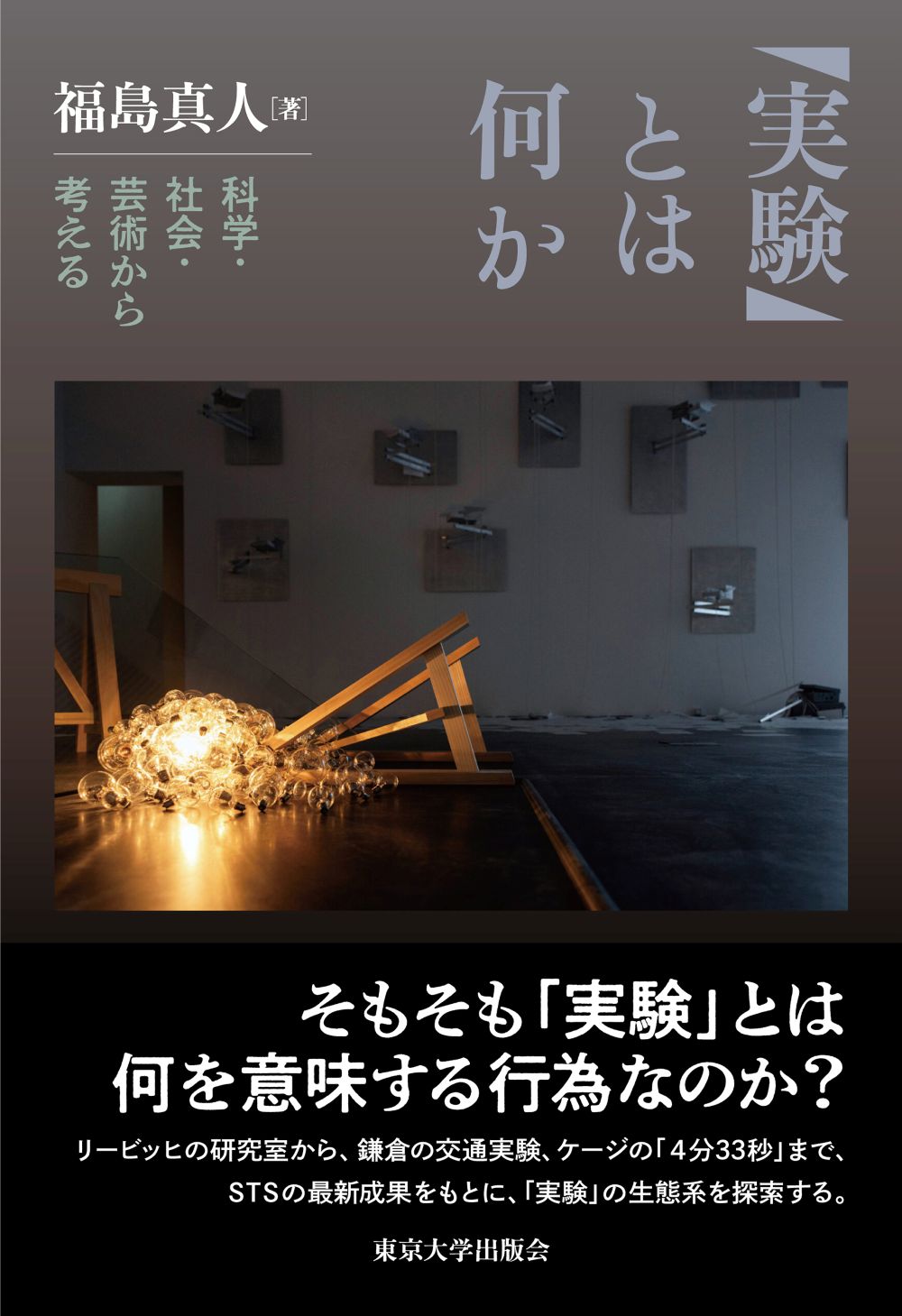
“Jikken” to ha nanika? (What is “Experiment?” - Thinking through Science, Society and Art)
Size
400 pages, 127x188mm
Language
Japanese
Released
April 01, 2025
ISBN
978-4-13-010160-8
Published by
University of Tokyo Press
Book Info
See Book Availability at Library
Japanese Page
 eBook
[The Basic Question: Towards an Experimenting Society?]
In recent years, the word “experiment” has become a common part of our discourse. While experiments are ordinarily associated with scientific laboratories, scientists do not have a monopoly on experimentation in our society. For instance, in the realm of politics, testing a specific policy plan to gauge its effects constitutes an important form of social experimentation in recent years. The significance of such methods has been widely recognized throughout society, alongside phenomena such as organizational experiments and even experimental art.
The focal questions that this book pursues are: What lies behind this trend of experimentation spreading across society, and what common features and differences characterize these forms of experimentation?
[Background: Science and Technology Studies (STS)]
This book is grounded in the framework of science and technology studies (STS), a field that has developed in the West since the 1980s. STS focuses on the dynamics of technoscience through the lens of the social sciences. It challenges the traditional emphasis on theoretical science by exploring the practical realities of experimentation and observation. These activities are intertwined with various locations, apparatuses, and organizations, thereby forming a complex network of interactions in and out of society.
For example, the notion that an experiment is simply a procedure for verifying a hypothesis is far from reflecting the reality of experimentation. In some fields, experimental trials are often improvisational, with rigorous conditions established only later. Moreover, the scaling up of experiments in recent years may lead to unexpected consequences, such as delays in projects and impediments to researcher training.
[Unity and Diversity of Experiments]
Part I traces the evolution of experiments, both as concepts and practices, throughout history, drawing on insights from STS and related fields. The term “laboratory” originally referred to a workspace in settings like monasteries before evolving into its modern meaning. The prototype of the laboratory as we know it emerged in 19th-century Germany, where experimentation and researcher training became inextricably linked. By contrast, maintaining strict environmental control—required in the laboratory— is difficult in field science. Addressing this challenge is crucial for experiments conducted in society.
Building on these discussions, Part II examines and compares diverse forms of social experimentation. Unlike laboratory settings, experiments conducted in society involve a host of new elements where many of them require extensive preparation and advance coordination among a vast array of stakeholders. Furthermore, depending on the type of social experiment, citizen participation may be prioritized over scientific data collection.
Part III focuses on the art world, where the discussion takes a completely different approach. While all creative activities are, in a sense, processes of trial and error, experimental art represents only one subset of them. It also raises the question of whether experimental and avant-garde arts are similar to each other. Starting with John Cage’s experimental music, this section traces the distinctive evolution of experimentation in the arts.
Part IV revisits the practice of experimentation across various fields through the lens of STS. It examines how STS conceptualizes the relationship between experiments and their counterpart, theory. It also re-evaluates the connection between everyday experiments (a concept I have explored in my book, The Ecology of Learning) and experimentation in the general sense. Ultimately, what does it mean for society to be the one that experiments?
(Written by FUKUSHIMA Masato, Professor Emeritus, Interfaculty Initiative in Information Studies / 2026)
Related Info
The Experimental Zone of Learning: Mapping the Dynamics of Everyday Experiment (Mind Culture and Activity 24 (4): 311-323 March 2017)
https://doi.org/10.1080/10749039.2017.1293689
Before Laboratory Life: Perry, Sullivan and the missed encounter between psychoanalysis and STS (BioSocieties June 2020)
https://doi.org/10.1057/s41292-019-00157-5