

 Find a book


Title
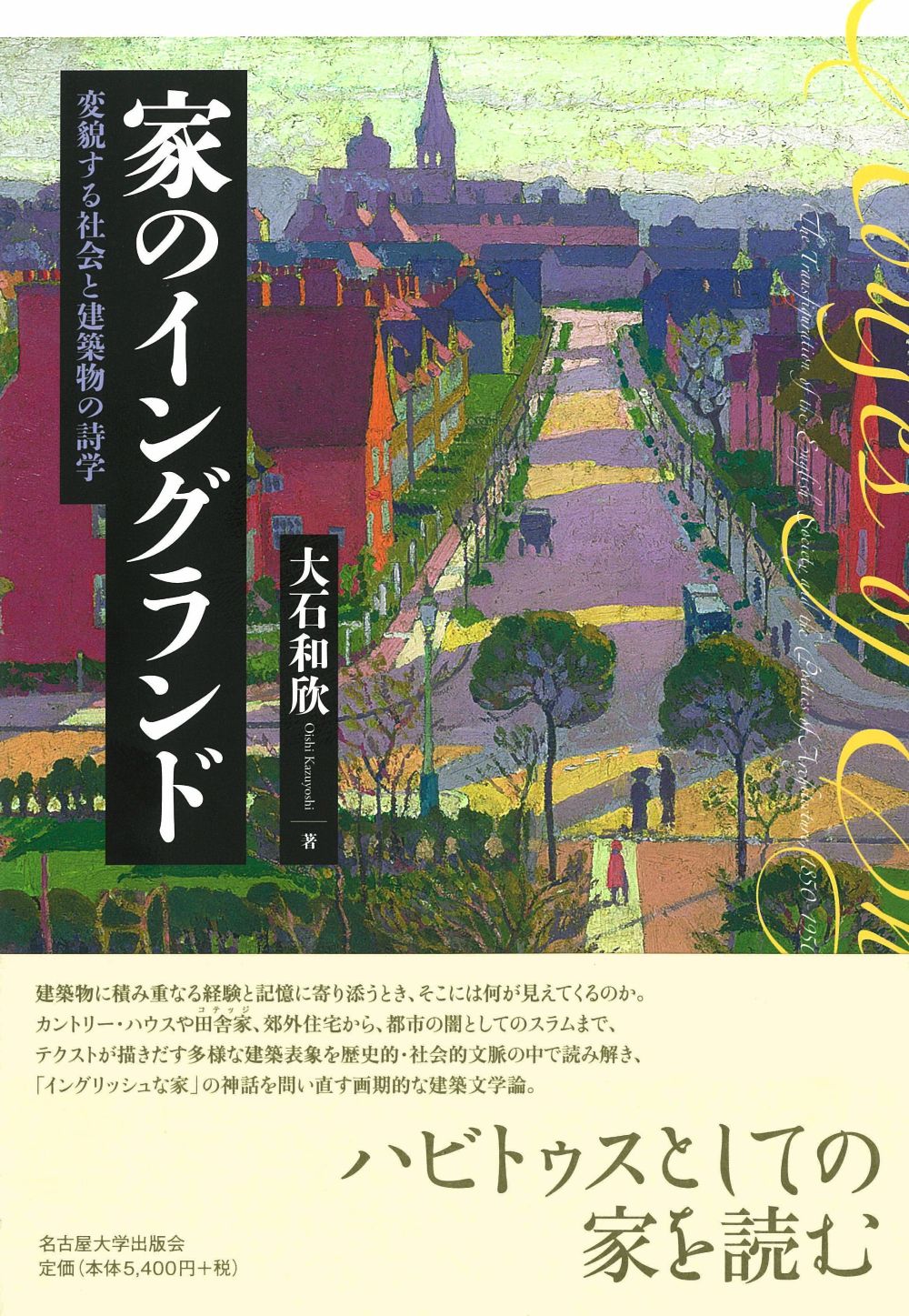
Ie no England (Houses of England - The Transformation of English Society and the Poetics of Architecture, 1850-1950)
Size
418 pages, A5 format, hardcover
Language
Japanese
Released
August 30, 2019
ISBN
978-4-8158-0959-1
Published by
Nagoya University Press
Book Info
See Book Availability at Library
Japanese Page
This book is a study of "architectural literature" that traces the mythologised image of the "English home" within English literature from the 19th century to the first half of the 20th century, capturing the society and culture of England in this period through the topos of "home." It illuminates the depths of English literature and culture from a novel perspective. A "home" is not merely a physical structure; it is a living space where people dwell, build communities, harbor memories, and symbolise their eras, while they are simultaneously shaped by their times and society themselves. Homes depicted in literature are represented as such "lived spaces," that is, existential and phenomenological realities, and underpinned by specific social and historical contexts.
Using Pierre Bourdieu's concept of "habitus" as a theoretical basis, this book disentangles the complex structures of literary representations surrounding architecture, highlighting the utopian image projected onto "English home" and the reality of the social and cultural contexts lying behind it. Habitus, which is at once an everyday "habitat" and a culture-producing "mental structure," manifests itself in the voices and discourses of each age, the texture of history and humanity, and the vibrancy of people’s lives, finding its way into literature. This book reconstructs these elements by interpreting "homes" represented in literary works.
The book begins by examining the slum, the "dark holes" of the great metropolis of London, as the background that accentuates the "light" of the "ideal home." Literary works such as Strange Stories of Dr Jekyll and Mr Hyde and Dracula are embedded with middle-class fears and curiosity regarding the slums. Political and economic liberalism was viewed as the cause of such impoverishment and slumification. Criticism of this liberalism, led by figures like John Ruskin and William Morris, fostered a longing for medieval society; consequently, Neo-Gothic churches were constructed within the city as "picturesque" symbols.
Meanwhile, seeking to detach themselves from the chaotic, slum-ridden city, the middle class moved to the suburbs, generating the phenomenon known as suburbanization. Belied by their utopian, picturesque exteriors, however, suburban homes were in reality fluid and unstable spaces as well. The "suburban novels" which flourished from the late 19th to the early 20th century represented “homes” of the (lower) middle class as seemingly peaceful, yet in reality burdened by such existential anxiety.
It was precisely against the backdrop of slums and suburban housing that "English home" became idealized, stereotyped, and disseminated throughout society. E. M. Forster's novel Howards End features an old rural farmhouse embodying such an "English home" as its central character, illuminating the conflicts and contradictions entwined in the 1900s, such as urban/rural, imperialism/Little Englandism, Britain/colony, and past/present.
"English home" is nothing but an illusion. Similarly, English country houses rapidly vanished during the interwar period, accompanying the political and economic decline of the aristocracy. Consequently, they became phantoms that people came to regard as an "English tradition." Precisely because they had become "empty shells," bereft of cultural substance, as Daphne du Maurier’s Rebecca describes Manderley, they attracted nostalgia and became idealized. This fictive nature is ironically highlighted in Kazuo Ishiguro's The Remains of the Day.
The final chapter analyses the architectural criticism of Poet Laureate John Betjeman, who was also a unique architectural critic. He argued that Victorian Neo-Gothic architecture, though shunned as being in poor taste, actually harboured meaningful layers of history, and he advocated for inheriting a sense of history through its preservation. This multilayered history constitutes a "complex hybridity" that continues to function as a historical bond for community and society. This is, ultimately, the "poetics of architecture."
(Written by OISHI Kazuyoshi, Professor, Graduate School of Arts and Sciences / 2026)