

 Find a book


Title
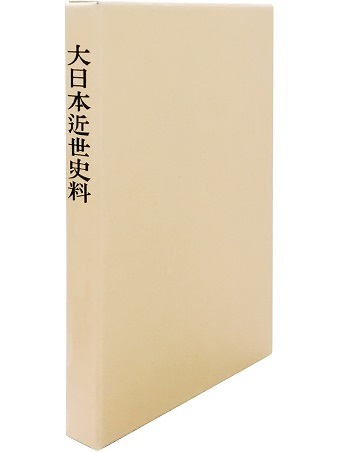
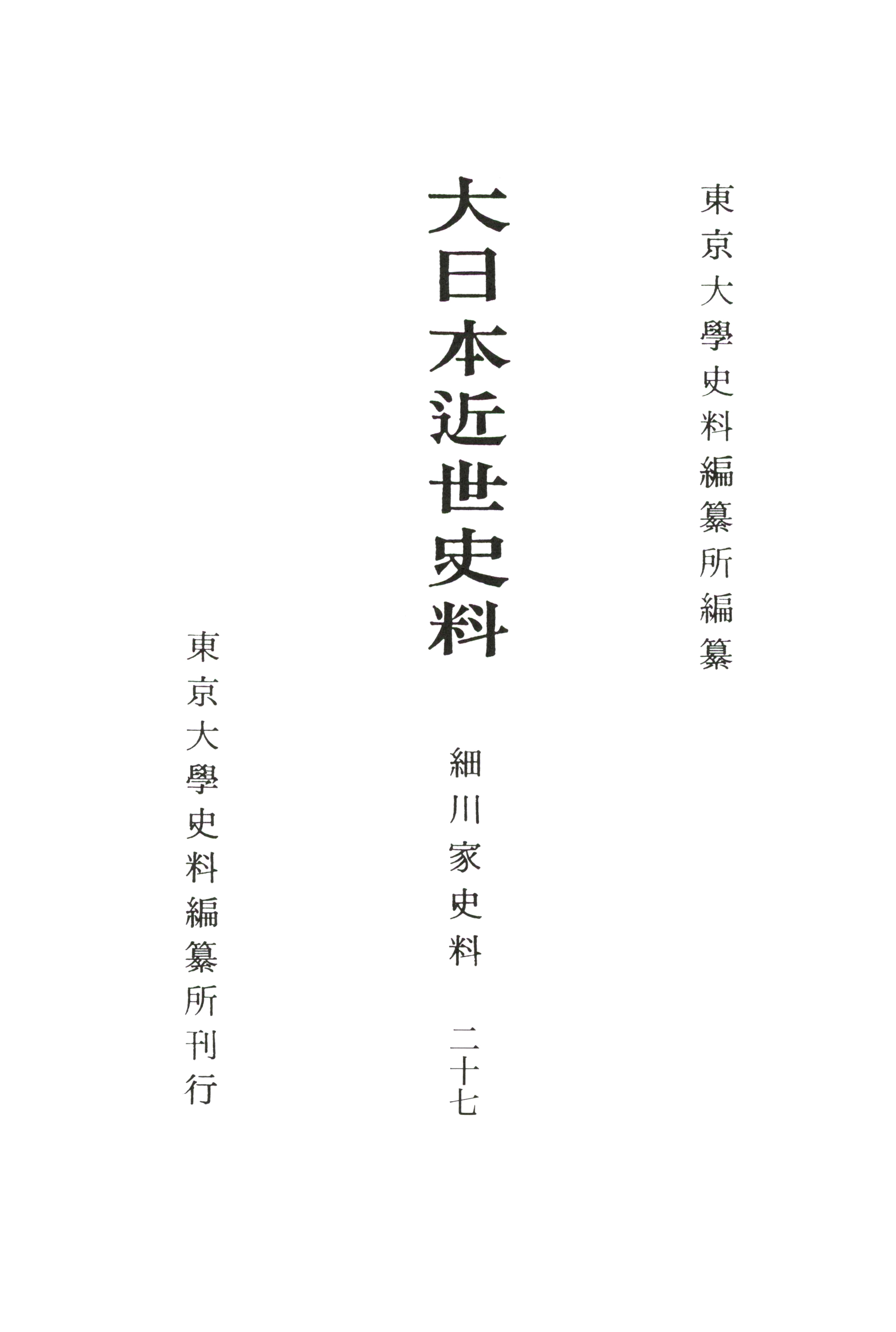
Early Modern Historical Materials of Japan Hosokawake Shiryo 27 (Historical Materials of the Hosokawa Family, Vol. 27: Hosokawa Tadatoshi Documents, Vol. 20: Drafts of Official Letters)
Size
382 pages, A5 format
Language
Japanese
Released
April 04, 2022
ISBN
978-4-13-093067-3
Published by
Historiographical Institute, The University of Tokyo (publisher), University of Tokyo Press (sales)
Book Info
See Book Availability at Library
Early Modern Historical Materials of Japan: Hosokawake Shiryo 27
Japanese Page
This book is not the work of an individual faculty member. It is one of over 1,200 volumes representing the results of a project to study, compile, and publish historical materials pertaining to Japan that has been underway at a division of the University of Tokyo. For this book, textual historical materials from the first part of the Edo period, handwritten on Japanese paper with brush and ink in cursive script, were digitally photographed, and then two faculty members were tasked with deciphering the texts, preparing the manuscript, editing the text, adding notes, and proofreading. The process from submission of the manuscript to the printer through to publication took approximately one year and incurred considerable publication expenses.
There follows an overview of the project. (This English overview is an abridged version of the original Japanese overview.)
(1) The predecessor of the Historiographical Institute at the University of Tokyo was the Bureau for the Compilation of Historical Materials and the Revision of National History established by the Restoration government in 1869, and it inherited the library, etc., of the Edo-period Institute of Japanese Studies (Wagaku Kōdansho). After its transfer from the Cabinet to the University, its purpose was redefined so as to focus on the investigation and study of historical materials and the publication of collections of historical materials, and it has been publishing core collections of historical materials since 1901.
(2) The series Early Modern Historical Materials of Japan began publication in 1953, the aim being to “compile and publish major historical materials of the early modern period.” It is a series that focuses on early modern Japanese historical materials, which were produced and have survived in large quantities.
(3) The series Historical Materials of the Hosokawa Family consists of documents transmitted by the Hosokawa family, lords of former Higo domain, and records of the domanial office. The Historiographical Institute has been investigating historical materials of the family of Marquis Hosokawa since the nineteenth century, initially producing handwritten copies that were utilized in research and the compilation of collections of historical materials. In the early days of the Eisei Bunko Foundation, established in 1950, the Institute began investigating materials housed in several storehouses at the Hosokawa family’s Kumamoto residence. (According to the recollections of former Professor Yamaguchi Keiji [1920–2013], background factors included the abolition of the peerage system, a strong desire on the part of staff members such Yamaguchi and Murai Masuo to investigate and preserve materials, and the understanding of the owners, and with the establishment of Kumamoto University in 1949 the site was preserved.) The Institute has continued to take microfilm photographs of the materials, and since the 2010s it has transitioned to digital photography and continues to gather image data and make the images publicly accessible.
Historical Materials of the Hosokawa Family, part of the series Early Modern Historical Materials of Japan, began publication in March 1969, and since then letters and so on exchanged between Hosokawa Tadaoki and his son Tadatoshi during the formative period of the bakuhan system have become a shared asset for academia and have been utilized in the compilation of Part 12 of Source Books of Japanese History and in various fields of research such as political history.
(4) Hosokawa Tadatoshi Documents: Drafts of Official Letters is a collective term for collections of drafts that were produced by scribes when Hosokawa Tadatoshi (1586–1641), lord of Higo and Kumamoto domains, sent letters to various people, including shogunate officials, ladies-in-waiting at Edo Castle, daimyō, and court nobles. A total of 15 volumes of base texts exist for the period from Kan’ei 9 (1632) to Kan’ei 18 (1641), when Tadatoshi died. The Historiographical Institute began publishing Hosokawa Tadatoshi’s “Drafts of Official Letters” in vol. 16 of Historical Materials of the Hosokawa Family in the series Early Modern Historical Materials of Japan (1998), and they were brought to completion with this vol. 27 of Historical Materials of the Hosokawa Family (published in March 2022). Vols. 21–25 provide basic historical materials concerning the Shimabara-Amakusa rebellion, the Battle of Hara Castle, and the shogunate’s management of the aftermath. Currently, the publication of “Drafts of Official Letters” sent to various parties by Tadatoshi’s son Mitsunao is ongoing (Historical Materials of the Hosokawa Family, vols. 28 and 29).
(5) In the present volume there are transcribed, edited, and annotated 273 drafts of letters sent by Hosokawa Tadatoshi to various parties from the 1st of the ninth month of Kan’ei 17 (1640) to the 13th of the third month of Kan’ei 18 (1641). In addition, it also includes 70 drafts of Tadatoshi’s acknowledgments of letters received from officials of the shogunate sent from the 1st of the second month of Kan’ei 11 (1634) to the 15th of the second month of Kan’ei 18 (1641). Their content is quite varied, and some of it is summarized below.
On the 15th of the eleventh month of Kan’ei 17 (1640), a fire broke out at the main Edo residence of the Owari Tokugawa family. Chiyohime, the shogun Iemitsu’s daughter (and at the time his only biological child) who was married to Mitsutomo, heir of the Owari Tokugawa family, was given shelter in the main keep of Edo Castle through arrangements made by Kasuga no Tsubone (docs. 5999, 6000).
Tadatoshi, who had been in poor health for some years, often went hawk hunting during the slack farming season (doc. 5917). At the start of the eleventh month of Kan’ei 17, he went to the hot springs in Yamaga to recuperate (doc. 5963), and on the 18th of the first month of the following year he met with his father, Tadaoki, at Yatsushiro (doc. 6023). His condition worsened thereafter, and his symptoms are described in detail in the draft of a memorandum dated 23rd of the second month and addressed to Yoshida Jōgen, a Kyoto physician (doc. 6052). He suffered from numbness and weakness in his limbs, stiffness of the tongue, fever, headaches, excretory difficulties, and insomnia. He dictated the letter to his scribe, adding a postscript in his own hand in which he requested that a message be passed on to his relatives in Kyoto. In a letter dated 28th of the second month, he informed Sakai Tadakatsu, the shogunate’s chief minister, that his attendance in Edo might be delayed (doc. 6053). In the draft of a letter dated 10th of the third month, he stated that he had had thirty-six bloody bowel discharges since the 7th, and he asked Yoshida Jōgen to visit him. He could no longer write his stylized signature below the date of the letter written by his scribe and stamped it with a seal instead (docs. 6062, 6063). His condition became critical on the 14th of the third month, and he died on the 17th in Kumamoto (aged 55).
Detailed descriptions of his illness right up until his death are preserved in the drafts of letters sent daily by Tadatoshi. His strong determination, even when critically ill, to depart for his alternate-year attendance in Edo (docs. 6061–6070) gives us a keen sense of the heavy burden of the obligations of service imposed on daimyō by the shogun.
Also worth noting is the account of the damage caused by the Mount Komagatake eruption in Hokkaido on the 13th of the sixth month of Kan’ei 17. Matsumae Kinhiro, who was recuperating in Ezo Fukuyama, reported details to Tadatoshi in a letter dated 9th of the ninth month of the same year, and Tadatoshi informed various people about the situation described by Kinhiro.
This book is one volume in a research project that has been underway at the Historiographical Institute at the University of Tokyo for over half a century with the understanding of the Eisei Bunko Foundation, the original owners of the historical materials, and Kumamoto University Library, where the materials were deposited since 1964. It is to be hoped that it will be widely read by those interested in various aspects of Japanese history.
(Written by YAMAGUCHI Kazuo, Professor, Historiographical Institute / 2025)
Related Info
Compiled by Historiographical Institute, The University of Tokyo
https://www.hi.u-tokyo.ac.jp/en/
Sales by University of Tokyo Press
https://www.utp.or.jp/company/cc10366.html
Historical materials owned by Eisei Bunko Museum
https://www.eiseibunko.com/english/index.html