

 Find a book


Title
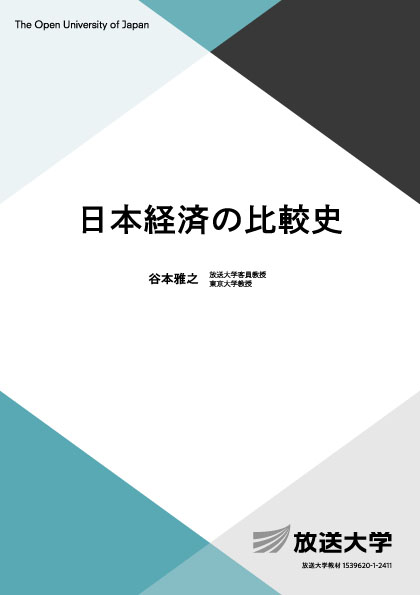
Open University of Japan Teaching Materials Nihonkeizai no Hikakushi (A Comparative History of Japanese Economy)
Size
344 pages, A5 format
Language
Japanese
Released
March, 2024
ISBN
978-4-595-32475-8
Published by
Foundation for the Promotion of The Open University of Japan
Book Info
See Book Availability at Library
Japanese Page
It has been standard understanding in economic history to view Japan’s economic development up to the late 20th century as a process of catching up with advanced Western nations, beginning with the systemic transformation brought about by the Meiji Restoration. However, the last 30 years of subsequent period of prolonged economic stagnation—a phenomenon distinctive on a global scale—has highlighted the limitations of historical narratives that emphasize catch-up story, while also suggesting that the path of economic development is not a single, linear one. What are the factors that have driven the growth of the Japanese economy, and what has caused its stagnation? To understand this, it is necessary to identify the logic and characteristics unique to Japan’s economic development.
To explore this, we introduced a comparative history as a method. This book examines the characteristics of the Japanese economy from a comparative historical perspective, using Japan’s economic dynamics as the vertical axis and comparisons with cases from Western countries and East Asian nations as the horizontal axis, within a 400-year timeframe spanning from the early modern period to the present. Furthermore, to understand the impact from international environment, we have paid close attention to international relations within East Asia. The writing team consists of five authors: two researchers specializing in Japanese economic history, including the editor, joined by three experts in the socio-economic history of China, the United Kingdom, and Germany. The chapter-by-chapter structure is rather unique among other volumes of textbook-style Japanese economic history, and I am proud to say that this is a highly original work.
Chapter 1 utilizes recent advances in historical GDP estimation to provide an overview of the long-term economic dynamics of the Japanese economy since the early modern period, comparing it with European and non-European regions. Chapter 2 examines the process of the establishment of the Tokugawa regime within the context of the open international relations of East Asia during the 16th and 17th centuries. This chapter forms a counterpart to Chapter 9, which describes how Japan—having been integrated into the Asian trade sphere under a free-trade system—began to build colonies and spheres of influence in East Asia from the late 19th century onward, and it strongly emphasizes a relational historical perspective. In contrast, Chapters 3 through 6 examine the characteristics of early modern Japanese society and economy through explicit comparisons with Europe (Britain and Germany) and China, focusing on themes such as the family, public goods, technology, and the environment and resources. Regarding the European Industrial Revolution, which served as a pivotal factor in the divergence of world economic history, Chapter 7 provides an overview centered on Britain. Chapter 8 discusses the process of industrialization followed by modern Japan under the expansion of Western powers into Asia following the Industrial Revolution, focusing on technology transfer and the diversity of production organizations. Chapter 10 examines this process through the lens of spatial divisions, such as central-peripheral and urban-rural distinctions. Chapters 11 and 12 explain the trajectory of the Japanese economy from the 1920s through the postwar period of high economic growth, with a strong emphasis on its relationship to fluctuations in economic relations with East Asia during this time. Chapters 13 and 14 focus on the characteristics of Japan’s employment system and welfare regime, examining issues related to labor and care that are directly linked to people’s livelihoods. The final Chapter 15 provides an overview of trends in the Japanese economy since the 1990s from the perspective of economic history.
Since the beginning of the 21st century, numerous problems have emerged in the Japanese economy. While various countermeasures have been discussed, it is difficult to address the structural cracks in our economic and social system through ad hoc remedies for each specific situation. How did the various elements constituting our economic and social system come to possess their historical background and structure? Understanding the depth of these roots is essential to establishing a clear path toward overcoming these challenges. I hope that the efforts presented in this book will contribute to this endeavor.
(Written by TANIMOTO Masayuki, Emeritus Professor, Graduate School of Economics / 2026)
Related Info
“Nihonkeizai no Hikakushi“ Introduction
https://bangumi.ouj.ac.jp/v4/bslife/detail/01924008.html
“Nihonkeizai no Hikakushi“ vol.1
https://bangumi.ouj.ac.jp/v4/bslife/detail/15396201.html
“Nihonkeizai no Hikakushi“ vol.2
https://bangumi.ouj.ac.jp/v4/bslife/detail/15396202.html
“Nihonkeizai no Hikakushi“ vol.3
https://bangumi.ouj.ac.jp/v4/bslife/detail/15396203.html
“Nihonkeizai no Hikakushi“ vol.4
https://bangumi.ouj.ac.jp/v4/bslife/detail/15396204.html
“Nihonkeizai no Hikakushi“ vol.5
https://bangumi.ouj.ac.jp/v4/bslife/detail/15396205.html
“Nihonkeizai no Hikakushi“ vol.6
https://bangumi.ouj.ac.jp/v4/bslife/detail/15396206.html
“Nihonkeizai no Hikakushi“ vol.7
https://bangumi.ouj.ac.jp/v4/bslife/detail/15396207.html
“Nihonkeizai no Hikakushi“ vol.8
https://bangumi.ouj.ac.jp/v4/bslife/detail/15396208.html
“Nihonkeizai no Hikakushi“ vol.9
https://bangumi.ouj.ac.jp/v4/bslife/detail/15396209.html
“Nihonkeizai no Hikakushi“ vol.10
https://bangumi.ouj.ac.jp/v4/bslife/detail/153962010.html
“Nihonkeizai no Hikakushi“ vol.11
https://bangumi.ouj.ac.jp/v4/bslife/detail/153962011.html
“Nihonkeizai no Hikakushi“ vol.12
https://bangumi.ouj.ac.jp/v4/bslife/detail/153962012.html
“Nihonkeizai no Hikakushi“ vol.13
https://bangumi.ouj.ac.jp/v4/bslife/detail/153962013.html
“Nihonkeizai no Hikakushi“ vol.14
https://bangumi.ouj.ac.jp/v4/bslife/detail/153962014.html
“Nihonkeizai no Hikakushi“ vol.15
https://bangumi.ouj.ac.jp/v4/bslife/detail/153962015.html