

 Find a book


Title
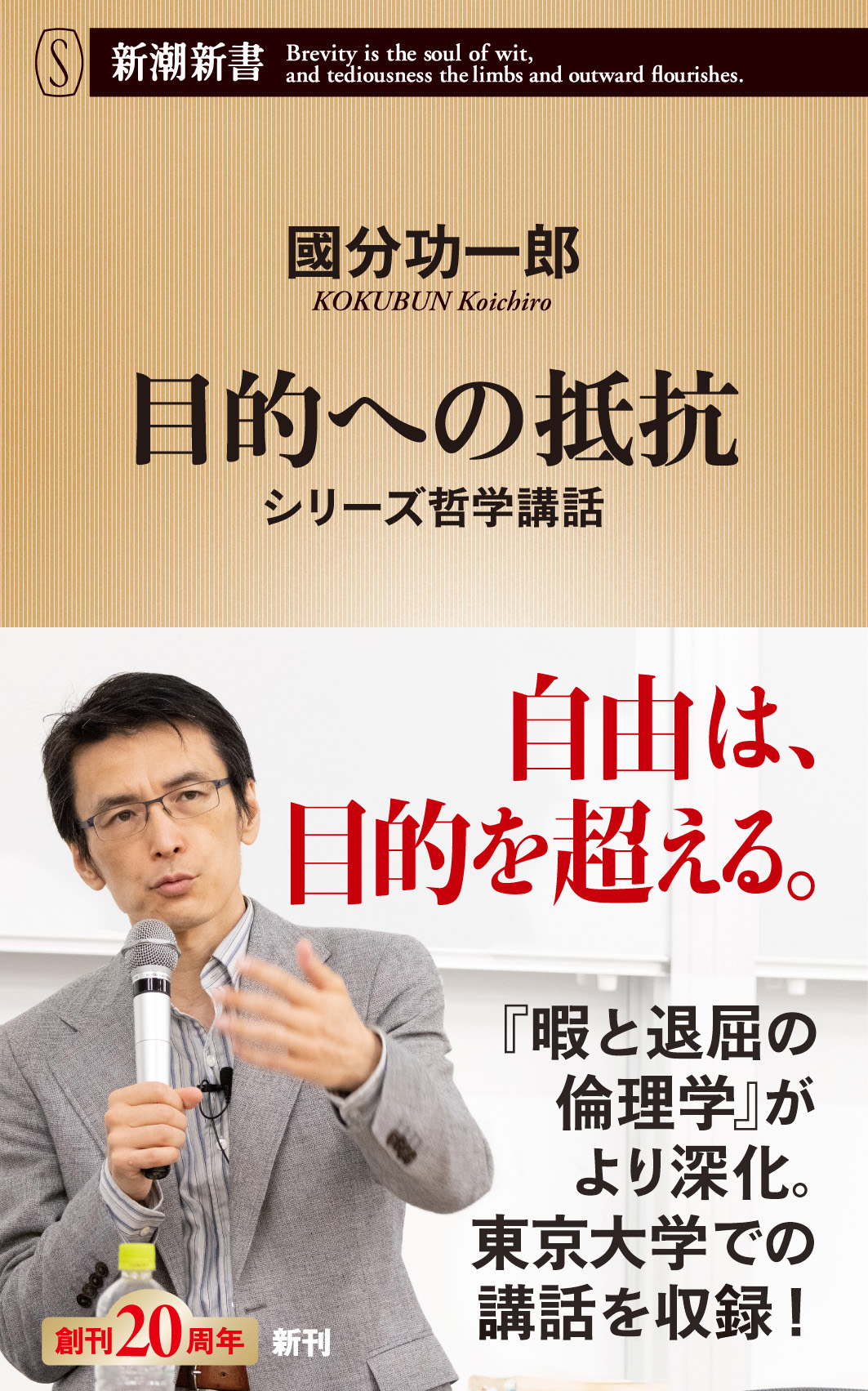
Shincho Shinsho 991 – Philosophy lecture series Mokuteki e no teikō (Resistance to the Ends)
Size
208 pages, paperback pocket edition
Language
Japanese
Released
April 17, 2023
ISBN
9784106109911
Published by
SHINCHOSHA
Book Info
See Book Availability at Library
Japanese Page
This book is a compilation of two lectures given in 2020 and 2022. The two intervening years marked the peak of the COVID-19 pandemic’s impact on our society. In my lectures I talked about my thoughts as the pandemic hit us. The title, Resistance to the Ends, is a phrase that succinctly expresses the conclusion I reached after thoroughly examining my thoughts on this crisis, that is, my thoughts on the very idea of how to interpret “means and ends” in the context of the pandemic.
During the pandemic, we were repeatedly told to avoid going out on “non-essential, non-urgent” activities so as to prevent the infection from spreading any further. This restriction on freedom of movement had an especially profound effect. Undoubtedly, it was necessary to a certain extent, but I question how well the repercussions of restricting movement were understood at the time.
In the beginning of this book, I introduce the Italiam philosopher Giorgio Agamben who questioned the restrictions on movement and was fiercely criticised for publishing an article stating that the danger posed by the pandemic was being exaggerated. According to Agamben, the all-encompassing restrictions on movement were unprecedented, not even having been attempted in wartime. How did the restrictions affect human relationships? What were the ethical and political implications? Agamben sounded the alarm as to how the restrictions on movement imposed by governments were based on ambiguous legal grounds, noting that this was a manifestation of a “state of exception” by which governments make decisions that go beyond their legislative authority. As a philosopher, Agamben had studied this subject for many years and was keenly aware of the danger of such a situation.
Why was this “state of exception” accepted without question worldwide? My hypothesis is as follows: The COVID-19 pandemic did not change society. Rather, it merely poured fuel on a smoldering fire of change that was already steadily underway.
So, what was this steady change that was already occurring? I propose that there has been a growing, deepening subordination of human activity to “purpose” or “end.” The phrase “non-essential, non-urgent” refers to activities lacking clear purpose, and since everything must be subordinated to a purpose, activities without purpose should not be permitted. The atmosphere this has created seems to be gradually enveloping all of society.
This reminds me of the philosopher Hannah Arendt and her research on totalitarianism. According to Arendt, under a totalitarian regime, there can be no neutrality in “playing chess for the sake of chess.” In other words, since all activities must be directed at serving the state, activities that do not do this are suspected of serving an end that is not publicly recognized and that is something other than the state.
It would seem that contemporary society is getting closer and closer to this kind of totalitarianism, and that may be why, under the pandemic, society did not object to the curtailing of activities that appear to serve no end.
You may think I am exaggerating. But one of the missions of philosophy, as Agamben demonstrated to us and as I believe is true, is to point out overlooked facts and speak up when we should, even if it makes people dislike us. This book is an introduction to philosophers who have fulfilled this mission of philosophy.
(Written by KOKUBUN Koichiro, Professor, Graduate School of Arts and Sciences / 2025)
Related Info
Everybody has small addictions Philosopher Koichiro Kokubun discusses shikohin with youth (DIG THE TEA December 28, 2023)
https://digthetea.com/en/2023/12/koichiro_kokubun_pt1/