

 Find a book


Title
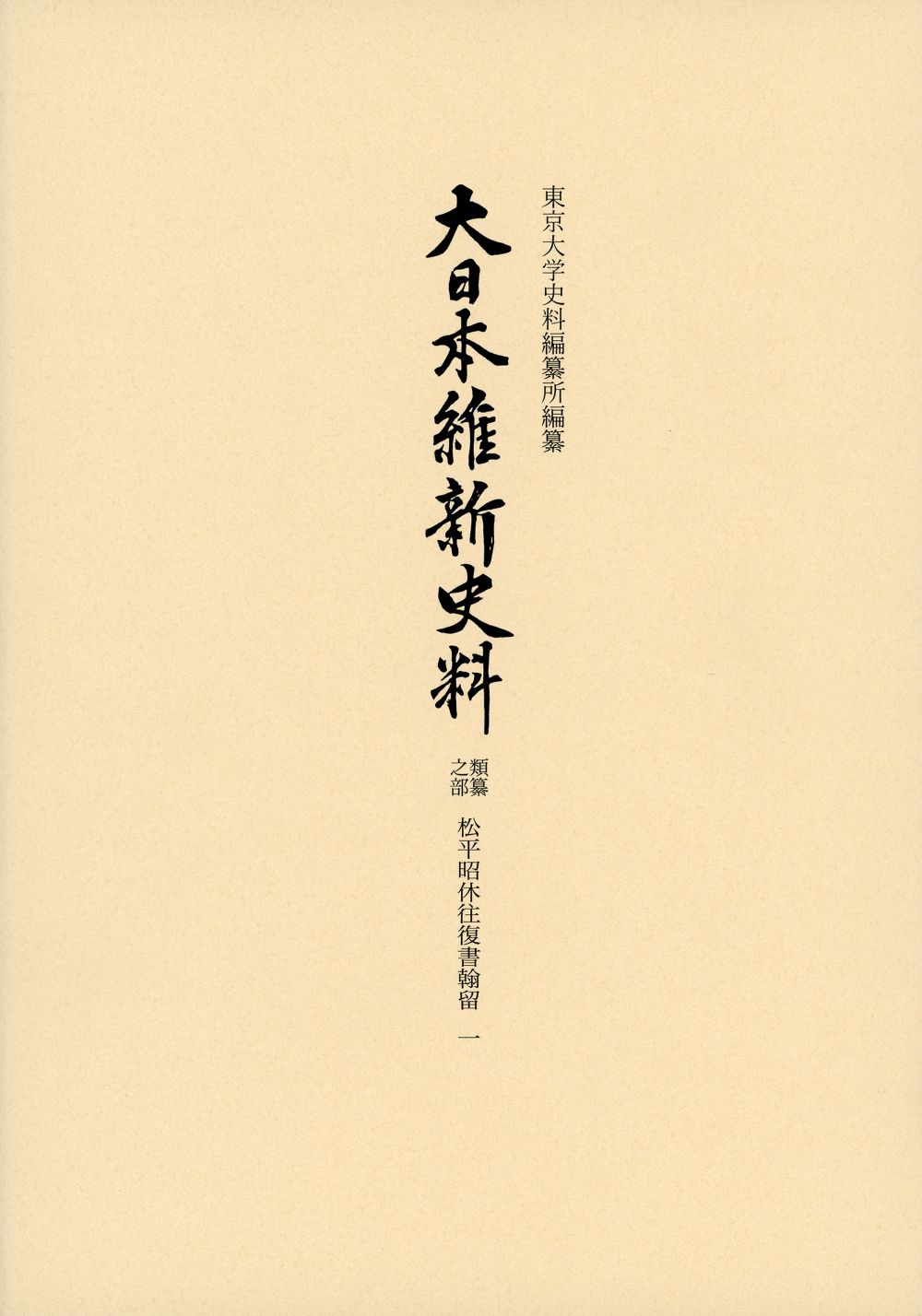
Historical Materials of the Meiji Restoration Ruisan no bu—Matsudaira Akiyasu ōfuku shokan dome (Dai-Nihon Ishin Shiryō: Matsudaira Akiyasu's Correspondence, Volume 1)
Size
382 pages, A5 format
Language
Japanese
Released
May 02, 2024
ISBN
978-4-13-090911-2
Published by
University of Tokyo Press (sales)
Book Info
See Book Availability at Library
Dai-Nihon Ishin Shiryō: Ruisan no bu—Matsudaira Akiyasu ōfuku shokan dome
Japanese Page
The series “Dai-Nihon Ishin Shiryō” (Historical Materials of the Meiji Restoration), consisting of historical documents on the history of the end of the Edo period and the Meiji Restoration, is a collection of historical documents that was established in 1911 and began to be compiled and published by the Ministry of Education's Restoration Historiographical Association. In 1949, the Ministry of Education transferred the historiography and publication of the “Dai-Nihon Ishin Shiryō” to the University of Tokyo, where it was taken over by the Historiographical Institute.
The “Dai-Nihon Ishin Shiryō” compiled by the Meiji Restoration Historiographical Association consisted of the “Hennen no bu,” arranged in chronological order, but its publication was stopped midway through. Therefore, the Historiographical Institute has newly launched the “Ruisan no bu,” a collection of documents and historical records related to important events in various families such as the families of feudal lords. The first collection to be published was “Ii-ke shiryō” (Ii Family Documents), which contained historical documents related to Ii Naosuke, who was chief minister of the Tokugawa shogunate at the end of the Edo period. This collection was completed in 2019 in 30 volumes, and we then decided to compile and publish “Matsudaira Akiyasu ōfuku shokan dome” (Matsudaira Akiyasu's Correspondence) as its successor. This is a collection of 14 volumes of Matsudaira Akiyasu’s correspondence in the collection of the Historiographical Institute and related historical documents.
Matsudaira Akiyasu (Kurōmaro) was the ninth son of Tokugawa Nariaki, lord of Mito domain. In 1848, he was adopted by Matsudaira Tadakuni, lord of Oshi domain, and changed his name to Tadanori. But he was disinherited in 1859 during the Ansei purge and thereafter resided at Mito domain’s residence in Edo. In 1863, Akiyasu was adopted by the feudal lord of Okayama, Ikeda Yoshimasa, and became the feudal lord of the same domain, taking the name Ikeda Mochimasa.
The “Matsudaira Akiyasu ōfuku shokan dome” in the collection of the Historiographical Institute is a collection of letters and other correspondence Akiyasu received from December 1858, when he was a son of Matsudaira Tadakuni, lord of Oshi domain, to January 1863, the month before he was adopted by Ikeda Yoshimasa. The first volume published on this occasion contains documents up to December 1861. Notable events include a Buddhist memorial service on the first anniversary of the death of Tokugawa Nariaki and the death of Nariaki's eighth son, Matsudaira Naoyoshi (lord of Kawagoe domain).
One of the features of the recorded correspondence is that many of the letters were written to and from siblings of the same family, whose birth mother was Sadako, Nariaki's concubine. In chronological order of birth, the siblings were Akiko, the sixth daughter (wife of the lord of Morioka domain, Nanbu Toshihisa); Ikeda Yoshinori, the fifth son (lord of Tottori domain); Matsudaira Akiyasu, the ninth son; and Takako, the ninth daughter (wife of the lord of Sendai domain, Date Yoshikuni's successor). The greater part of the correspondence was with Ikeda Yoshinori.
Most of the commonly known letters written by members of feudal families were exchanged through official clan channels, and private correspondence between brothers and sisters who were adopted by or became wives of other families is extremely rare. For this reason, the “Matsudaira Akiyasu ōfuku shokan dome” is an extremely rare collection that provides insight into private exchanges that took place between families of feudal lords on opposing sides during the turmoil at the end of the Tokugawa shogunate. The collection also contains a great deal of valuable information about women such as the wives of feudal lords and maidservants, and it is expected to contribute to research on the domestic affairs of early modern feudal lords, a subject that has been the subject of much interest in recent years.
(Written by HAKOISHI Hiroshi, Professor, Historiographical Institute / 2025)