


 Find a book


Title
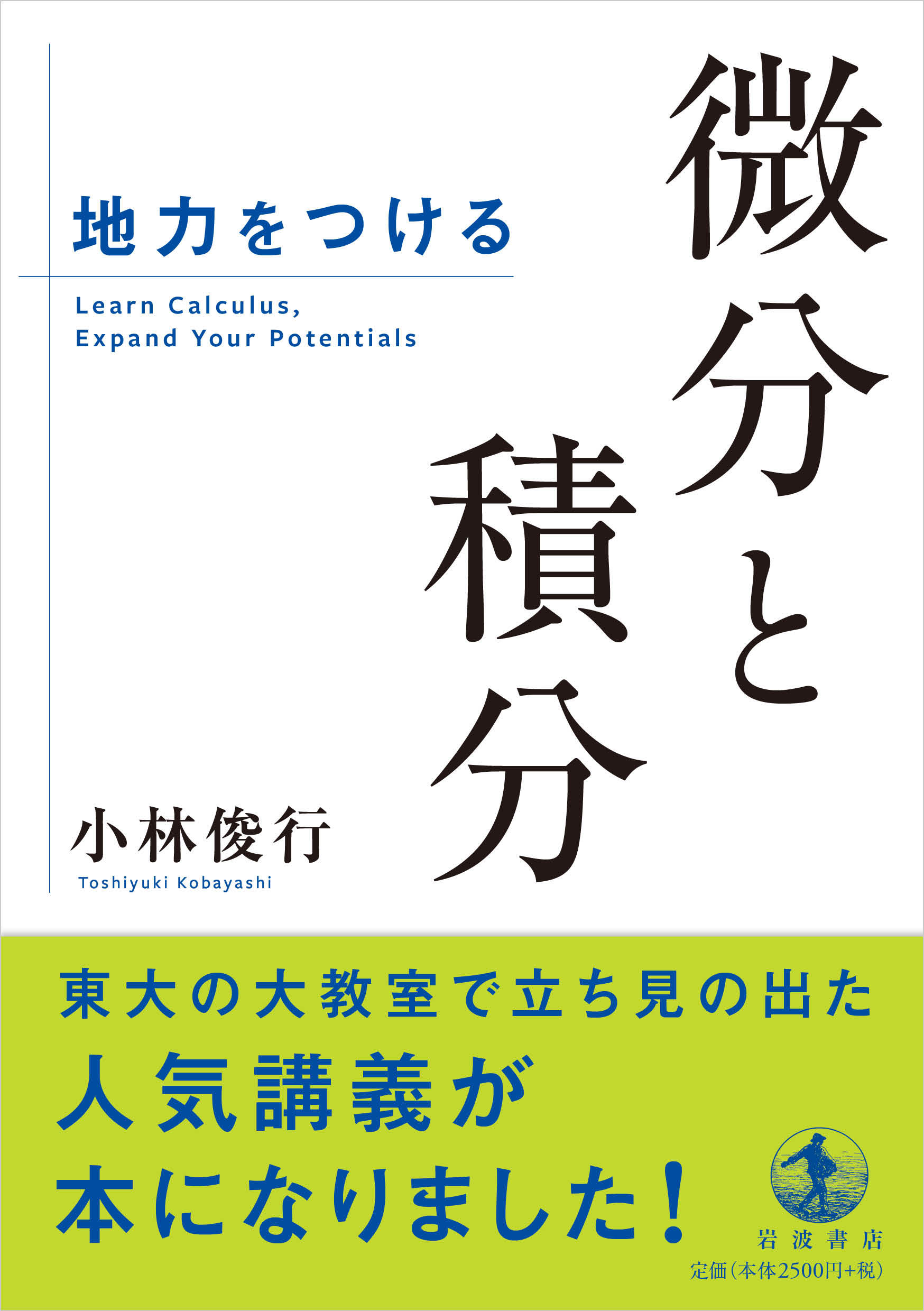
Jiriki wo Tsukeru Bibun to Sekibun (Learn Calculus, Expand Your Potentials)
Size
278 pages, A5 format, softcover
Language
Japanese
Released
September 20, 2024
ISBN
9784000058896
Published by
Iwanami Shoten
Book Info
See Book Availability at Library
Japanese Page
 eBook
eBook
This book, Learn Calculus: Expand Your Potentials, has grown out of lectures originally given to liberal arts students, including those studying law and economics, at The University of Tokyo. The course was designed as an introduction to advanced calculus, tailored for students outside the natural sciences. There were three principal motivations behind offering this course.
First, I was concerned that after graduation, when facing real-world challenges, uncritical reliance on mathematical formulas or making estimations without adequately assessing possible errors could result in serious misunderstandings or even hazardous outcomes.
Second, I believe that rather than memorizing theorems and formulas, students should be guided through the underlying thought processes. This approach nurtures the intuitive core of mathematics and offers intellectual training that can serve as a valuable lifelong asset.
Third, I wished for liberal arts students to experience the depth and richness of mathematics, not merely as a set of tools, but as an intellectually rich and engaging realm in its own right.
The Approach in This Book
Reflecting these aims, this book distinguishes itself from conventional textbooks that focus heavily on proofs and computational techniques. Instead, it is anchored in a fundamental question: What is differentiation or integration truly trying to capture?
To answer this, the book draws on vivid, relatable examples such as the number of cherry blossom petals, musical tuning systems, the physical strain of hammer throwing, the topography of natural landscapes, and estimations of the volume of soil on an island. Through familiar topics, readers are invited to explore mathematical ideas through diverse and intuitive perspectives.
In the first half of the book, we examine foundational concepts such as large numbers, rates of convergence, and approximation that may appear simple at first glance, but reveal surprising depth upon closer inspection. Readers encountering these ideas for the first time may find their intuitions both challenged and expanded.
The second half focuses on multivariable calculus, and explores topics such as error estimation, differential equations, Lagrange multipliers, and multiple integrals. Each topic is presented not merely as a computational tool but also as a window into the underlying structure and logic of the mathematical analysis.
Mathematics, Application, and Learning
Mathematical theory serves as a powerful tool across diverse fields such as natural sciences, engineering, finance, and artificial intelligence. However, if one accepts formulas and theorems uncritically, without a clear grasp of their assumptions or limitations, there is a risk of misjudgment or being misled by meaningless data.
This book emphasizes the importance of critically examining premises and cultivating a flexible mindset that is capable of shifting perspectives. Although calculus provides potent methods, they must be applied with a clear awareness of their scope and underlying principles to be truly effective in addressing real-world challenges.
Ultimately, the aim of this book is not merely to equip readers with the ability to apply formulas but also to foster a deep comprehension of the principles from which these formulas emerge.
Cultivating Foundational Thinking
Beyond the classroom, one inevitably encounters problems unlike those studied before. In such moments, what truly aids one’s understanding is not a memorized collection of formulas, but a solid foundation of thinking—an intellectual resilience that enables one to approach new challenges from first principles.
In mathematics, this resilience is cultivated not solely through computation but through grasping the essence of concepts with both logical rigor and personal intuition. My hope is to assist students in laying down this groundwork early in life, so that when the need arises, they may confidently return to their studies and continue to deepen their understanding throughout their lives.
Learn Calculus: Expand Your Potentials is the embodiment of this philosophy, born from a shared journey with students who embraced this vision.
(Written by KOBAYASHI Toshiyuki, Professor, Graduate School of Mathematical Sciences / 2025)
Related Info
Festschrift in honour of T. Kobayashi, published from Springer in 3 volumes (2025)
Doctorat Honoris Causa, l'université de Reims Champagne-Ardenne, France (2022)
Fellow of American Mathematical Society, USA (2017)
Medal with Purple Ribbon, Japan 2015
Inoue Prize for Science, Japan 2010
Humboldt Research Award, Germany 2008
JSPS Prize, Japan, 2007
Spring Prize, Mathematical Society of Japan 1999.