

 Find a book


Title
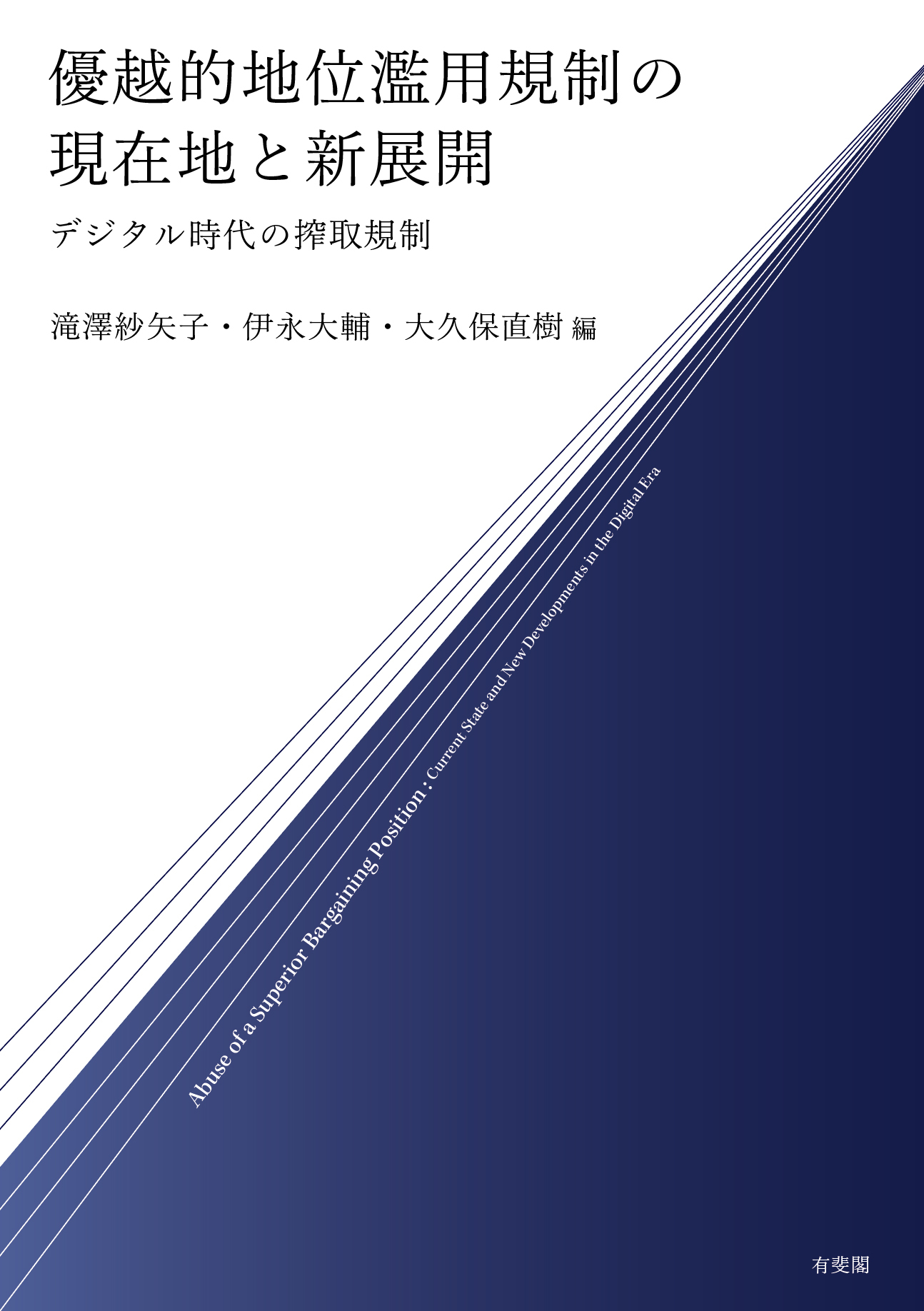
Yuetsutekichiiranyokisei no Genzaichi to Shintenkai (Abuse of a Superior Bargaining Position: Current State and New Developments in the Digital Era)
Size
332 pages, A5 format, hardcover
Language
Japanese
Released
August, 2025
ISBN
978-4-641-24382-8
Published by
Yuhikaku Publishing Co., Ltd.
Book Info
See Book Availability at Library
Japanese Page
Behind the convenience of digital platforms sometimes lurk hidden costs. Our personal data may be harvested without consent, or an essential database may start charging unreasonably high fees. Practices like these can violate the Antimonopoly Act’s rules against “abuse of a superior bargaining position”. In the digital era, such exploitative practices – where a party exploits its counterpart in a market already lacking effective competition—have become a global concern, drawing increasing attention to the regulation of exploitative conduct worldwide.
Japan introduced rules against the abuse of a superior bargaining position as early as 1953, and has since built up a long track record of enforcement. By contrast, U.S. antitrust law has traditionally been skeptical of regulating exploitative conduct, long treating it as outside the scope of competition law. Because of this, Japan’s system was once seen as idiosyncratic. Today, however, the picture looks different: as digital exploitation problems have become more pressing, EU competition law has moved quickly to address them. Scholars have begun to note that similar rules exist in many other jurisdictions. What was once seen as uniquely Japanese has thus become part of a broader global debate on how to regulate exploitative conduct.
This book seizes that moment and provides a multidimensional analysis of the rules on exploitative abuse.
Part I examines the development of “classical” abuse of superior bargaining position regulation in Japan, focusing on case law and enforcement by the Japan Fair Trade Commission, and reassessing its current state.
Part II explores the potential and limits of such regulation in new areas, including digital platforms, freelance work, and intellectual property enforcement, often in interplay with other legal domains such as constitutional law, civil law, labor law, personal information protection law, and intellectual property law.
Part III situates Japan’s framework within a comparative perspective, presenting regimes in the EU and Asia, in order to provide a broader cross-jurisdictional overview.
The book was written as a tribute to Professor Tadashi Shiraishi on the occasion of his 60th birthday. From the University of Tokyo, Sayako Takizawa served as editor and author, while Simon Vande Walle contributed as an author.
(Written by TAKIZAWA Sayako, Professor, Graduate Schools for Law and Politics / 2025)