

 Find a book


Title
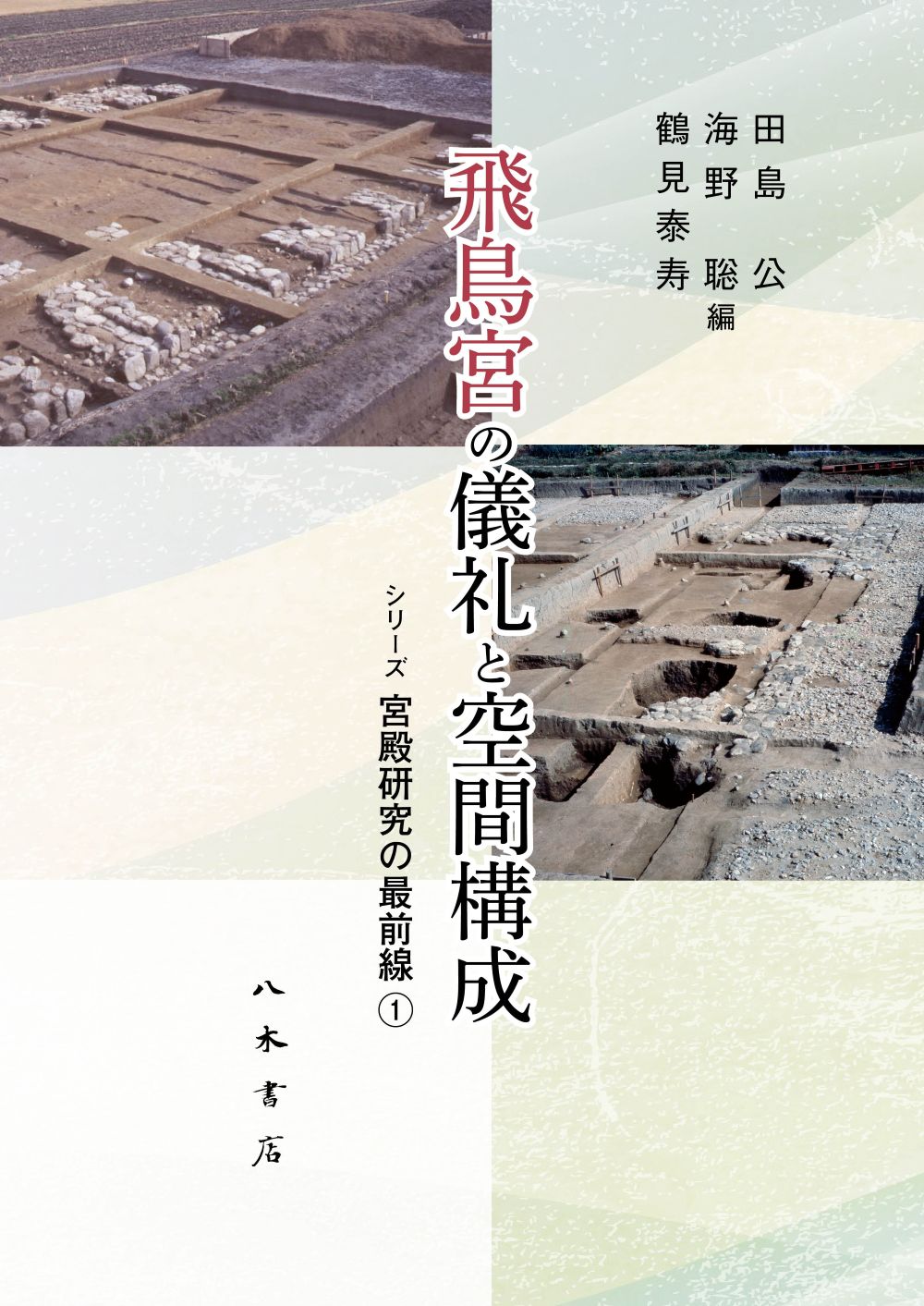
The Forefront of Palace Research, Vol. 1 Asuka-kyu no Girei to Kukan-Kousei (The Rituals and Spatial Configuration of Asuka Palace)
Size
226 pages, A5 format, hardcover
Language
Japanese
Released
February 20, 2025
ISBN
978-4-8406-2608-8
Published by
Yagi Shoten
Book Info
See Book Availability at Library
Japanese Page
In the seventh century, Asuka Palace was an important site where successive royal palaces—Okamoto Palace (Emperor Jomei), Itabuki Palace (Empress Kōgyoku), Later Okamoto Palace (Empress Saimei), and Kiyomihara Palace (Emperor Tenmu)—were established in the same location. Yet, despite being at the centre of the ancient Japanese state, the greater part of its remains still lies dormant beneath the soil of the village of Asuka in Nara prefecture. Visitors today are met only with a sprawling, quiet rural landscape. Consequently, while many people may recognize the name from textbooks, few can picture its actual spatial layout.
This book is an academic study that comprehensively elucidates the actualities of the spatial configuration and rituals of Asuka Palace, the royal palace during the Asuka period. By combining archaeological remains uncovered through excavations, close readings of ancient historical sources, and spatial reconstructions based on the perspective of architectural history, this book attempts to reconstruct three-dimensionally the space within one particular palace.
A distinctive feature of this book is its interdisciplinary approach, which moves fluidly between architectural history, archaeology, and text-based historical research without treating them as separate fields. It deciphers the placement of the Main Hall, Front Hall, and Rear Hall, the configuration of the courtyard, and the nature of venues for banquets and diplomatic rites by cross-referencing the dimensions of remains, the placement of pillars, the circumstances in which artefacts were unearthed, and accounts in sources such as the Nihon shoki. The moment when plans align with accounts in historical sources, the actual physical movements and spatial experiences involved in the rituals come to light. What emerges is a space of strong individuality that differed from both the earlier Naniwa Palace and the subsequent Fujiwara Palace. In particular, the establishment of a Main Audience Hall in Asuka Palace as a building for public rituals marked a turning point for ancient palaces, and one can also see aspects of a palace situated within East Asia. It becomes quite clear that the palace was not merely a collection of buildings, but a stage where domestic politics and diplomatic rites intersected.
In addition, this book does not limit itself to issues within the Japanese archipelago. It examines the spatial order of Asuka Palace through an East Asian lens, comparing it with palaces in Tang China and the Korean Peninsula, and it discusses the actual architectural space that came to fruition through the adoption of continental institutions and the reorganization of indigenous traditions. This is an attempt to reposition Japan during its period of state formation within dynamic exchanges in the East Asian world.
For students with an interest in ancient history, as well as those studying architectural history and historical archaeology, the process of deciphering space by comparing plans, remains, and historical sources ought to be stimulating. How is a massive space like a palace connected to political systems and intellectual thought? This book tackles this question head-on. I would be delighted if it sparks an interest in the world of ancient palaces yet to be elucidated.
(Written by UNNO Satoshi, Associate Professor, School of Engineering / 2026)