

 Find a book


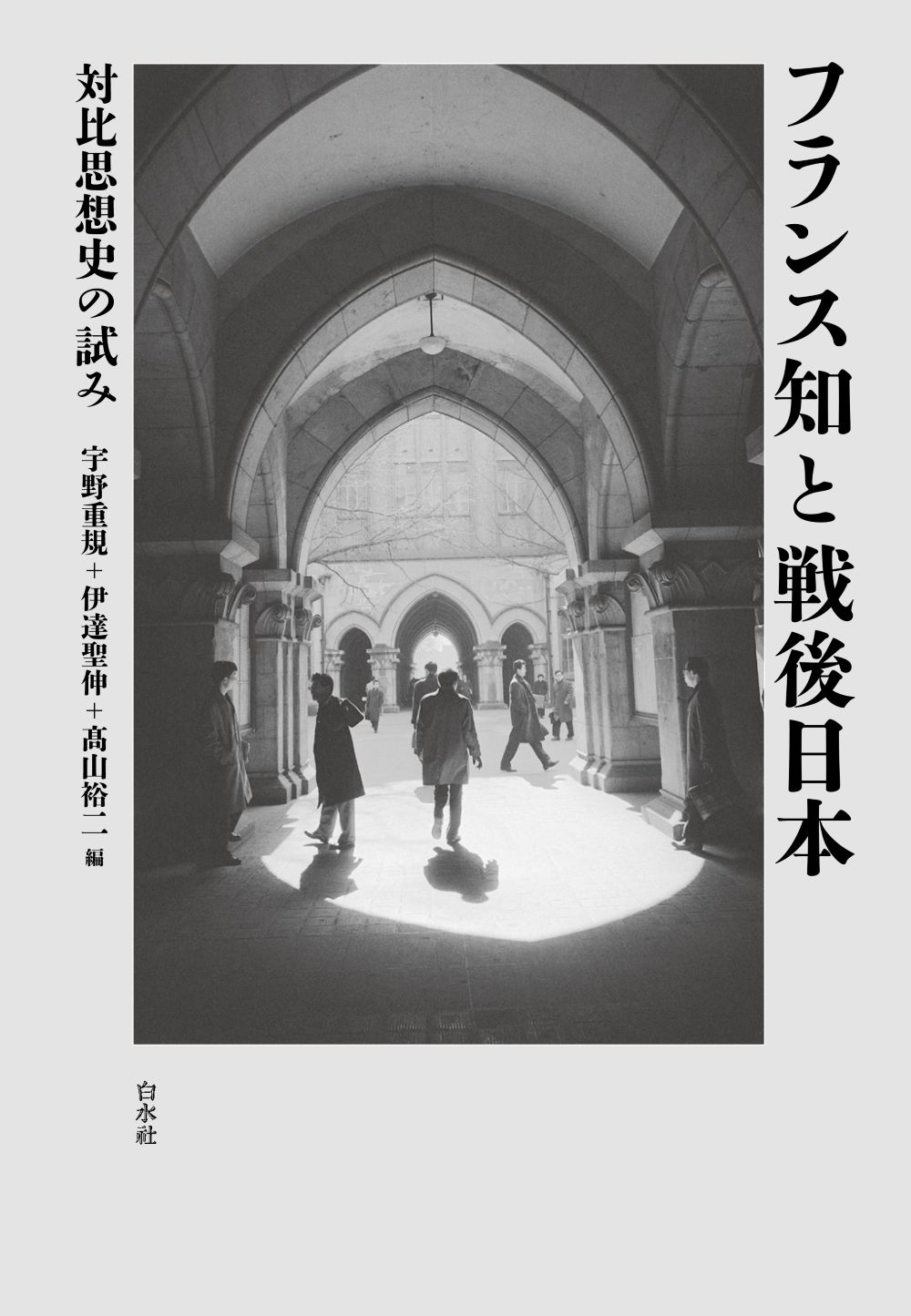
Title
France-chi to sengo Nihon (“French Knowledge” in Post-war Japan - toward a comparative history of thought)
Size
332 pages, 127x188mm
Language
Japanese
Released
March 28, 2024
ISBN
9784560092774
Published by
Hakusuisha Publishing Co., Ltd.
Book Info
See Book Availability at Library
Japanese Page
Until the 1980s in Japan, there were must-read books for students. While many were theory-based works in the social sciences, in the humanities, French philosophy and thought were particularly prominent. Jean-Paul Sartre’s death in 1980 was widely reported throughout the country. “French knowledge” had a strong presence and influence in post-war Japan.
Today, the notion of must-read books for students has almost disappeared, and interest in France has shifted toward contemporary French society. Does this signify a decline of “French knowledge” in Japan? If so, why and how? The reasons lie within both countries. Our book examines various works by Japanese authors dealing with French philosophy, thought, or history, and analyzes their historical and intellectual contexts as well as their significance from a contemporary perspective. Among these works, some are outdated, while others still shed light on aspects that recent books could not provide.
I focus on 1989, the bicentenary year of the French Revolution, and on Michio Shibata’s French Revolution, published that year. At the time, when “French knowledge” still had a strong presence in Japan, the series of commemorative events organized in France was widely reported. I remember the parade in Champs-Elysées on July 14, which was broadcast on TV. What I could not realize then was that the image of the French Revolution differed between these commemorative events in France and historical books in Japan: the former emphasized the universal and cross-class aspects of the Revolution, while the latter viewed it as a national and class-based upheaval. This gap seems to be related to the subsequent decline of interest in “French Knowledge.”
Our book gives particular emphasis to key historical years, such as “1789” or “1968.” In Japan, especially in school education, people tend to avoid chronology based on specific years, whereas in France, references to particular years are common—for example, “1981” or “2027” to signify presidential elections. “1789” and “Mai 68” are iconic symbols of this chronological language. It is as if the historical consciousness of the French people is structured around a year-based rhythm. This hypothesis could be the subject of another academic study.
(Written by NAGAI Nobuhito, Professor, Graduate School of Humanities and Sociology / 2025)