

 Find a book


Title
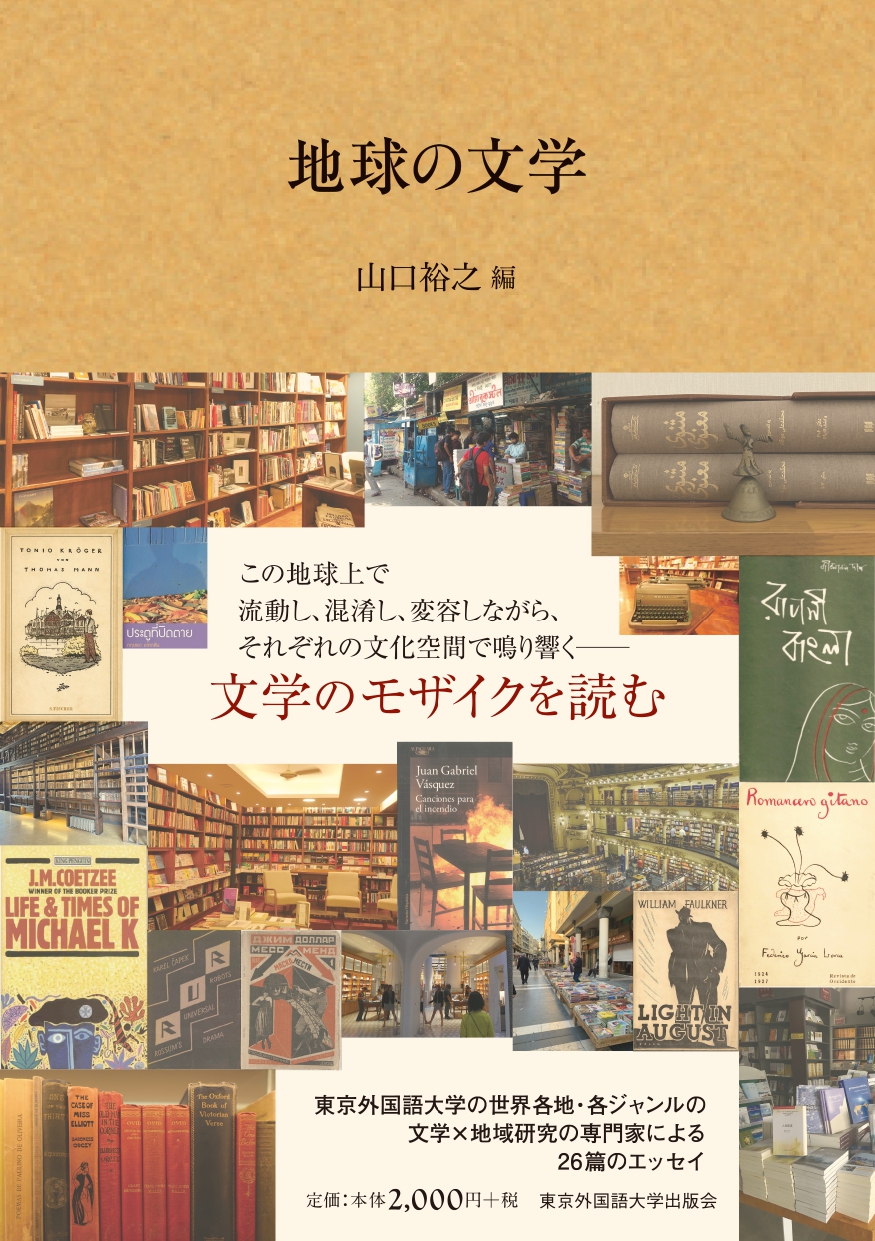
Chikyu no Bungaku (Literature of the Earth)
Size
296 pages, A5 format, softcover
Language
Japanese
Released
March 31, 2025
ISBN
978-4-910635-17-0
Published by
Tokyo University of Foreign Studies Press
Book Info
See Book Availability at Library
Japanese Page
The Japanese term bungaku (“literature”) is an extremely tricky expression. It can refer to verbal arts, such as poetry and novels, or to literary studies, as an academic discipline. Naturally, when we look to other eras and regions, the scope of “literature” becomes even broader and more complex. Since the turn of the millennium, the American literary scholar David Damrosch has advocated the term “World Literature,” which encompasses circulation, translation, and production. However, his argument is grounded in an English-mediated context and has been subject to various criticisms.
In this context, the book “Literature of the Earth” attempts to depict various forms and expressions of literature. Intended to present “the resonant image of the entire Earth,” this volume is structured into five parts, “I. What Translation Provokes,” “II. Portraits of Modernism,” “III. The Actuality of Poetry,” “IV. Within the Dynamics of Politics,” and “V. Reception and Transformation Within History,” containing 26 essays.
This book is titled “Literature of the Earth,” rather than “World Literature,” not only because it is a sequel to “Music of the Earth,” but also because it depicts “how literary texts take shape in their respective languages before translation, and how they live within their own cultures and societies” (Hiroyuki Yamaguchi, “Afterword”). In other words, it does not imply a unified “world literature,” but rather an accumulation of literatures scattered across distinct regions. Of course, individual literatures are not isolated; they resonate through “translation” and come into contact with other literatures because of the political and historical contexts in which they emerge. The perspectives of the 26 contributors to this volume provide a vivid illustration of this multifaceted reality.
Whereas a typical book about literature might introduce and explain authors and works, this volume is compelling precisely because of its unique approach. Allow me to cite a few specific examples: Nozomi Kubota brings to light the multilayered nature of the expression “African”; Ryoichi Kuno notes the differences between the original and translated book covers of works by Colombian author Juan Gabriel Vásquez; and Kosit Tiptiempong discusses the trend of male homosexual novels in Thailand. This approach of contextualizing writers and works while touching on the social, historical, and political realities of each region demonstrates the depth and diversity of literary studies.
(Written by ABE Kenichi, Professor, Graduate School of Humanities and Sociology / 2025)