


 Find a book


Title
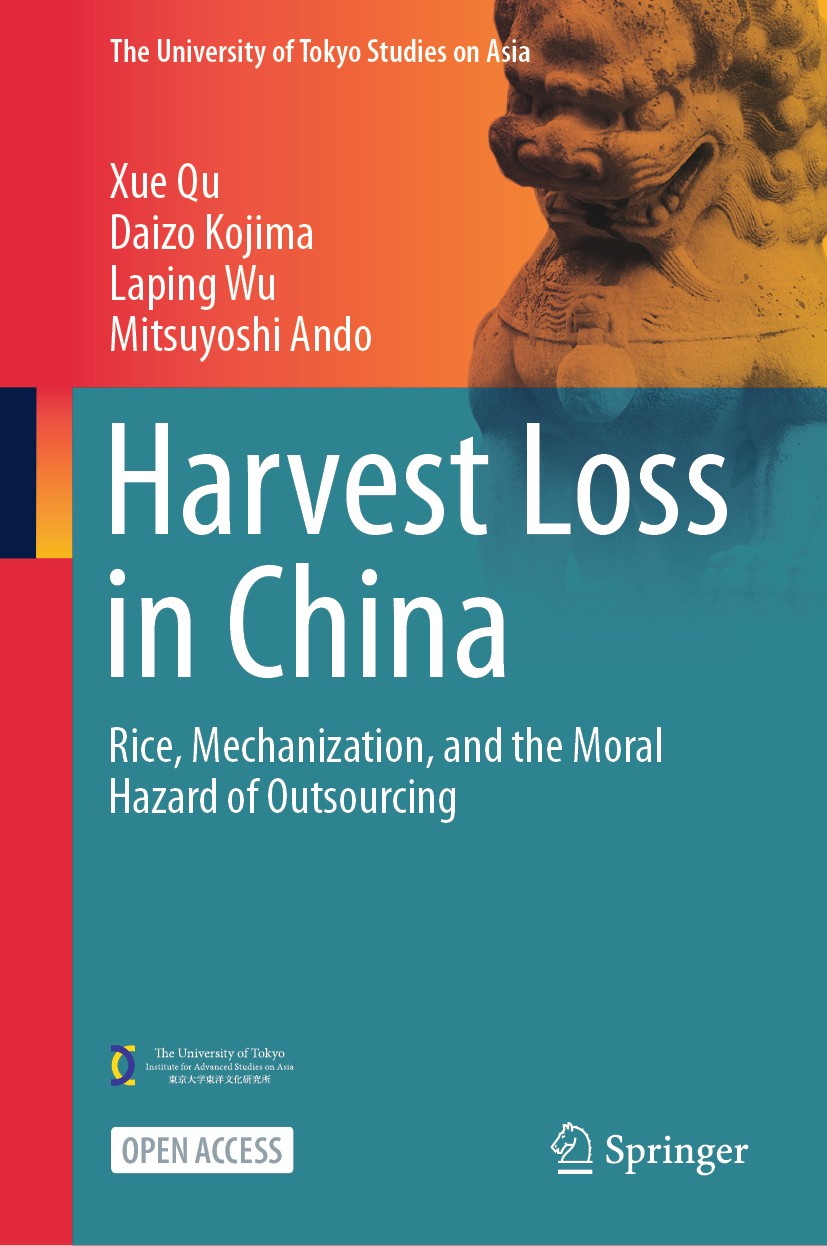
The University of Tokyo Studies on Asia Harvest Loss in China Rice, Mechanization, and the Moral Hazard of Outsourcing
Size
176 pages, hardcover
Language
English
Released
December 28, 2024
ISBN
978-981-97-9155-2
Published by
Springer Singapore
Book Info
See Book Availability at Library
Japanese Page
 eBook
eBook
The United Nations has established a development goal of reducing food loss by 2030. According to the Food and Agriculture Organization, an examination of food loss across each stage of the supply chain, such as production, retail, and consumption, shows that the production stage accounts for approximately half of total food loss, with the bulk of losses occurring in emerging and developing countries.
While Chinese agriculture accounts for a substantial share of global agricultural production, it also experiences significant harvest losses during the production stage. In particular, recent studies have pointed out that although the mechanization and outsourcing of agricultural operations have increased productivity, they have also contributed to harvest losses. It has been suggested that the outsourcing of agricultural work can negatively affect harvest outcomes due to the attitude of contractors (agents) toward the work; specifically, a moral hazard may arise in which contractors act in ways that contradict the interests of clients (principals), thereby contributing to harvest losses. However, there is limited empirical analysis to support this claim.
This book aims to clarify, from the perspective of principal–agent relationship, how contractors’ moral hazard contributes to harvest losses among rice farmers in China. The book is structured as follows: Chapter 1 presents a conceptual framework that incorporates the aforementioned background issues and concepts such as moral hazard; Chapter 2 reviews prior research on methods for estimating rice harvest losses and their associated impacts; Chapter 3 provides a statistical overview of the sample data; Chapters 4 through 6 present the empirical analyses; and Chapter 7 summarizes the conclusion and policy implications.
Utilizing the instrumental variable method, the final part of the empirical analysis in Chapter 6 builds upon the analyses presented in Chapters 4 and 5 to examine the impacts of contractors’ moral hazard on harvest loss rates, specifically differentiating these by farmland area. The results confirm that contractors’ negative work attitude increases the harvest loss rate; however, the effect diminishes as farmland area increases and becomes statistically insignificant for farms in the top decile by area. Based on these findings, it is apparent that although contractors’ moral hazard in outsourced operations exerts a negative impact on harvests, the impact becomes negligible in large-scale farming.
This book empirically reveals the existence of moral hazard among contractors—and its negative impact on yields—in the context of rice harvest losses in China. It provides new insights not only into factors related to moral hazard—the primary focus of the book—but also into other determinants, such as farmland size and harvesting methods. These insights are expected to offer valuable implications for reducing harvest losses in the agricultural sectors of emerging and developing economies—such as China—where further advances in mechanization and outsourcing are anticipated.
(Written by KOJIMA Daizo, Professor, Graduate School of Agricultural and Life Sciences / 2026)
Table of Contents
Chapter2 Literature Review
Chapter3 Data Collection and Descriptive Statistics
Chapter4 The Moral Hazard in Harvest Outsourcing Service
Chapter5 The Effect of Outsourcing Service on Rice Harvest Loss Through Moral Hazard
Chapter6 The Effect of Moral Hazard on Rice Harvest Loss
Chapter7 Conclusion and Policy Implications
Appendices
Index
Related Info
Academic Award by the Agricultural Economics Society of Japan, 2025 (The Agricultural Economics Society of Japan 2025)
https://www.aesjapan.or.jp/englishtop
Related Article:
research letter
A Study of Rice Harvest Losses in China:Do Mechanization and Farming Scale Matter?
Xue Qu, Daizo Kojima, Yukinaga Nishihara, Laping Wu, Mitsuyoshi Ando (Japanese Journal of Agricultural Economics vol.23, pp.83-88 March 31, 2021)
https://doi.org/10.18480/jjae.23.0_83