

 Find a book


Title
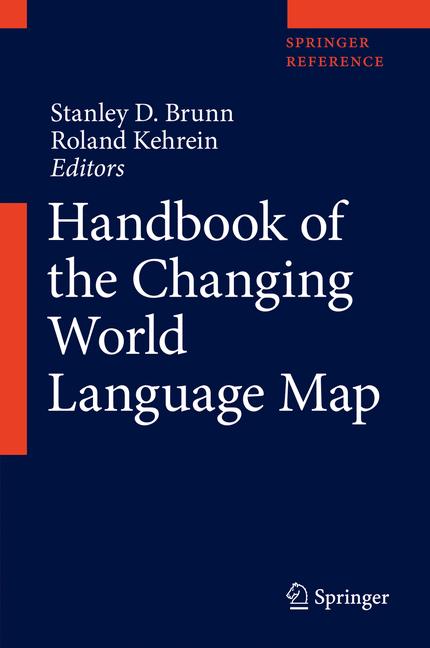
Handbook of the Changing World Language Map
Size
4186 pages, hardcover
Language
English
Released
November 11, 2019
ISBN
978-3-030-02437-6
Published by
Springer Nature Switzerland AG
Book Info
Japanese Page
 eBook
eBook
Many of you might have heard of the Tower of Babel. Some may recall the beautifully intriguing painting by the Dutch artist Pieter Bruegel the Elder. The Tower of Babel originally appeared in an old myth. The myth relates that, in ancient times, a united human race used to speak a single language. United by this common tongue, they attempted to build a tower so immense that it would reach the heavens. Yet when God beheld the tower's looming grandeur, He decided to confuse their speech. From then on, men could no longer understand one another, rendering collective construction impossible, and were scattered all around the world. Thus, the tower, nearing the heavens, was abandoned. That is how, in mythology, the human race came to speak a large number of different languages, and the name of that tower was the Tower of Babel.
This major work is divided into six volumes, comprising 23 parts and 215 chapters. A total of 339 researchers from over 50 countries in the world, who teach courses in over 12 different disciplines and interdisciplinary fields at universities, including human geography and linguistics, were invited to contribute original papers to this book. It discusses languages from over the world, including major languages such as English, Chinese, Spanish, French and German, as well as Arabic, Hebrew and Swahili. Furthermore, it covers regionally unique languages and dialects such as West Frisian, Rusyn, Magahi in India and the Ainu language in Japan, as well as major Western languages. Each language is deeply intertwined with the culture and history of its region. Describing their characteristics thus reflects the challenges that the people of that region have faced throughout history and the wisdom they have developed in response. Selecting which languages from which regions to include and contextualizing them in the volumes is an act of discovery, revealing which linguistic spheres have produced meaningful words and expressions in response to particular challenges. For modern humanity, which is perpetually hindered by the divisions created by language barriers and the uniqueness of the cultures and histories they reflect, this compilation could be seen as the first step towards reconstructing the Tower of Babel, creating a place where everyone can live together. The fact that many chapters of this volume are co-authored is surely a natural consequence. We would once again like to express our gratitude to Professors Brun and Kehrein for designing and compiling such an extraordinary work.
The first volume of this book begins by establishing a shared foundation for mapping language. It examines key considerations and mapping models, as well as the languages and methodologies of mapping, with a focus on specific regions and constituent groups. Consideration is also given to maps for the visually impaired. It then introduces languages and speech patterns that have established their identities in various locations, presenting perspectives that are relevant throughout the volume. In this volume, the unique vocabulary of Japanese environmental design, which encompasses not only architectural design, but also that of garden and neighbourhood design, is presented as an identity within the global context that represents a design philosophy valuing coexistence and collaboration with the environment. Traditional Japanese architecture and gardens are composed in a way that is highly unique from a Western perspective, such as being able to slide shoji screens and fusuma sliding doors open to connect the interior seamlessly to the garden and even to the natural landscape beyond without partitioning walls, and the presence of eaves and En, Japanese traditional style verandas, where one can temporarily occupy a position between the garden or the street and the house's interior. Since before the war, these features have attracted the attention and admiration of architects and art historians, both domestically and internationally. Thanks to my studies in architecture and my involvement in a human geography course at the University of Tokyo, I am honoured to have had the opportunity, alongside my fellow co-authors, to introduce and organise the terms in this book that express these concepts, for the benefit of students worldwide. I hope this represents a valuable step forward for those aspiring to pursue related interdisciplinary fields.
From Volume 2 onwards, the book begins with an exploration of the rise, fall and diversity of languages throughout history. This is followed by a discussion of topics such as linguistic situations in multiethnic societies, mapping endangered languages, gender and language, languages embedded in landscapes, non-human animal languages, language education, plagiarism, and the science of translation. It then addresses various contemporary issues and recent topics concerning language within society, further exploring subjects such as language and politics, art, technology and branding. Readers may find pleasure in journeying through diverse regions of the world to decipher their linguistic landscapes or imagining the Tower of Babel's transformations and future.
(Written by YOKOYAMA Yurika, Professor, Graduate School of Arts and Sciences / 2025)
Table of Contents
Part 1 Geography, Language, and Mapping
1. Towards “Mapping” a Complex Language Ecology: The Case of Central Asia -- Stephen Bahry
2. Austronesian Archipelagic Linguistic Diversity Amid Globalization in the Philippines -- Meriam A. Bravante and William N. Holden
3. Mapping the World’s Languages: From Data via Purpose to Representation -- Bernard Comrie
4. Expanding the Map of the Literary Canon Through Multimodal Texts -- Crag Hill and Jennifer Dorsey
5. Transforming Narratives of a Caribbean Downtown Neighborhood: Community Mapping and “No Man’s Land” in Kingston, Jamaica -- David Howard
6. Language Mapping Worldwide: Methods and Traditions -- Stefan Rabanus
7. Dialect Typology: Recent Advances -- Melanie Röthlisberger and Benedikt Szmrecsanyi
8. Study of Linguistic Areas: Evidence from Cultural Words, Semantic Maps, and Spatial Reference in Southeast Asia -- Stefanie Siebenhütter
9. Preparing a National Sociolinguistic Map for Equatorial Guinea -- Scott Smith
10. Visualizing Dialect Variation on a 3-D Interpolated Map: A Case Study in Chiang Mai, Thailand -- Paporn Thebpanya, Sudarat Leerabhandh Hatfield, and Jay Lee
11. Mapping Cantonese: The Pro-Cantonese Protest and Sina Weibo in Guangzhou -- Wilfred Yang Wang
12. Revising the Language Map of Korea -- Changyong Yang, William O’Grady, Sejung Yang, Nanna Haug Hilton, Sang-Gu Kang, and So-Young Kim
13. Characterizing the Language Boundaries of the Arab Middle East and North Africa: A Geolinguistic Analysis -- Moran Zaga and Ronen Zeidel
Part 2 The Language of Maps
14. Symbolic, Syntactics, and Semantics: Teaching a Language of Maps -- Phil Gersmehl
15. Map Design for the Color Vision Deficient -- Dave Hobbins
16. The Map’s Changing Role: A Survey of the Annals of the Association of American Geographers -- Fritz C. Kessler and Terry A. Slocum
17. Language of Maps for Blind and Partially Sighted People: Expressive and Perceptive Skills -- Elaine Kitchel and Fred Otto
18. Maps as Language/the Language of Maps -- Judith A. Tyner
19. Maps/Language -- Denis Wood
Part 3 Language Mapping and Documentation
20. Linguistic Geography’s Role in Clarifying the Linguistic Situation in Specific Language Regions in Southeast Europe -- Luchia Antonova-Vasileva
21. Slovene Nouns and Adjectives: Non-standard Use of Dual Number from 1925 to 2015 -- Tjaša Jakop
22. Exploring Linguistic Diversity in India: A Spatial Analysis -- Rajrani Kalra and Ashok K. Dutt
23. Historical Dialectology: West Frisian in Seven Centuries -- Arjen Versloot
24. Linguistic Geography of the Nostratic Macrofamily -- Barney Warf
25. Mapping Language Variation and Change in the USA and Canada -- Thomas A. Wikle and Guy H. Bailey
Part 4 Language and Identity
26. Language and Pain in the Landless workers’ Movement (MST) in Brazil -- Claudiana Nogueira de Alencar, Sandra Maria Gadelha de Carvalho, and José Ernandi Mendes
27. Linguistic Marketplace of Osh, Kyrgyzstan: From Bazaar to Bizarre -- Emily R. Canning
28. Immigration, Language, and Conflicting Ideologies: The Czech in Texas -- Eva Eckert
29. Northern Ireland and the Union “Fleg”: Linguistic Associations in a Disputed Geographical Area -- Brendan Gunn
30. Languages and Space-Related Identity: The Rise and Fall of Serbo-Croatian -- Peter Jordan
31. Spatial Distribution of Regional Dialects: Interplay of Language, Community, and Action -- Alfred Lameli
32. “Spanish Languages” as a Polysemic Expression: Territories, Borders, and Geopolitical Identities -- Rubén C. Lois-González, Jorge Oleina Cantos, and Miguel Pazos-Otón
33. Cultural Wisdom in Design and Planning: Linguistic Terms from Japan -- Sanjoy Mazumdar, Yurika Yokoyama, Shunsuke Itoh, and Nana Fukuda
34. Food, Language, and Identity in Singapore’s Hawker Centers -- Kelly Ong
35. Aztlán and Mexican Transnationalism: Language, Nation, and History -- Magnus Pharao Hansen and Kurly Tlapoyawa
36. Place Names and Kazakh Song Making in the Western Mongolian Steppes -- Jennifer C. Post
37. Practicing Language: The Dynamic Language Geographies of Young Migrants’ Talk in London and Glasgow -- Sophie Shuttleworth
38. Hebrew in the Daily Life of Israelis -- Stanley Waterman
39. Ethnic Self-Perception of Georgian Teenagers in Moscow: Role of Language and Culture -- Dionysios Zoumpalidis and Julia V. Mazurova
Volume 2
Part 5 Language and Heritage Chapters 40.~47.
Part 6 Linguistic Minorities and Majorities Chapters 48.~68.
Part 7 Linguistic Varieties and Patterns of Language Use Chapters 69.~74.
Part 8 Multilingual and Multiethnic Societies Chapters 75.~81.
Volume 3
Part 9 Endangered and Disappearing Languages Chapters 82.~91.
Part 10 Indigenous Peoples’Languages Chapters 92.~95.
Part 11 Language and Gender Chapters 96.~99.
Part 12 Nonhuman Languages Chapters 100.~102.
Part 13 Place names and Toponyms Chapters 103.~115.
Volume 4
Part 14 Language of Political Organization, Boundaries, and Borders Chapters 116.~118.
Part 15 Language Policy, Laws, and Ethics Chapters 119.~124.
Part 16 Music, Art, Photography, and Entertainment Chapters 125.~138.
Part 17 Religion Chapters 139.~147.
Volume 5
Part 18 Language of and Language in the Landscape Chapters 148.~166.
Part 19 Language, Environment, and Ecology Chapters 167.~174.
Part 20 Teaching and Learning Languages Chapters 175.~186.
Volume 6
Part 21 Language and Technology Chapters 187.~201.
Part 22 Translation Chapters 202.~209.
Part 23 Language and Product Branding Chapters 210.~215.