

 Find a book


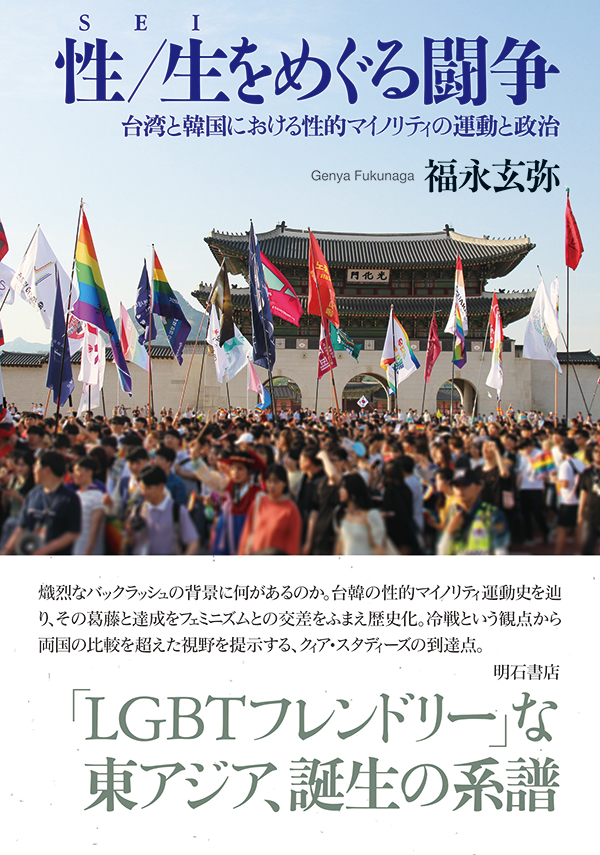
Title
Seiwo meguru Tousou (Struggles over Sexuality: Queer Movements and Politics in Taiwan and South Korea)
Size
464 pages, 127x188mm
Language
Japanese
Released
February 28, 2025
ISBN
9784750358680
Published by
Akashi Shoten Co., Ltd.
Book Info
See Book Availability at Library
Japanese Page
 eBook
eBook
Struggles over Sexuality examines modern East Asian history through the lens of sexuality. The book focuses on Taiwan—often described as “the most gay-friendly society in Asia”—and South Korea, where LGBTQ protections have advanced and receded in turn. From their liberation from Japanese colonial rule to their incorporation into a U.S.-led Cold War order and the subsequent waves of democratization, the book traces how queer activism, feminism, religion, and the state have interlocked to confront a fundamental question: whose deaths are mourned and whose are not? Connecting queer studies and Cold War studies, the author explores multiple arenas (military, schools, courts, policymaking, and activism) to narrate the history of queer struggles along three axes: inclusion, liberation, and rights.
The first axis, inclusion, considers Taiwan and South Korea as societies permeated by conscription and militarism. Its key question: how have gay and transgender people gained—or been stripped of—“membership” as soldiers? Debates in Taiwan over a “gay-friendly military” and in South Korea over the “right to serve” cannot be captured by a simple inclusion/exclusion binary. The book describes cases in which “reasonable accommodation” becomes a pretext for pushing people outside the system and how, in the name of inclusion, the state seeks to marshal minorities as military resources.
Second, liberation. By examining practices in public spaces, from pride parades to street demonstrations, the book demonstrates how walking, speaking out, and gathering have crystallized into political collective actions. At the same time, it interrogates the other side of the “gay-friendly” label: which sexual minorities are welcomed, and who is rendered invisible?
The book considers the third axis, rights, by analyzing the politics surrounding marriage equality and comprehensive anti-discrimination laws. It traces the mutual responsiveness of civil movements and political parties in Taiwan, culminating in Asia’s first legalization of same-sex marriages in 2019. In South Korea, the book examines how religious conservatives have repeatedly derailed efforts to enact a comprehensive anti-discrimination statute, and how exclusionary rhetoric targeting transgender people has deepened fractures within feminism. Here, rights emerge not as a given, but as sites and processes of struggle that are won and lost through the actions of diverse actors.
Methodologically, the book triangulates firsthand voices; movement archives and field observations; and law, policy, and media discourse within a comparative historical-sociological framework. Rather than simply praising or condemning one country’s “success” or “failure,” it highlights the new exclusions that often arise. For instance, only middle-class-conforming models are often recognized as “exemplary citizens.” By situating the analysis within East Asia, it also probes the potential for regional studies that go beyond side-by-side comparison.
Reading refreshes one’s way of seeing. This book aims to prompt the reader to reconsider their sense of “normal,” offering tools to identify the norms and boundaries implicit in everyday places.
(Written by FUKUNAGA Genya, Associate Professor, Graduate School of Arts and Sciences / 2025)