

 Find a book


Title
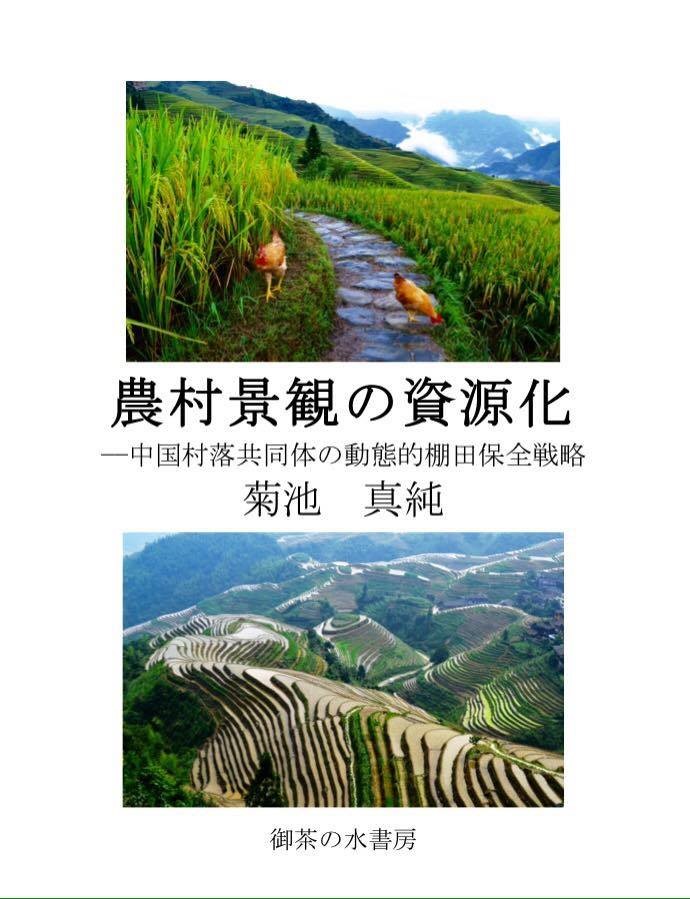
Chugoku-Noson deno Kankyo-Kyosei-gata Shinsangyo no Soshutsu (The Creation of New Environmental Industries in Rural Chinese Villages - Development Based on Forest Conservation)
Size
192 pages, A5 format
Language
Japanese
Released
July 27, 2023
ISBN
978-4-275-02181-6
Published by
Ochanomizu Shobo Publisher
Book Info
See Book Availability at Library
Chugoku-Noson deno Kankyo-Kyosei-gata Shinsangyo no Soshutsu
Japanese Page
The title of this book, “The Creation of New Environmental Industries in Rural Chinese Villages,” does not indicate that its main subject was pre-established in advance and that each respective research study was conducted over the years based on this subject. My field of expertise is environmental sociology, and I have been most interested in environmental problems and conservation in rural regions. I selected each study region by accompanying my senior researchers, having it introduced to me by them, or developing it myself. From 2007 to 2023, however, I repeatedly held dialogues with the local people of each region and conducted qualitative research studies. Hence, although these studies were conducted separately, I found commonalities in each region: those of development based on the conservation of the natural environment and the creation of new industries in these villages based on this conservation. The discovery of this large, common framework enabled the compilation of this book.
Regarding the case studies, the first was in Gusheng Village, Bijie City, Guizhou Province, China. In this region, the natural environment of the village is being improved and the main industry has shifted from field agriculture to fruit production, following the implementation of a national policy targeting this region to convert cultivated land into forests.
Next, in Tiemuriwude Village, which is in the Inner Mongolia Autonomous Region, China, following the implementation of the natural forest protection policy for grasslands and the process of restoring pastureland to its original state, the village’s main industry has shifted from animal grazing to field and dairy farming.
Third, Fanggan Village, Laiwu District, Jinan City, Shandong Province, China, is now a very wealthy village that has improved its environment, developed its industry, and escaped poverty thanks to the efforts of the villagers working under a unified system of collective ownership. The village’s industry was traditionally field agriculture. However, based on its natural environment, which is blessed with rich forest resources as a result of afforestation, the village currently positions tourism and medical care, caregiving, and recreational services as its main industries.
Finally, in the Longji Terraced Rice Field Area, Longsheng Various Nationalities Autonomous County, Guilin City, Guangxi Zhuang Autonomous Region, China, ethnic minorities are conducting large-scale terraced rice field cultivation, while preserving the forests, which have an abundance of water sources. Today, this landscape of terraced rice paddies has become the region’s greatest resource, and tourism has been developed to become its main industry while the paddy rice farming industry has been retained.
When I conducted research on environmental problems and conservation in rural Chinese villages, I was constantly confronted with the problem of poverty in these villages and challenges related to regional promotion and development. Environmental problems and the issue of poverty are not independent of each other and are often strongly related. However, dealing with both issues together and simultaneously is usually difficult, so most of the responses to them are separated within Chinese policy. Currently, however, after a certain level of mitigation and resolution has been achieved, they have been merged and are being advanced in the direction of promoting rural development. Indeed, “The Creation of New Environmental Industries in Rural Chinese Villages” is based on the conservation of China’s abundant natural environment, especially its forest resources.
When I first began researching rural Chinese villages, the three main agricultural problems were poor farming villages, farmers struggling to make a living, and low-profit farming. Today, however, rural Chinese villages have clearly changed and been developed to reach a different stage, with improvements to the natural environment and the implementation of regional promotion and development.
Based on the case studies of four regions, this book aims to generalize and universalize a theory of the development of new environmental industries by examining the characteristics of each form of development and identifying their commonalities. Moreover, it considers the direction taken by sustainable development in these regions, based on the initiatives and changes being made for the difficult problems that have traditionally existed in rural Chinese villages, namely, environmental problems and poverty.
(Written by KIKUCHI Masumi, Project Associate Professor, Graduate School of Arts and Sciences / 2025)