

 Find a book


Title
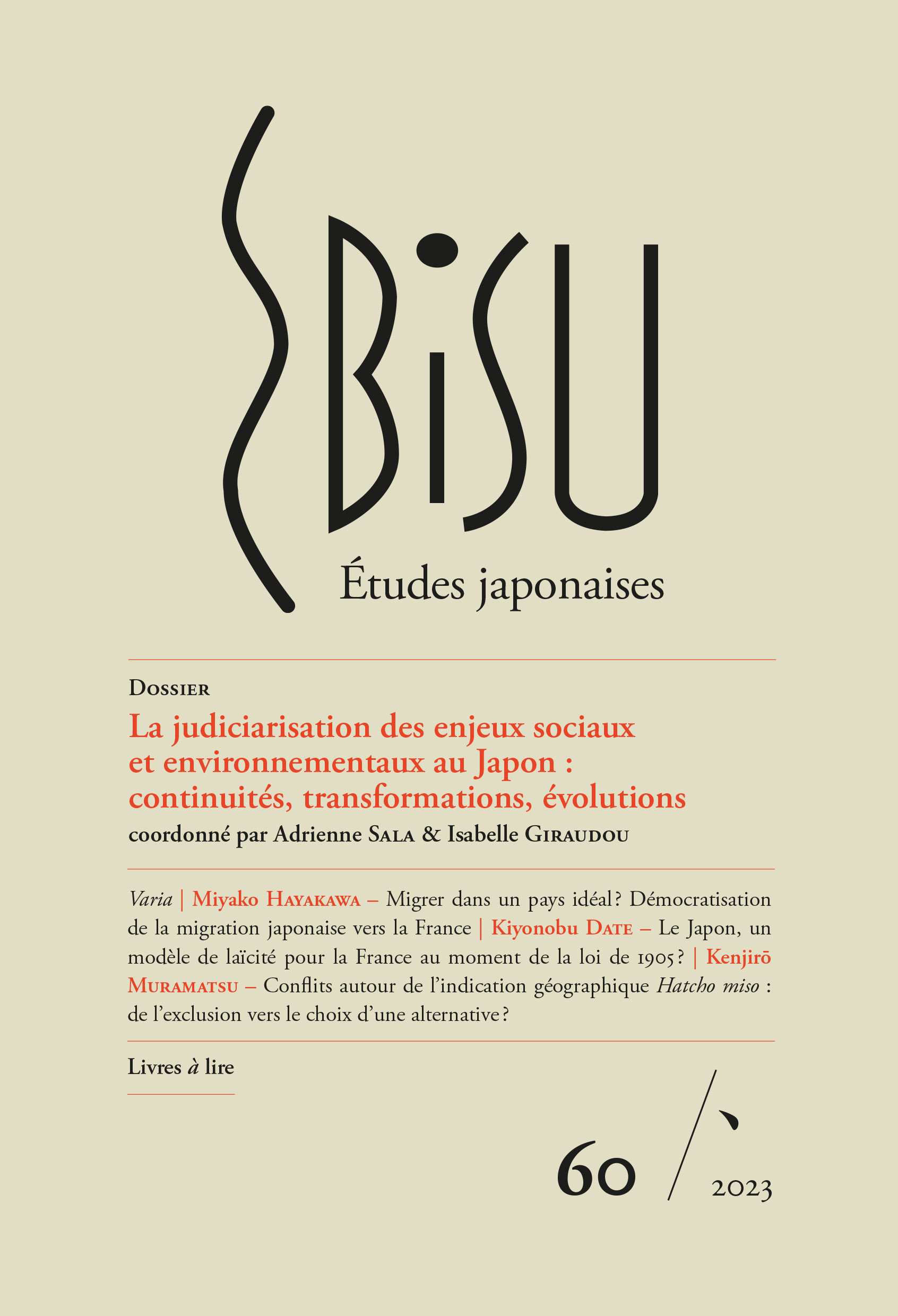
Ebisu. Études japonaises Numéro 60 La judiciarisation des enjeux sociaux et environnementaux au Japon: continuités, transformations, évolutions (The Judicialization of Social and Environmental Issues in Japan. Continuities, transformations, evolutions)
Language
French
Released
2023
ISSN
1340-3656
Published by
Institut français de recherche sur le Japon à la Maison franco-japonaise
Book Info
Japanese Page
 eBook
eBook
French and international studies on judicialisation pay little attention to Japan, where the phenomenon is only marginally discussed. Entitled The Judicialization of Social and Environmental Issues in Japan. Continuities, Transformations, Evolutions, this special issue aims to remedy such a dual shortcoming. It draws on the numerous exchanges that the research programme Judicialisation of social and environmental issues in France and Japan, conducted at the IFRJ-MJF between 2021 and 2023, has made possible. Led by Adrienne Sala, and involving Isabelle Giraudou in particular, this project intended to develop a conceptualisation of the role of the judicial institution in the development of public policy.
Existing literature has focused primarily on certain aspects of judicial life in Japan, namely: a supposedly moderate “legal consciousness,” limited judicial activism, and a predominant search for consensus. Taking a more nuanced approach, this dossier views judicialisation as a social and political phenomenon embedded in an evolving institutional and normative context. Building on this approach, it enriches our understanding of the role and influence of the judiciary in public policy-making in Japan. Adopting a bottom-up approach to the interactions between law and society, the contributions in this special issue (eight articles and one interview) shed light on the political and social significance of the judiciary in Japanese democracy.
Several contributions in this issue examine the role of Japanese legal professionals in formulating claims, highlighting their ability to make the most of the restrictive legal framework of liability. Looking back on the centenary of civil conciliation (minji chōtei 民事調停), celebrated in 2022, Béatrice Jaluzot explores alternative methods of conflict resolution beyond the traditional procedural framework of litigation. Dimitri Vanoverbeke’s contribution offers a critical analysis of judicial reform and the introduction of the lay jury system (the saiban.in 裁判員 system) at the start of the 21st century. Offering additional insight, the text by Kage Rieko 鹿毛利枝子 (tr. Nakamura Sota) analyzes in detail the process that led to the development of the jury system, a key component of jjudicialisation and a decisive factor in its development in 21st-century Japan. The following five contributions (Machimura Yasutaka 町村泰貴, Mizumachi Yūichirō 水町勇一郎, Okubo Noriko 大久保規, Isabelle Giraudou, Isabelle Konuma) examine the influence of litigation on changes in the law in the areas of consumer affairs, labor, the environment, and family law. Concluding this special issue, Celeste Arrington, in an interview conducted and translated by Adrienne Sala, analyses the interactions between law, judicial activism, and public policy-making, with a particular focus on Japan and South Korea.
Taken as a whole, these contributions demonstrate the value of continuing to study the complex dynamics between the judicial, executive and legislative branches, on which the conceptualisation of Japanese judicial bodies and their integration into public policy theories depend, at least in part.
(Written by GIRAUDOU Isabelle, Professor, Graduate School of Arts and Sciences / 2026)
Table of Contents
The Judicialization of Social and Environmental Issues in Japan. Continuities, transformations, evolutions
Adrienne Sala et Isabelle Giraudou
Introduction
Béatrice Jaluzot
Le centenaire de la conciliation civile au Japon
100 Years of Civil Conciliation in Japan
Dimitri Vanoverbeke
Le jury populaire au Japon: la conscience du droit en éclosion ou « beaucoup de bruit pour rien » ?
Trial by Jury in Japan: the Emergence of Legal Consciousness or ‘Much Ado About Nothing?’
Rieko Kage
La mise en place du système de jury populaire au Japon: la « responsabilité » comme intérêt
The Creation of the Lay Judge System in Japan: the Benefit of Accountability
Yasutaka Machimura
L’impact et les limites de l’action de groupe: vers une judiciarisation de la société japonaise ?
The Impact of the Associative Right to Sue and its Limits: the Potential for Judicialization of Japanese Society
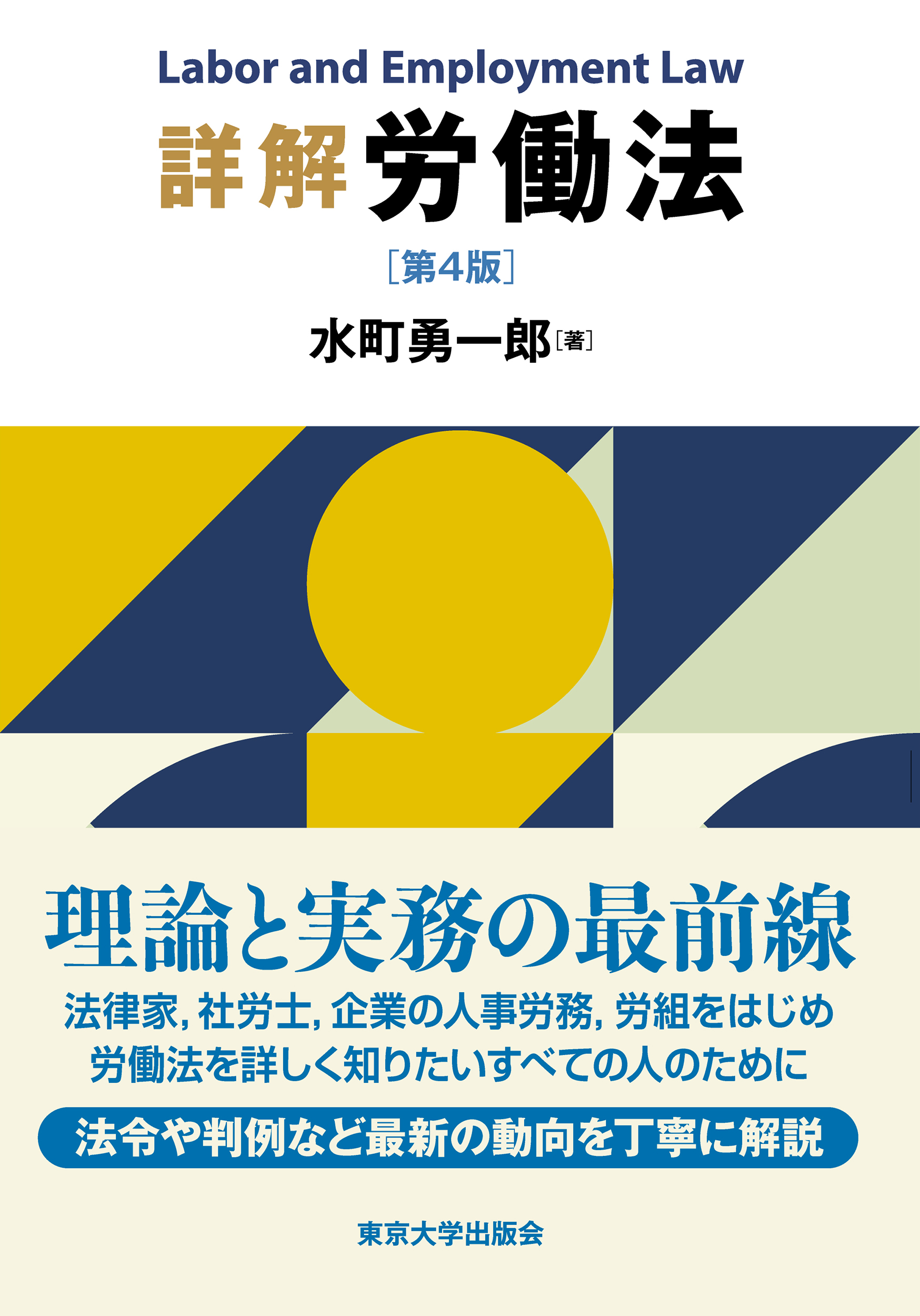
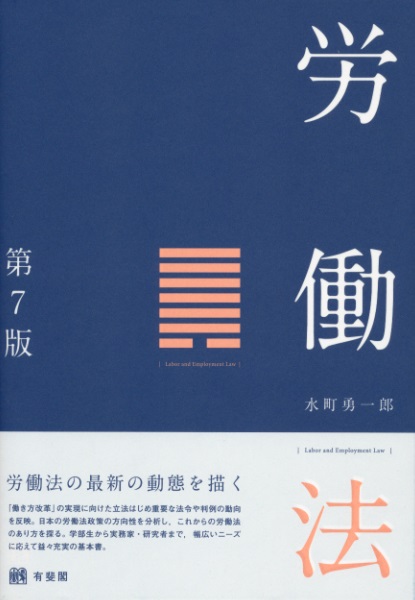
Yūichirō Mizumachi
La Loi portant réforme de la manière de travailler au Japon: quelques réflexions du point de vue de la « judiciarisation »
The Work Style Reform: Analysis from the Perspective of Judicialization
Noriko Okubo
Problèmes environnementaux et pouvoir judiciaire au Japon
Environmental Issues and the Judiciary in Japan
Isabelle Giraudou
Chronotopes du contentieux climatique au Japon: maillons d’une judiciarisation pour l’Anthropocène ?
Narrating an Emergency in Slow Motion: Chronotopes of Law and the Search for Novel Climate Change Litigation Strategies in Japan
Isabelle Konuma
Les mouvements LGBT et le droit au Japon: autour du mariage entre personnes de même sexe
LGBT Movements and Law in Japan: Examining Same-Sex Marriage Rights
Celeste Arrington et Adrienne Sala
Entretien avec Celeste Arrington
An Interview with Celeste Arrington