

 Find a book


Title
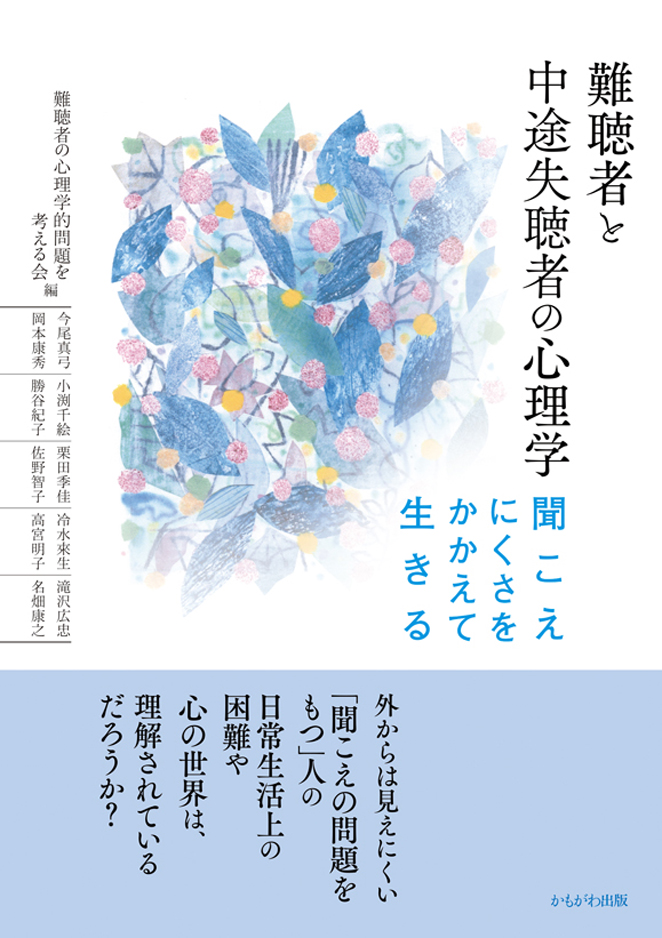
Nancho-sha to Chuto Shiccho-sha no Shinrigaku (Psychology of the Individuals with hard of hearing and acquired hearing loss)
Size
204 pages, A5 format
Language
Japanese
Released
July, 2020
ISBN
978-4-7803-1093-1
Published by
Kamogawa Shuppan
Book Info
Japanese Page
This book is based on the activities of the Group for Considering Psychological Issues of the Hard of Hearing, which was established in 2011. The group brought together researchers studying hearing loss and researchers who are hard of hearing, including the authors. The authors are from various fields, including clinical psychology, social psychology, developmental psychology, cognitive psychology, and medicine. The book is grounded in the insights gained from the group's ongoing independent workshops and open symposia at the annual conferences of the Japanese Psychological Association.
It is estimated that over 10 million people in Japan have hearing loss. This book explores how difficulties with "hearing," which are often unnoticed by the individuals themselves and those around them, impact daily life, personal psychology, and behavior. The book examines ways to understand and support these challenges based on domestic and international knowledge. At the same time, the authors have made efforts to avoid overly formal language. The text uses the polite style, striving for simplicity and incorporating relatable anecdotes.
Regarding the book's structure: In Chapter 1, which I wrote, I provide an overview of the different problems associated with hearing difficulties. It includes personal experiences with rare diseases that cause hearing loss and are difficult to diagnose. Specifically, it addresses the relationship between hearing loss and mental health and the need for support for individuals with hearing loss and their friends and family. Chapter 2 follows, presenting the causes of hearing loss and countermeasures from a medical perspective. Chapter 3, "Hearing Difficulty and Prejudice," explores the stigmatization of hearing difficulty. Chapter 4, "Hearing Loss in Later Life," focuses on age-related hearing loss and its physical and psychological impacts. Chapters 5 and 6 address mental healthcare for hard-of-hearing individuals. Chapter 5, "Psychological Clinical Understanding of the Hard of Hearing and Acquired Hearing Loss," and Chapter 6, "Psychological Clinical Issues in Children with Hearing Loss," cover this topic from different perspectives. The former focuses on issues concerning individuals with acquired hearing loss and those with mild to moderate hearing loss, areas that have been under-examined in the past. The latter discusses the challenges faced by children with hearing loss, as well as the concerns of their parents and siblings. Chapter 7, "Information Accessibility for Individuals Who are Hard of Hearing," discusses the current state of information accessibility and how to ensure that individuals who have difficulty understanding spoken language can access information through alternative means, such as text. Columns cover topics such as auditory processing disorder (where hearing is present, but comprehension is difficult), how hard-of-hearing individuals perceive sound, and auditory hypersensitivity. These sections reflect experiential knowledge through contributions from multiple authors, including individuals with lived experience.
This introductory book systematically organizes knowledge from researchers, medical professionals, and practitioners, including individuals with hearing loss. The book covers the reality, psychology, and medical aspects of hearing loss, as well as prejudice and information accessibility, while bridging the gap between practical application and academia. It also serves as a valuable resource for individuals with hearing loss, as well as for their families, friends, support professionals, and individuals in the medical, welfare, and educational fields, providing them with the knowledge necessary to understand the current situation and develop effective support strategies.
(Written by KATSUYA Noriko, Project Assistant Professor, Research Center for Advanced Science and Technology / 2025)