

 Find a book


Title
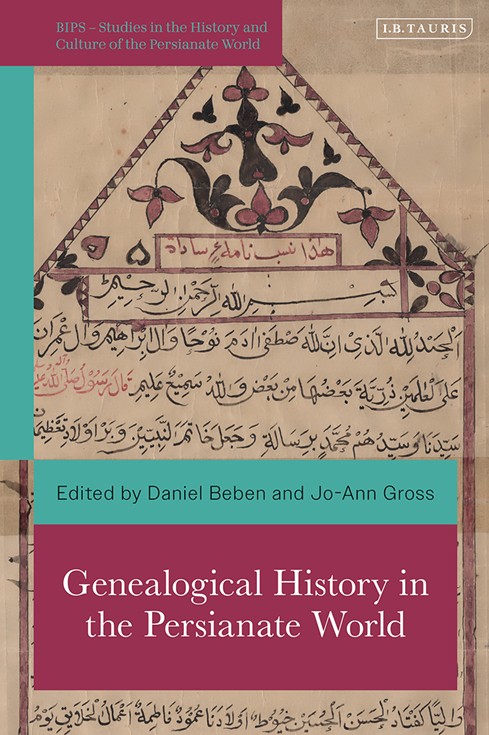
BIPS: studies in the history and culture of the Persianate world Genealogical history in the Persianate world
Size
320 pages, hardcover
Language
English
Released
July 24, 2025
ISBN
9780755649792
Published by
I.B. Tauris
Book Info
Misc.
English, Persian
Japanese Page
This volume explores how genealogical records were constructed and functioned socially across the “Persianate world,” which spanned Central Asia, South Asia, and the Persian Gulf. Although genealogical documentation is an important category of historical sources, differing in nature from narrative histories such as chronicles, research into its role in societies where Persian was the common language of culture and administration has been limited compared to studies of the Arab world. This book aims to address this gap by presenting unstudied primary sources from the 14th to 20th centuries, alongside the outcomes of extensive fieldwork.
Genealogy is far more than a mere record of biological descent. It can serve as a claim to identity, a basis for political legitimacy, and a means of maintaining economic interests and social privileges. Through specific case studies from various regions, the book illustrates how nasab (lineage) has been positioned at the center of social discourse and reconstructed according to shifting social contexts.
The eight case-study chapters cover a multifaceted range of research topics. These include the strategic rewriting of genealogies in response to changing missionary activities in Badakhshan (Chapter 1, Beben), the formation of “common ancestor” traditions to strengthen military alliances between Afghans and Balochis (Chapter 2, AlMaazmi), and the reconstruction of regional connections across modern national borders through the analysis of historical documents (Chapter 3, Gross). Each case study illustrates how genealogy functions as social capital. Furthermore, studies on the assertion of economic rights by prominent families in 16th-century Bukhara (Chapter 4, Schwarz) and the redefinition of identity in response to political shifts in the Persian Gulf (Chapter 5, Onley) show that genealogical practice is an ongoing contemporary phenomenon.
The final three chapters explore the relationship between genealogy and Sufi (Islamic mystical) traditions. The studies in these chapters discuss how sacred authority was codified in the form of genealogies and shared among communities. They focus on the transmission of spiritual legitimacy within the Naqshbandi order (Chapter 6, DeWeese); the construction of hagiographies linked to the sanctification of cities (Chapter 7, Ziad); and the infiltration of the title “Khawaja” — a status akin to “Sayyid” (a descendant of the Prophet) — into the 19th-century Ferghana Valley (Chapter 8, Kawahara).
The spatial and temporal breadth of this volume reflects the profound depth of the Persianate world. By exploring how to handle sources rooted in everyday life and society, and how to extract the nuances of regional history often overlooked in macrohistorical narratives, this book showcases the rich potential of genealogical materials. It provides an engaging case study for individuals interested in history and regional studies, with applications that extend well beyond the specific framework of the Persianate world.
(Written by KAWAHARA Yayoi, Associate Professor, The University of Tokyo Library System / 2026)
Table of Contents
Part I: Genealogy, Translocality, and Narratives of Origin in Early Modern Persianate Societies
1 Beyond Sayyid-hood: genealogy and narrative in the Nasab-nāma of Malik Jahānshāh and the Ismā'īlītradition of Badakhshān / Daniel Beben
2 Solomon's shadow: the politics and poetics of Baloch genealogical traditions / Ahmed Y. AlMaazmi
3 The Nasab-nāmas of Zībāk: connectivity between sacred lineage and conversion from Zībāk to Hunza / Jo-Ann Gross
Part II: Genealogy as Discourse and Praxis
4 The Sāmānid file: embedding genealogy in 16th-century Bukhara / Florian Schwarz
5 Crossing the Arab/Persian divide in the Gulf: Persianized Arabs, Arabized Persians, and the politics of Persianness / James Onley
6 An Aḥrārī genealogical compilation spanning the sixteenth, seventeenth, and eighteenth centuries / Devin DeWeese
7 Where genealogies of texts meet genealogies of saints: concretizing ImāmīSunni Sufism and female leadership in the Afghan Mujaddidīlineage / Waleed Ziad
8 Sacred genealogies of Khwājas in the Ferghana Valley of the 19th century / Yayoi Kawahara
Index
Related Info
“While ancestry and lineage were fundamental preoccupations of Persianate societies, generating a mass of documentation in many different genres, such sources have rarely been analyzed in a systematic way that places nasab at the center of discussion. This agenda-setting volume finally does so, combining fascinating case studies from Hunza, Badakhshan, Bukhara,Fergana, Balochistan, the Gulf, and Qandahar.” ―Nile Green, Ibn Khaldun Endowed Chair in World History, UCLA
“Through insightful empirical studies spanning diverse milieus-from the towering heights of the Pamirs to the blue waters of the Persian Gulf, this volume highlights the rich potential of genealogical materials for advancing historical studies of the Persianate world and beyond. A must-read for scholars engaging with Persianate and Islamicate genealogical literature.” ―Kazuo Morimoto, Professor, University of Tokyo, Japan
“Jo-Ann Gross and Daniel Beben have made a major contribution to Persianate historiography by bringing together scholarship on the role genealogy has played in embedding the past in the present while claiming for it a timeless validity. The studies in this volume provide a comprehensive view across the Persianate world-from the Persian Gulf in the west to Central Asia in the north and northern India in the east-of how genealogy was wielded and manipulated to create social capital.” ―R.D. McChesney, author of An Afghan Prince in Victorian England: Race, Class and Gender in an Afghan-Anglo Imperial Encounter