

 Find a book


Title
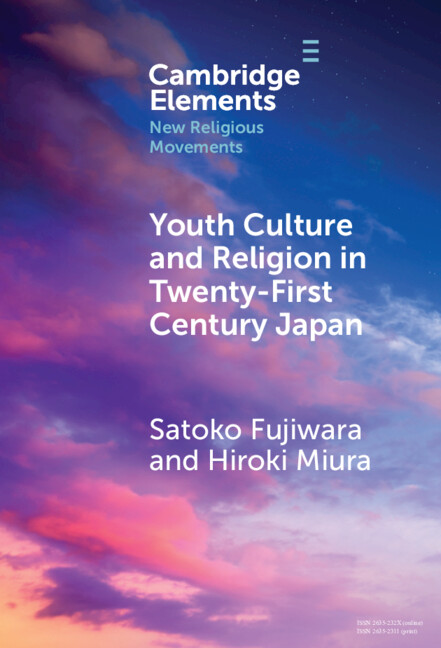
Cambridge Elements, New Religious Movements Youth Culture and Religion in Twenty-First Century Japan From Hyper-Real to 2.5-Dimensional Religion
Size
72 pages, hardcover
Language
Japanese
Released
January, 2026
ISBN
9781009550260
Published by
Cambridge University Press
Book Info
Japanese Page
Visitors to the University of Tokyo are sometimes surprised to find that relatively few courses focus directly on Japanese youth and popular culture, which was once broadly referred to as otaku culture or sabu-karu and centered on manga, anime, gaming, and idol fandom. This book was written partly in response to that gap. It offers an original analysis of contemporary fandom-based practices such as oshi-katsu, which is now a widespread social phenomenon, along with well-known topics such as anime pilgrimages and gaming culture.
The book grew out of a series of five “Religious Studies Seminars” for undergraduates held at the University of Tokyo between 2012 and 2024. It was coauthored by an instructor who designed and taught these seminars (Fujiwara) and one of the students who participated in them (Miura). Each year, the seminar began with a simple but challenging question posed to the students:
If formal religious organizations and established spiritual cultures feel distant or irrelevant to your generation, what then is the nature of your religiosity as part of Generation Z? If it is neither “religious” nor “spiritual,” how would you describe it?
At the beginning of the twenty-first century, sociologist Adam Possamai described the “hyper-real religions” of Generation X as quasi-religious formations based on fictional universes such as Star Wars (Jediism) or the Church of the Flying Spaghetti Monster. This was understood through Baudrillard’s theory of hyperreality.
Our findings indicate that Generation Z in Japan engages in different forms of quasi-religiosity. Fiction-based invented religions certainly exist in Japan, but they do not exhaust the ways in which young people form affective, ritualized, or devotional attachments.
During the seminars, we first used the provisional term “post-spirituality” to capture what seemed to go beyond Possamai’s “hyper-real religion,” but we soon found a more suitable and substantial concept: “2.5-dimensional religion.”
In Japanese youth-culture contexts, “2.5-dimensional” typically refers to stage musicals in which human actors (3D) perform characters from anime or manga (2D). This in-between space—neither purely fictional nor entirely real—mirrors the modes of engagement seen in today’s XR (virtual, mixed, and augmented-reality) environments. We therefore use “2.5-dimensional religion” to describe emergent practices that occupy a similar boundary zone.
A well-known example is the vocaloid Hatsune Miku, whose existence is not based on a pre-existing narrative universe (unlike Jediism) but on a composite of “moe-elements,” technological mediation, and participatory creativity. Her presence blurs the line between the imaginary and the real in ways that are characteristic of contemporary youth culture.
While some scholars have described otaku culture as “religion-like,” such framing often relies on conventional religious categories such as devotion, collective effervescence, and charisma.
Our approach reverses the direction of analysis. Instead of asking whether otaku culture is religious, we ask whether there are new phenomena in religious or spiritual settings that share characteristics with otaku culture.
Across the seminars and subsequent research, we identified six characteristics that recur in both ostensibly religious-spiritual and non-religious contexts: Practicing belonging, Vicarious spirituality, Gendered fetishism, Parody of religion, The 2.5-dimensional mode of engagement, Subjective ritualization. Our earlier article examined the first three; this book provides an extended analysis of the latter.
Overall, this book proposes a new analytical framework for understanding religion across cultures in an era marked by fragmented identities, technological mediation, and the search for connections through affectively charged and often playful quasi-religious practices. It offers a perspective grounded in both empirical observations and theoretical reflections emerging directly from over a decade of teaching and collaborative inquiries at the University of Tokyo.
(Written by FUJIWARA Satoko, Professor, Graduate School of Humanities and Sociology / 2026)
Table of Contents
Six Aspects of Contemporary Japanese Youth Religiosity
2 From Hyper-Real to 2.5-Dimensional
From the Era of Fictionality to the Era of Virtuality
2.5-Dimensional
The 2.5-Dimensional Characteristics of Tulpas
“Phantom Body” in “Digital Nature”
3 From Subjective Myths to Subjective Ritualization
Rituals that Make Oshi Real in Oshi-Katsu
Tulpa Practice as a Ritual of Real-Making
Rituals in Gaming Culture
Anime Pilgrimage
4 Conclusion
References
Related Info
Practicing belonging, vicarious spirituality, and gendered fetishism: The transformation of the non-religious/religious in contemporary Japanese youth culture (Social Compass Volume 71, Issue 2, p.212-235 June 22, 2024)
https://doi.org/10.1177/00377686241260494