

 Find a book


Title
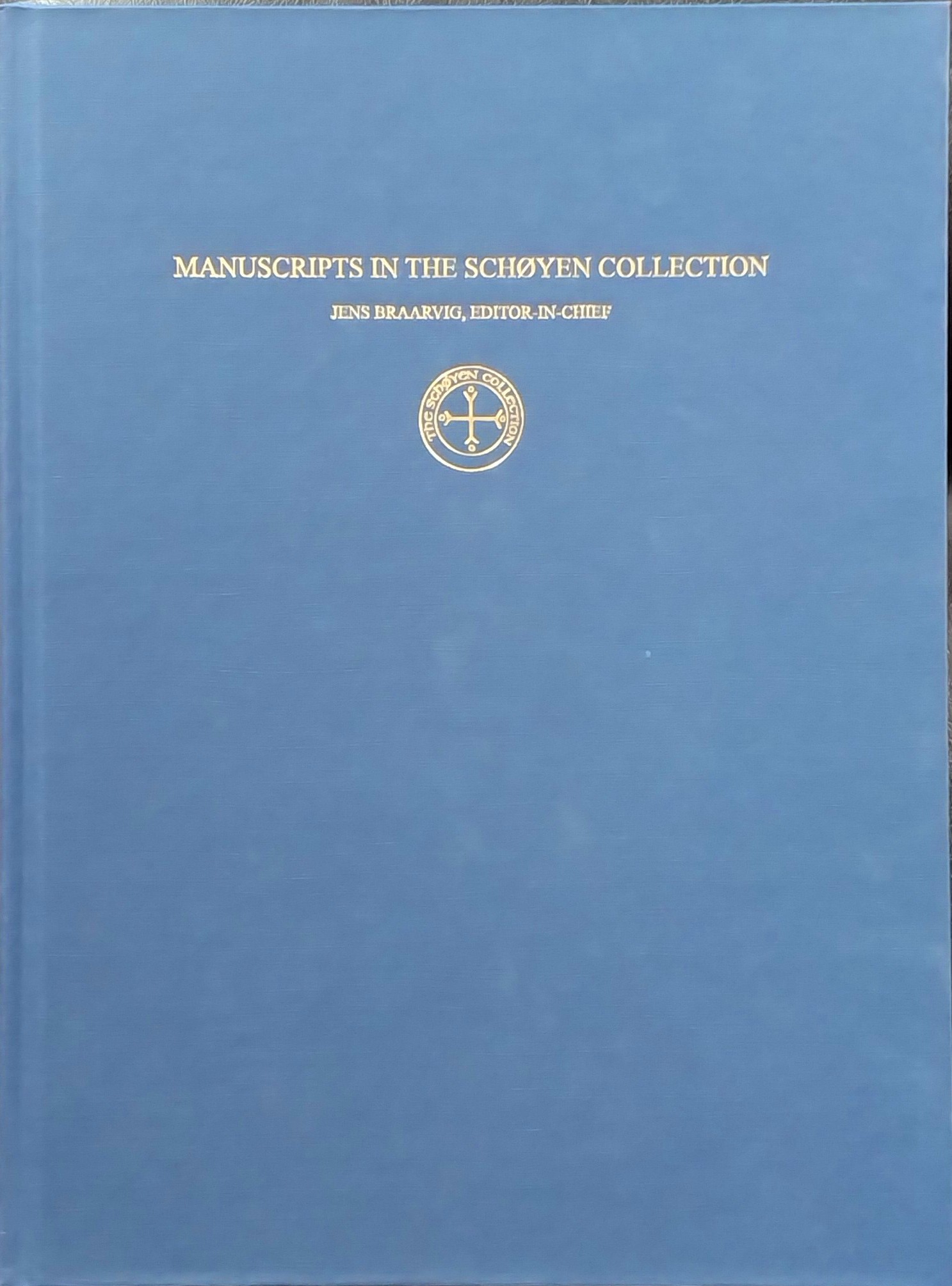
Manuscripts in the Schøyen Collection: Buddhist Manuscripts V The Bhaiṣajyavastu of the Mūlasarvāstivāda Vinaya
Size
467 pages
Language
English
Released
2025
ISBN
978-82-8034-205-8
Published by
Hermes Publishing
Book Info
See Book Availability at Library
Japanese Page
 eBook
eBook
This book introduces a manuscript copied somewhere in the region ranging from present-day Pakistan to eastern Afghanistan sometime between the late seventh and eighth centuries.
Vinaya is a genre of Indian Buddhist scripture concerning monastic law. Apart from regulations for monks and nuns, it also includes various contents such as stories explaining the circumstances behind the establishment of regulations, thus revealing how the Buddhist monastic system worked, and what contemporary Indian society was like. Furthermore, vinaya is also an important source for the history of Indian literature. This book examines a manuscript that represents the “Chapter of Medicines” of a vinaya transmitted by a Buddhist school called Mūlasarvāstivāda. While this vinaya is preserved in Chinese and Tibetan translations, the original Sanskrit text survives only partially. Although the Chapter of Medicines belongs to the surviving portion, approximately half of the entire chapter has been lost due to damage to the Sanskrit manuscript excavated in the 1930s, which had been considered the sole Sanskrit manuscript of the chapter for decades.
At the end of the twentieth century, another Sanskrit manuscript was identified with the Chapter of Medicines. Written in a script called Gilgit/Bamiyan Type II, the manuscript seems to have originally consisted of 205 birch bark folios. It has come down to us in such a fragmentary state, each fragment ranging from those measuring 20 cm wide to extremely small ones measuring less than 1 cm square, that not a single complete line survives. Nevertheless, the manuscript provides invaluable text that fills the gaps in the other manuscript, thereby enabling us to identify clues about the originals used by the Chinese and Tibetan translators.
The book consists of an introductory section, transliterations of the manuscript fragments, reconstructed text, concordances of fragment numbers, bibliography, and plates. The introductory section outlines the research history, describes the present state of the manuscript and characteristics of its style and structure, and analyzes the text through comparison with other existing materials. The text reconstructed based on transliterations in the Roman alphabet is presented alongside the previously known Sanskrit manuscript, Chinese translation, and Tibetan translation in a comparative edition. In the plates section, 92 incomplete folios are reconstructed from 509 surviving fragments.
With its rich contents, the Mūlasarvāstivāda Vinaya has attracted modern scholars’ attention for nearly two centuries. Despite significant progress in research on this vinaya, especially in the past three decades, many sections remain under study, and many details are still unclear. This book will serve as a foundational material for future studies on the vinaya and the culture and history of ancient Indian Buddhism.
(Written by YAO Fumi, Associate Professor, Graduate School of Humanities and Sociology / 2026)
Table of Contents
CONVENTIONS
ABBREVIATIONS
Acknowledgements
Introduction
1.1. Research History and Present State of the Schøyen-Virginia Manuscript of the Bhaiṣajyavastu
1.1.1. Overview
1.1.2. A Brief History of Research on the Bhaiṣajyavastu Fragments
1.1.3. Scans and Photographs of the Manuscript Fragments Used in the Present Volume
1.1.4. Labeling of Images and Fragments
1.1.5. Folio Numbers
1.1.6. Physical Sequence of Folios
1.2. Formal Features of the Manuscript
1.2.1. Radiocarbon Dating
1.2.2. General Format and Quality of the Text
1.2.3. Script
1.2.4. Orthography
1.2.5. Folio Numbering and Combination with the Uttaragrantha
1.3. Comparison with Other Extant Versions of the Bhaiṣajyavastu
1.3.1. Comparison of Narrative Structures
1.3.1.1. Discrepancies in the Abbreviation of a Sūtra
1.3.1.2. Discrepancy in the Order of Episodes
1.3.1.3. Other Examples of Agreement and Disagreement
1.3.2. Comparison of Stock Phrases and Repetitive Passages
1.3.3. Comparison of Words, Phrases, and Sentences
1.3.4. Concluding Remarks
Texts
2.1. Transliterations
2.2. Reconstructions
1. “Vaiśālī” of the Third Uddāna
2. Sections of the Fourth Uddāna
3. “Hungry Ghosts” of the Eighth Uddāna
4. Sections of the Ninth Uddāna: “Sāketā” (The Story of King Māndhātṛ), “Rice Soup,” “Toyikā,” “Śrāvastī” (The Story of a Leprous Beggar Woman’s Offering)
5. The Buddha’s Former Life Stories Narrated for King Prasenajit
6. The Question of Ānanda or Section of Many Buddhas
7. The Stories Related to the Anavataptagāthā
8. Verses of Lake Anavatapta (Anavataptagāthā)
9. The Remaining Sections of the Ninth Uddāna
10. Sections of the Tenth Uddāna: “The Sick,” “Foods,” “Breakfast,” “Leftovers,” “Fruits Growing in the Forest,” “Lotus,” “Lotus Roots,” “Miṇḍaka”
11. Sections of the Eleventh Uddāna: “The Drink Offered by Kaineya Was Received,” “The Town of Kāśi, Barley Porridge,” “Khādyaka in Pāpā,” “Doubts,” “Foul Foods”
Concordances
3.1. Concordances of Image Labels and Folio Numbers
3.1.1. Schøyen Collection
3.1.2. Private Collection, Virginia
3.2. Concordance of the folios and other extant Mūlasarvāstivāda Vinaya materials
3.3. Concordance of the verses of the Anavataptagāthā
Appendix: Verses from the Jyotiṣka section of the Anavataptagāthās in a palm-leaf manuscript (Gudrun Melzer)
BIBLIOGRAPHY
PLATES
Related Info
Buddhist Manuscripts in the Schøyen Collection (V) (HERMES ACADEMIC PUBLISHING)
https://www.hermesbooks.no/bmsc-v
Awards:
The author’s studies on sutras embedded in the Mulasarvastivada Vinaya, including this book, was awarded JSPS Prize 2025 (Japan Society for the Promotion of Science 2025)
https://www.jsps.go.jp/english/e-jsps-prize/awards.html
The 22nd Award Ceremony of the Japan Academy Medal (The Japan Academy 2025)
https://www.japan-acad.go.jp/en/news/2026/040101.html