


 Find a book


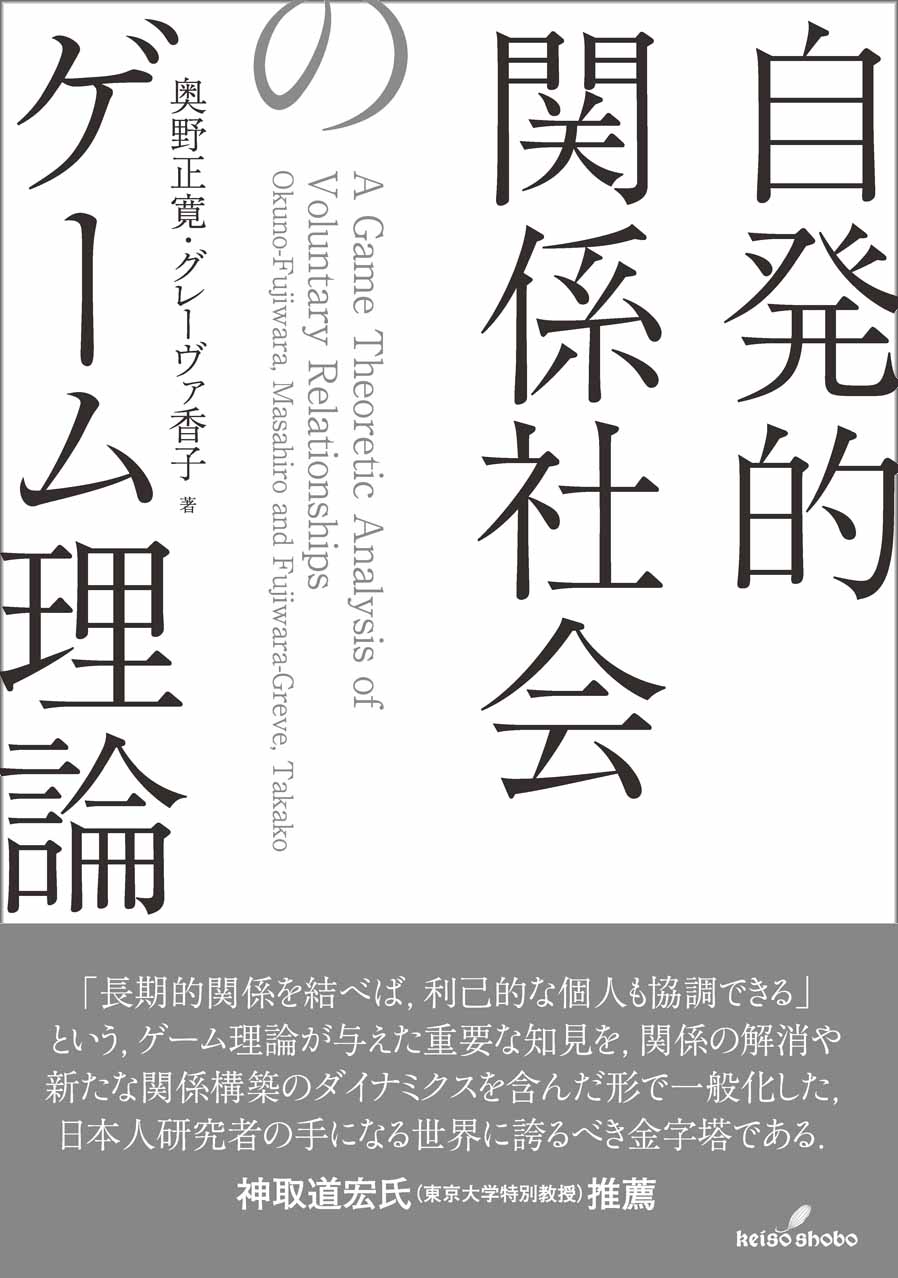
Title
Jihatuteki Kankei Shakai no Game Riron (A Game Theoretic Analysis of Voluntary Relationships)
Size
256 pages, A5 format
Language
Japanese
Released
August, 2025
ISBN
978-4-326-50515-9
Published by
Keiso Shobo
Book Info
See Book Availability at Library
Japanese Page
 eBook
eBook
This book studies modern society as an evolutionary dynamic game (hereafter referred to as the "VSRPD society"), where an infinite number of individuals are paired to play a component game called the "Voluntarily Separable Repeated Prisoner’s Dilemma (VSRPD)." The VSRPD is a dynamic game in which two players, randomly matched from a matching pool (MP), play the Prisoner’s Dilemma (PD) in each period for as long as they remain a pair. At the end of each period, based on the period’s PD outcome, players choose whether to continue the partnership in the following period or to leave the pair to seek a new partner in the MP at the start of the next period.
Authors analyze the stationary equilibria of such a dynamic society. Among various equilibrium classes, they focus on the following two. The first is the trust-building equilibrium, where all members of society play the same T-period trust-building strategy (cT). The sT is an intolerant strategy: "play Defection (D) for the first Τ periods and continue the pair only if the opponent also plays D; from period Τ+1 onwards, play Cooperation (C) and continue the pair only if the opponent also plays C." If the discount factor (δ) exceeds a certain threshold, there exists a Τ*≥1 such that for any Τ satisfying Τ≥Τ*, an evolutionarily stable equilibrium exists where all members of society play cT. However, in a society with an infinite number of population, it is difficult to assume that everyone commits to the same trust-building period Τ.
Authors discovered another (temporary) equilibrium Pcd where two opposing strategies coexist. One is the 0-period trust-building strategy (c0), which plays C and maintains the partnership as long as the opponent continues to play C. The other is the d0, which plays D for the duration of the pair and dissolves the partnership at the end of each period regardless of the opponent's actions. If δ exceeds a certain threshold, there exists a locally internally stable equilibrium Pcd where only c0 and d0 exist, and the proportion of c0 in the MP is α(δ)∊(0,1). Here, "locally internally stable" implies that the existing strategy proportions are locally stable.
The equilibrium Pcd is evolutionarily unstable because it is susceptible to invasion by the T-period tolerant strategy (𝑐̃Τ), which displaces both c0 and d0. Here, 𝑐̃Τ is defined as a strategy that adopts "tolerant behavior"—playing D for Τ periods and choosing to maintain the partnership regardless of the outcome, and if the opponent also exhibits tolerant behavior for Τ periods, 𝑐̃Τ adopts c0 as its continuation strategy from period Τ+1 onwards. On the other hand, define strategy d̃Τ as a strategy which plays the continuation strategy d0, after following T periods of tolerant behavior. Then as long as the Pcd equilibrium exists, for any T there exists a tolerant equilibrium in which 𝑐̃Τ and d̃Τ exist in a ratio of α(δ) to 1 - α(δ).
In the final chapter, we consider a society that employs cheap-talk communication at the start of the component game. We analyze the disequilibrium path starting from Pcd under plausible evolutionary dynamics, following the invasion of c0 that uses a neologism. We show that while the population of c0that uses a neologism initially increases along this path, d0 that uses the same neologism eventually invades, and society ultimately returns to Pcd that utilizes the neologism.
(Written by OKUNO-FUJIWARA Masahiro, Professor Emeritus, Graduate School of Economics / 2025)