

 Find a book


Title
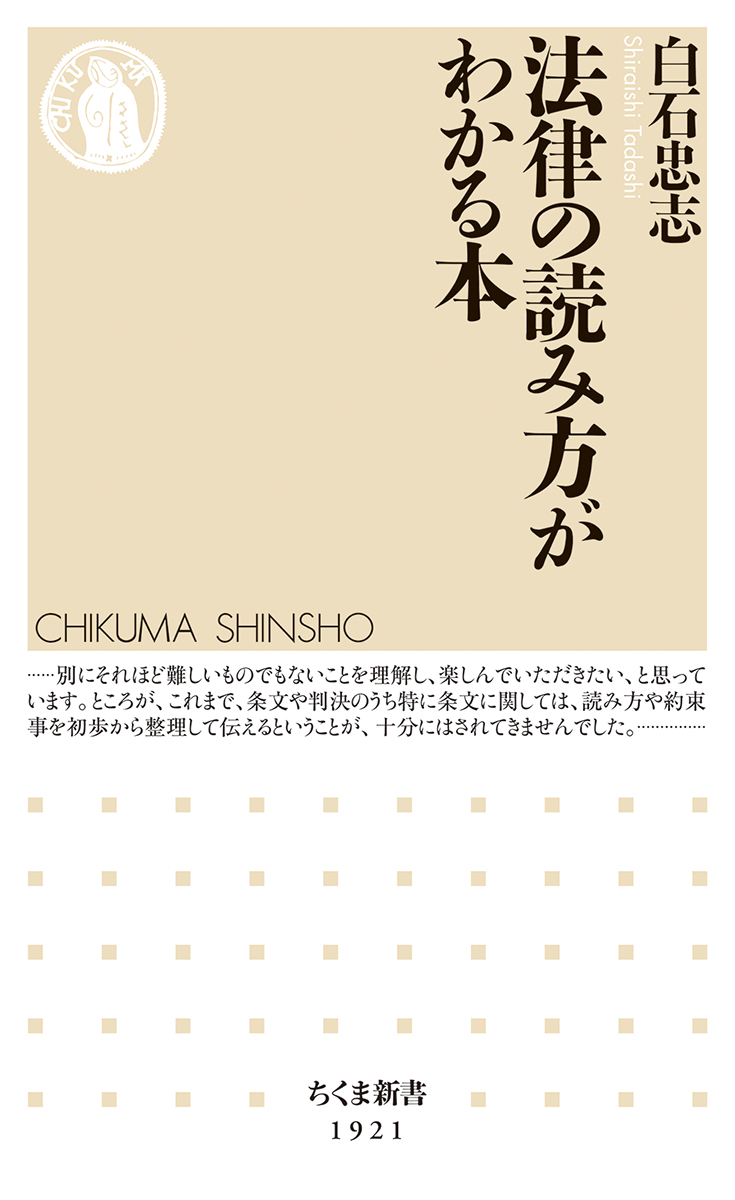
CHIKUMA SHINSHO 1921 Hōritsu No Yomikata Ga Wakaru Hon (Reading Japanese Statutes and Judgments: An Introduction)
Size
304 pages, paperback pocket edition
Language
Japanese
Released
June 08, 2026
ISBN
978-4-480-07750-9
Published by
Chikumashobo Ltd.
Book Info
See Book Availability at Library
Japanese Page
Suppose you find yourself drawn into the field that goes by names such as "law," "legal affairs," "regulation," or "legal studies." How do you build, from the very beginning, the ability to read actual statutory provisions and actual court judgments — and how do you turn that ability into a tool that lets you walk freely through whatever legal area you happen to enter? I wrote this book with that situation in mind.
Statutory provisions and judgments are not difficult things. They are written in ordinary, present-day Japanese. There are, to be sure, a few conventions to learn. But surely every specialized field has its share of conventions. What this book does is set out those few conventions for reading provisions and judgments, in an organized way and with concrete examples.
And yet, up to now — particularly in the case of statutory provisions — the work of explaining how to read them, and of laying out their conventions from the ground up, has not been done enough.
It cannot be denied that there has been a tendency to look down on such matters as low-grade, miscellaneous knowledge. Some suitable-looking book is recommended, everyone is presumed to have read it and absorbed its contents, and the discussion moves on without further explanation.
There is another factor as well. The foundational subjects that come early in a law curriculum are, in most cases, built on the premise that existing provisions will remain as they are, and they concentrate on the task of applying those provisions to individual cases. That task is essential to society and genuinely important. But the flip side is that attention to changing an institution, or to rewriting a provision, tends to remain low.
The professionals who write statutory text themselves are found in the secretariats of the Diet, and in large numbers throughout national and local government administration. At the national level, the majority of statutes enacted originate as bills submitted by the Cabinet, which means the bills are written by national government officials. Local governments employ many people who draft and maintain the text of the ordinances and regulations used by their own body, working with an eye on the provisions produced at the national level.
On the side of legal education, however, the central preoccupation is the application of existing provisions to individual cases — and this has opened up a distance between legal education and the professionals who draft provisions themselves.
The explanatory works written by those drafting professionals, meanwhile, tend to focus on the advanced techniques demanded by their day-to-day practice. Books that concentrate instead on the basic knowledge a newcomer actually needs do not appear to be especially numerous.
This book grows out of these concerns about the structure of legal education in Japan — about the way law is taught. Following the structure set out in the table of contents, it aims to bring readers to the point where they can read statutory provisions and judgments for themselves.
(Written by SHIRAISHI Tadashi, Professor, Graduate Schools for Law and Politics / 2026)