


 Find a book


Title
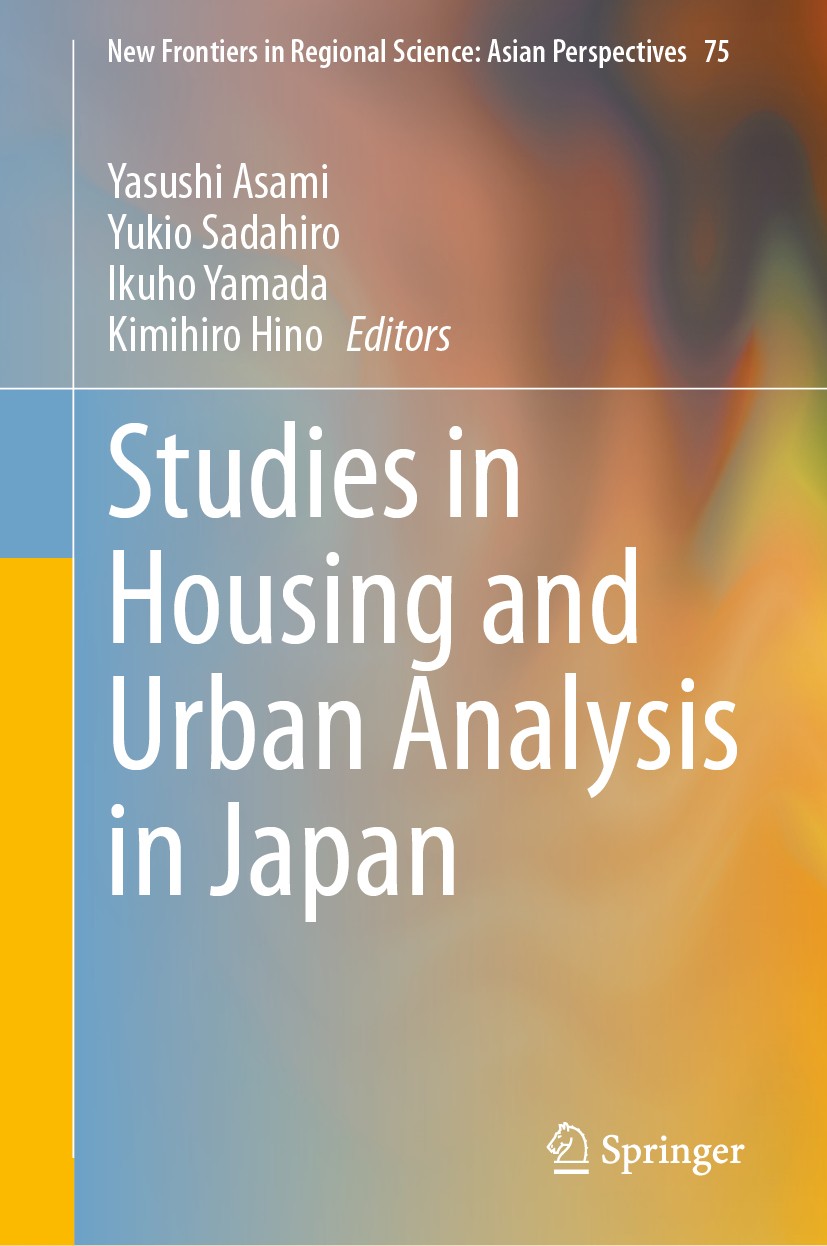
New Frontiers in Regional Science: Asian Perspectives 75 Studies in Housing and Urban Analysis in Japan
Size
287 pages, hardcover
Language
English
Released
March 07, 2024
ISBN
978-981-99-8026-0
Published by
Springer Singapore
Book Info
See Book Availability at Library
Japanese Page
 eBook
This book contains a collection of papers originally published in Japanese, by researchers closely associated with the Laboratory of Housing and Urban Analysis, Department of Urban Engineering, Graduate School of Engineering, The University of Tokyo. The papers have been translated into English, and compiled into a single volume on the occasion of Professor Yasushi Asami’s retirement from the University of Tokyo. The book provides an overview of the laboratory's research activities, which have long focused on housing and residential environment studies, and urban analysis. Although the individual papers were conducted as independent studies, they shared a common approach: examining urban phenomena quantitatively and spatially, and analyzing them using data and theory.
The origins of the Laboratory of Housing and Urban Analysis can be traced back to the Third Chair of Urban Planning, established in 1962 in the Department of Urban Engineering, Faculty of Engineering, The University of Tokyo. Initially, the laboratory focused on the spatial configuration of residential areas and housing issues. Over time, it expanded its research scope by incorporating quantitative methods for urban analysis, and theoretical and empirical approaches to spatial analysis. Professor Yasushi Asami further developed this line of research by bridging urban planning and urban economics, thereby linking studies of housing and residential environments with the methodology of urban analysis. This book builds on this long accumulation of research in the laboratory.
The book consists of two parts: Part I: “Housing Analysis,” and Part II: “Urban Analysis.” The first part addresses concrete issues related to housing and residential life, including the resale detached housing market, the rebuilding of old condominiums, the evaluation of living environments in residential choice, social participation and store accessibility among older adults, residential burglary, and the installation of photovoltaic panels in residential areas. Housing is a special good; it is expensive, used over a long period, and is highly heterogeneous, with no two houses being exactly alike. For this reason, analyzing housing means more than examining buildings and land. It also requires a comprehensive understanding of people’s lives, neighborhood safety, the environment, and institutions.
The second part contains methodological developments and applied studies for analyzing cities, including time-space mapping, estimation of building location, multicollinearity in hedonic analysis, relationships between building setback, plot frontage, plot depth, and building density, visualization of the growth of commercial agglomerations, and the selection of public transport systems in relation to urban density and travel distance. These studies do not merely seek to intuitively describe urban form and activity, but also to present them in a verifiable manner using spatial data, statistical models, visualization, and theoretical analysis.
Housing and cities are complex subjects in which economic markets, demographic structures, transport, the environment, safety, and everyday life overlap. Through this book, readers can gain an understanding of the breadth of housing and urban analysis research in Japan, while also encountering an analytical perspective that cuts across urban planning, housing policy, spatial information science, and regional studies. This book offers a foundation to better understand housing and cities, and to connect this understanding to future policy and planning.
(Written by HINO Kimihiro, Professor, School of Engineering / 2026)
Table of Contents
1. Demand–Supply Relationship in the Resale Housing Market in the Suburbs of Tokyo (Masatomo Suzuki, Yasushi Asami)
2. Old Condominiums and Their Tendency to Be Rebuilt: A Case Study of the Tokyo Metropolitan Area (Hiroki Baba, Chihiro Shimizu, Yasushi Asami)
3. Significance of “Living Environment Score” in Quantifying Attractiveness of Regions During Residence Selection (Hisatoshi Ai)
4. Relationship Between Participation of Older Adults in Hobby Clubs and Sports Groups and Density of Neighborhood Facilities: A Case of Nagoya City Using JAGES Panel Data (Hongjik Kim, Kimihiro Hino, Hiroyuki Usui, Masamichi Hanazato, Daisuke Takagi, Naoki Kondo et al.)
5. Environmental Factors Causing Inconvenience of Store Accessibility for Older Adults in Tokyo: Objective Indicators of Road Environments for Estimating People’s Inconvenience (Tatsuya Sekiguchi)
6. Relationship Between Crime Rate of Residential Burglary and Local Context (Kimihiro Hino, Takaya Kojima)
7. A Spatial Analysis of the Effects of Neighborhood Socio-economic Status on Residential Burglaries in Tokyo: Focusing on the Spatial Heterogeneity and the Interactions with Built Environment (Masaya Uesugi, Kimihiro Hino)
8. Factors Affecting Installation of Residential Photovoltaics in Housing Estates in Kakegawa City, Shizuoka: Focusing on Housing and Surrounding Environment Characteristics (Yuki Okazawa, Kimihiro Hino, Yasushi Asami)
Part II Urban Analysis
9. Statistical Multi-dimensional Scaling with a Geographical Penalty (Hayato Nishi, Yasushi Asami)
10. Factors that Influence Estimation of Building Location in City Blocks in Tokyo Commercial Zones (Masahiro Taima, Yasushi Asami, Kimihiro Hino, Wataru Morioka)
11. A Diagnostic Approach to the Multicollinearity Problem for Better Model Selection in the Hedonic Pricing Method (Yuki Hiruta, Yasushi Asami)
12. Theoretical Relationships Between Building Setback, Plot Frontage, and Plot Depth in Terms of Road and Building Densities (Hiroyuki Usui, Yasushi Asami)
13. A Method of Visual Analytics and Data Visualization in Design Context: Case Study of Spatiotemporal Data Visualization of Urban Retail Agglomeration Growth (Akiyoshi Inasaka)
14. Theoretical Approach for Selection of Public Transport System Considering Urban Density and Travel Distance (Daisuke Hasegawa, Tsutomu Suzuki)
Related Info
The Japan Section of the Regional Science Association International Book Award (JSRSAI October 2025)
http://jsrsai.jp/en/