


 Find a book


Title
Curating the Prehistoric Past Studies on West Asian Archaeology and Beyond in Honour of Yoshihiro Nishiaki
Size
404 pages, 297x210mm, hardcover
Language
English
Released
March, 2026
ISBN
9781805832577
Published by
Archaeopress Publishing Ltd
Book Info
Japanese Page
 eBook
This volume presents a collection of research papers on the archaeology of West Asia (the Near and Middle East). The title Prehistoric Past refers to periods preceding written records. In prehistoric archaeology, where textual evidence is absent, scholars reconstruct ancient cultures, technologies, daily lives, and social structures by analyzing architectural remains and artifacts such as stone tools, pottery, and floral and faunal remains. At the University of Tokyo, West Asian prehistoric archaeology has been practiced and advanced for 70 years, and this book represents its current achievement.
Following World War II, the University of Tokyo organized the "Tokyo University Iraq-Iran Archaeological Expedition" as the first large-scale overseas project in Japan, investigating ancient village sites in the "Fertile Crescent" and cultural exchange routes between East and West Asia. The vast collection gathered through these excavations is housed at The University Museum, The University of Tokyo (UMUT), with catalogs made publicly available online (https://umdb.um.u-tokyo.ac.jp/DKoukoga/). Outstanding in both quantity and quality, these materials serve student education and global researchers, making the museum an international research hub. The papers in this book are authored by scholars actively involved in these activities.
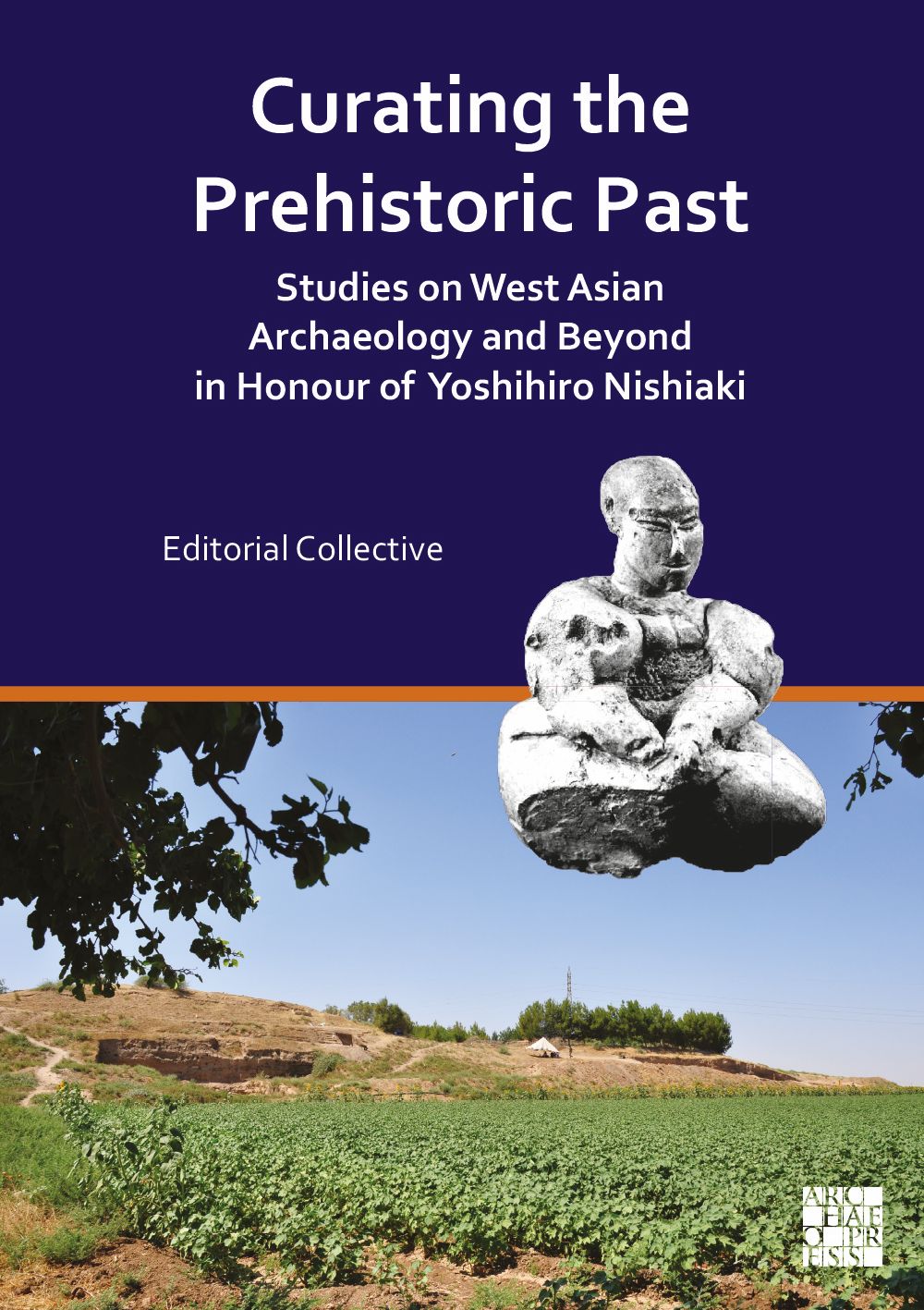
A common thread uniting the authors and editors is their research and educational connection to Professor Yoshihiro Nishiaki, who served as the director of UMUT until last academic year. The cover photograph features a Neolithic farming village in Syria excavated by Professor Nishiaki, alongside a female clay figurine found there. Over three decades, Professor Nishiaki has directed field excavations, managed the museum's vast collections, provided research opportunities for students and young scholars, and built a broad international, interdisciplinary network.
This wide scope is reflected in the diversity of this volume. Chronologically, the studies span the Paleolithic, Neolithic, Chalcolithic, Bronze, and Iron Ages. Their subjects cover lithics, pottery, shell ornaments, faunal and floral remains, architecture, burial mounds, and archaeological database. Geographically, while centered on Mesopotamia, the Levant, the Zagros, and Iran, the coverage extends to the Caucasus, the Persian Gulf, Central Asia, and the Japanese archipelago.
Due to increasing academic specialization and subdivision, it has become difficult for individual researchers to cover vast space-time scales and diverse material evidence. However, UMUT maintains a wide range of collection supporting broad research and provides an ideal environment for students and scholars to further their various research activities. The title Curating the Prehistoric Past reflects our belief that long-term curation of such a museum-based research environment is vital to clarifying humanity's past.
For students in the Junior Division, reading these technical English papers may seem challenging initially. However, elevating and innovating the quality of research through such international communication and interactions is the true appeal and strength of this field. If you are interested, we encourage you to utilize the museum's rich collections and environment to deepen your knowledge. The authors of this book once followed the same path and are now active on the front lines of international research.
(Written by KADOWAKI Seiji, Professor, The University Museum / 2026)
Table of Contents
Selected Publications by Professor Yoshihiro Nishiaki
Chapter 1 From Syria to Azerbaijan, a long collaboration with Y. Nishiaki
Bertille Lyonnet
Chapter 2 Highlights and memories of research activities by Professor Nishiaki
Masashi Abe, Takehiro Miki, Seiji Kadowaki, Saiji Arai and Miho Suzuki
Part II: Paleolithic and the Transition to the Neolithic
Chapter 3 Documenting and protecting Paleolithic heritage in the Afrin Valley, Aleppo, in times of conflict
Youssef Kanjou and Mustafa Al Najjar
Chapter 4 Variability in Middle Palaeolithic predatory strategy across Southwest Asia and beyond
Saiji Arai
Chapter 5 An application of PaleoAsia DB to the ecological niche comparison between the Middle and Upper Palaeolithic stone tool groups in the Eastern Hemisphere
Yasuhisa Kondo
Chapter 6 Carinated pieces in the Wadi Kharar area, northern inland Syria: An updated perspective on Upper Paleolithic technology in the northeastern Levant
Seiji Kadowaki
Chapter 7 Space as metaphor: The evolution from round to rectangular buildings in the Epipalaeolithic and Neolithic of the Near East
Marc Verhoeven
Part III: Prehistory of Mesopotamia and the Zagros
Chapter 8 Tracing the origins of architectural specialisation in early Mesopotamia (7th–5th Millennia BCE)
Emmanuel Baudouin
Chapter 9 Human figurines from Tell Kashkashok I, Halafian site on the Upper Khabur River Basin, Northeast Syria
Makoto Arimura
Chapter 10 Samarra pottery in the “west”: A perspective from the collection in the National Museum of Aleppo, Syria
Takahiro Odaka
Chapter 11 Corner-thinned blades and side-blow blade-flakes from Shakar Tepe and Shaikh Marif, Pottery Neolithic sites in Iraqi Kurdistan
Osamu Maeda
Chapter 12 Figurines and other clay objects of Jarmo: Material culture and symbolic practice in the Neolithic Zagros
Sari Jammo
Part IV: Prehistory of Iran
Chapter 13 At the end of the Jari: Neolithic pottery from Tall-e Jari B, Fars, southern Iran
Takehiro Miki
Chapter 14 Local luster and exotic beads: Neolithic and Chalcolithic shell finds from the Marv Dasht plain in Iran
Sofie Debruyne
Chapter 15 Shogha/Taimuran pottery collection at the University of Tokyo Museum
Mohammad Hossein Azizi Kharanaghi
Chapter 16 Animal exploitation in the Elamite settlement of Tol-e Qaleh in the Marvdasht Plain (Fars-Iran)
Hossein Davoudi, Marjan Mashkour, Homa Fathi and Fazlollah Habibi
Chapter 17 Ending of a painted pottery: Classification, typology, and chronology of Caspian black on red ware
Yui Arimatsu
Part V: Prehistory in the Caucasus and Beyond
Chapter 18 Beyond everyday know-how, technology as a chrono-cultural marker
Jacques Chabot and Ruben Badalyan
Chapter 19 Contrasting lithic strategies between mountainous and plain sites in the late 7th to 6th millennium BC South Caucasus: Technological divergence and convergence at Damjili Cave and Göytepe
Fumika Ikeyama and Farhad Guliyev
Chapter 20 Charcoal identification of Göytepe site (sixth millennium BC), Azerbaijan
Ken-ichi Tanno, Eri Shimooka, Chie Akashi and Farhad Guliyev
Chapter 21 Hulled or free-threshing: Change of cereal choices over time in Southwest Asia and South Caucasus
Chie Akashi
Chapter 22 Beyond the daily subsistence: Rituals among the prehistoric agropastoralists of the Inner Asian Mountains
Giedre Motuzaite Matuzeviciute, Aida Abdykanova, Shogo Kume, Yuichi Hayakawa, Inga Merkyte and Kubatbek Tabaldiev
Chapter 23 A study on the Early Dilmun burial mounds with subsidiary burials
Masashi Abe and Kenji Okazaki
Chapter 24 Reconsidering the emergence of pottery in the Japanese Archipelago
Hiroto Nakata


