


Title
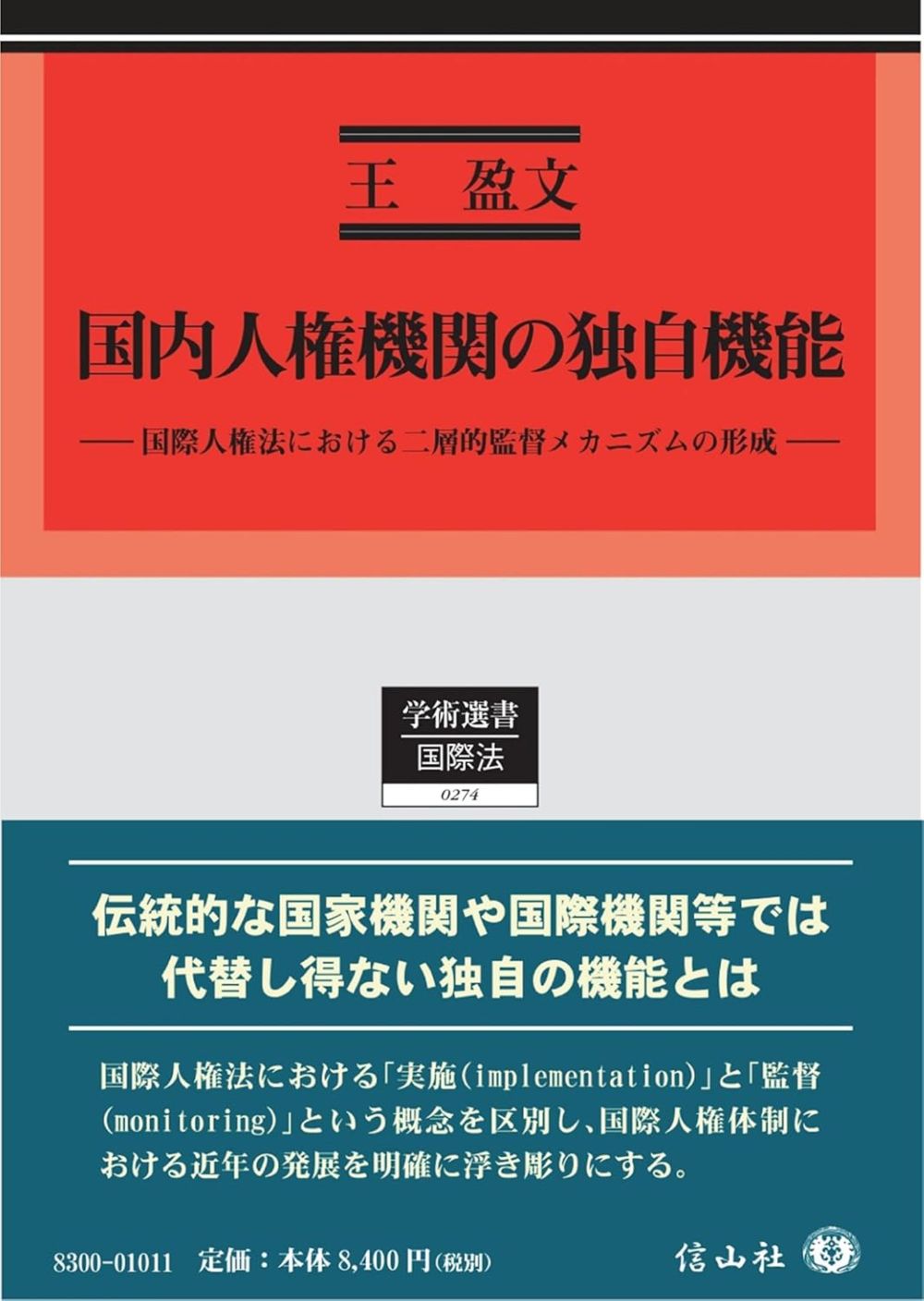
Academic Series 274 Kokunai Jinken Kikan no Dokuji Kinou (The Unique Function of National Human Rights Institutions - The Development of a Two-Tiered Monitoring Mechanism in International Human Rights Law)
Size
380 pages, A5 irregular format
Language
Japanese
Released
March 26, 2026
ISBN
9784797283006
Published by
Shinzansha Publisher Co.,Ltd
Book Info
See Book Availability at Library
Japanese Page
This book, based on my doctoral dissertation submitted to the University of Tokyo, is a research study focused on the subject of "National Human Rights Institutions" (NHRIs). The central inquiry of this work lies in why NHRIs have gained such prominence within the international human rights system and why their establishment is being demanded of all states.
An NHRI is generally understood as a state-established body that operates independently of existing government branches and has the mandate to promote and protect human rights. Currently, there are over 100 NHRIs worldwide, including the National Human Rights Commission of Korea and the National Consultative Commission on Human Rights in France. Japan, however, has yet to establish such an institution.
Why does the international community call upon every state to establish an NHRI?
Most existing studies have explained their necessity and utility by highlighting the functions NHRIs can perform, such as human rights education, advising on legislation and policies based on international standards, and providing more accessible remedies than the judiciary.
However, these explanations are debatable. For instance, human rights education can be conducted by executive agencies, and parliaments are already expected to consider human rights in the legislative process. Furthermore, some states already possess simplified dispute resolution mechanisms. Therefore, strengthening the expertise in international human rights law within existing legislative, executive, and judicial branches could, to a certain extent, enable them to fulfill similar functions.
Consequently, this book argues that conventional research frameworks are insufficient to fully explain the phenomenon of the international human rights system demanding the establishment of NHRIs across all nations.
The distinctive feature of this study lies in its premise that to justify the global demand for NHRIs, one must demonstrate that these institutions possess a "unique function" that cannot be substituted by existing actors in the international human rights regime, whether they are international bodies such as the Human Rights Committee or domestic legislative, executive, and judicial organs.
This book argues that the key to identifying this unique function lies in distinguishing between two concepts in international human rights law: "implementation" and "monitoring." Through this distinction, it argues that the unique function of an NHRI is to serve as a "permanent, independent monitoring body at the domestic level."
Furthermore, observing that some recent international human rights treaties explicitly mandate states to establish such domestic monitoring bodies, this book demonstrates that the contemporary international human rights legal system has evolved into a structure characterized by a "two-tier monitoring mechanism" operating at both international and domestic levels.
This book draws on extensive literature in Japanese, English, and French, as well as sources from Taiwan and China. It also analyzes a vast array of primary materials. As noted in the evaluation of author’s doctoral dissertation, it is considered one of the most comprehensive consolidations of data and discourse on NHRIs to date. It is my hope that this book will serve as a valuable resource for readers interested in NHRIs and international human rights law, and that it may contribute to the future establishment of an NHRI in Japan.
(Written by: Yin-Wen WANG / July 23, 2026)
Related Info
The 6th UTokyo Jiritsu Award for Early Career Academics (The University of Tokyo 2025)
https://www.u-tokyo.ac.jp/ja/research/systems-data/n03_kankojosei.html
2024 International Law Paper Award - the Taiwanese (Traditional Chinese) abridged version of this book (Taiwanese Society of International Law 2024)
https://www.tsil.org.tw/member_writings?post=1112&enble=1