

 Find a book


Title
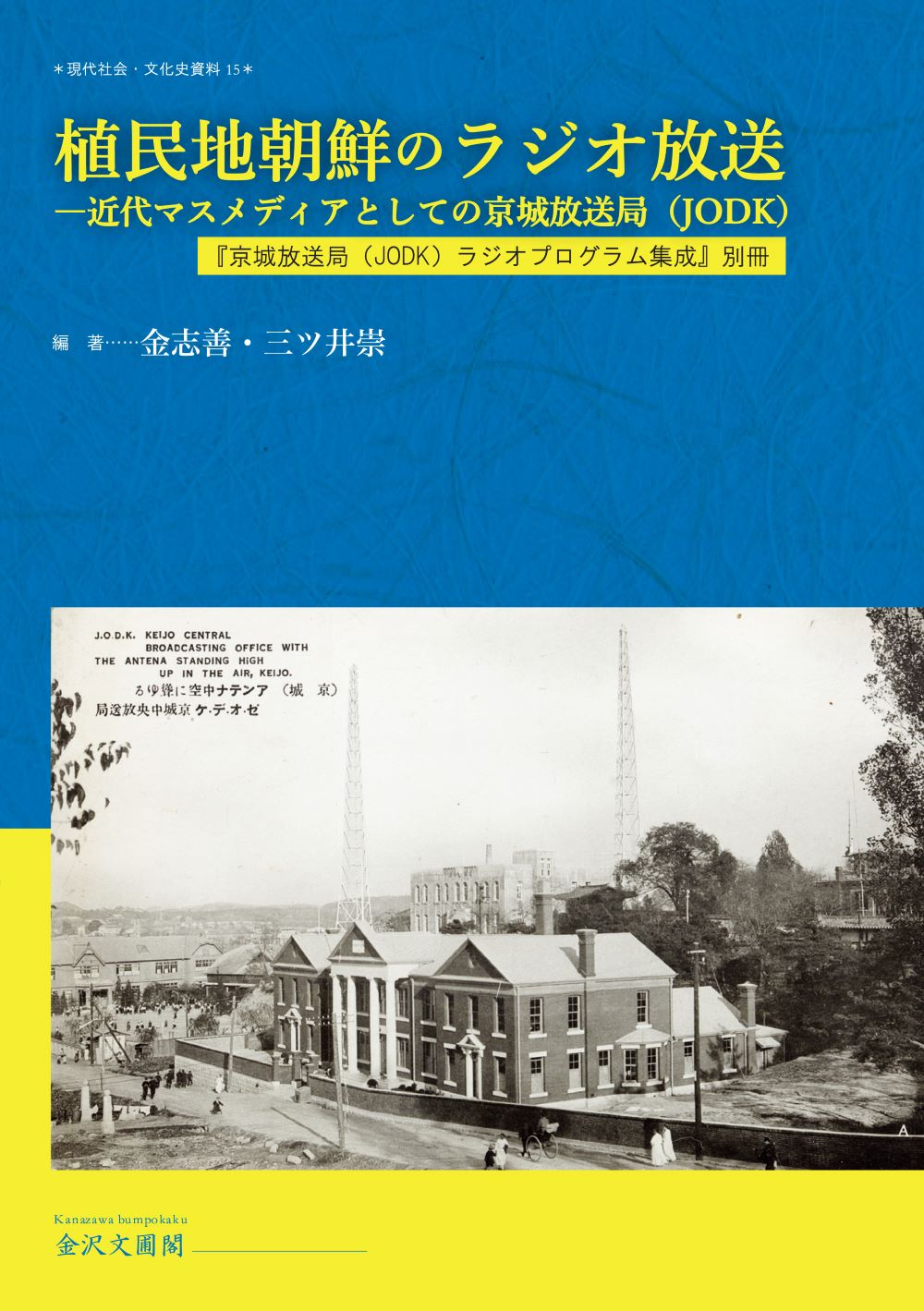
A Collection of Radio Programs from the Keijo Broadcasting Station (JODK), separate volume Shokuminchi Chosen no Radio Hoso (Radio Broadcasting in Colonial Korea - Keijo Broadcasting Station (JODK) as Modern Mass Media)
Size
291 pages, A5 format, softcover
Language
Japanese
Released
2023
ISBN
9784910998121
Published by
Kanazawa Bunpokaku
Book Info
Japanese Page
Starting in the 1990s, a movement emerged to understand the nature of colonial Korea through the lens of culture, raising new questions in the field of history as well as in sociology, anthropology, literature, linguistics, and other fields. This period also coincided with new research on Japan's imperial history as well as critiques of the history of nation-states. At the same time, diverse historical perspectives were proposed that differed from the dominant narratives in specific academic fields. Research on radio broadcasts in colonial Korea began at this time and expanded in scope from the 2000s onwards. Media history has primarily emphasized written-language (Hangŭl) media, but this has contributed to a simplistic schema of “written language (Hangŭl) = modern” and “sound = premodern”. However, research on radio broadcasts and records avoided this dichotomy and considered 'sound' media to be modern. Research into radio broadcasts played a major role in expanding research horizons. This book is a perfect example of such an expansion.
Various perspectives and arguments on colonial Korea have been presented through research focused on the medium of radio. First, there was a confirmation of the basic policies and systems as expressed through radio media (Kang Hye-kyung's paper), followed by an exploration of the political nature of language compilation (Seo Jae-gil's paper). Considering the dual-language system, with its hierarchical order that favored Japanese above Korean, radio broadcasting was inevitably forced into an antagonistic dynamic. Through this medium, it was possible to clarify how ethnic culture was mobilized by the logic of the empire. Research has also delved into the reality of the broadcasting system exemplified by the Keijo Broadcasting Station. In addition, research on female announcers (Eom Hyeon-seop’s paper) is especially interesting because it focuses on these matters from the perspective of gender.
Furthermore, in individual fields, there has been more comprehensive research into the significance of various radio programs, such as entertainment (Lee Sang-gil's paper), music (Park Yong-gyu's paper, Kim Ji-sun's paper), and Japanese language education (Ueda Takahito's paper), in relation to colonial rule or society.
How did the radio broadcasting system and content management define the structure of Japan's colonial rule over Korea, and the relationship between the Japanese and Koreans within this system? Such questions were raised in Seo Jae-gil’s paper from the perspective of language planning, whereas Kang Hye-kyung discussed the issue in terms of control and mobilization. Focusing on the pressure from above in terms of control and mobilization, Michael Robinson pointed out that the nature of colonial broadcasting, such as the dual-language system, Korean involvement in radio broadcasting policy, and acceptance in Korean society, was ambivalent and that radio broadcasting could have been a force for change in the policies of the Japanese Governor-General of Korea. Cultural hegemony changes over time, and Robinson’s paper emphasizes t the need to view culture dynamically. Kim Ji-sun's paper, focusing on an analysis of a music program, reveals the transcultural nature of broadcast programming. This aspect cannot be considered by looking only at the Japan-Korea dichotomy. Mitsui Takashi's paper summarized this research context and presents a key point of discussion.
(Written by MITSUI Takashi, Professor, Graduate School of Arts and Sciences / 2025)