

 Find a book


Title
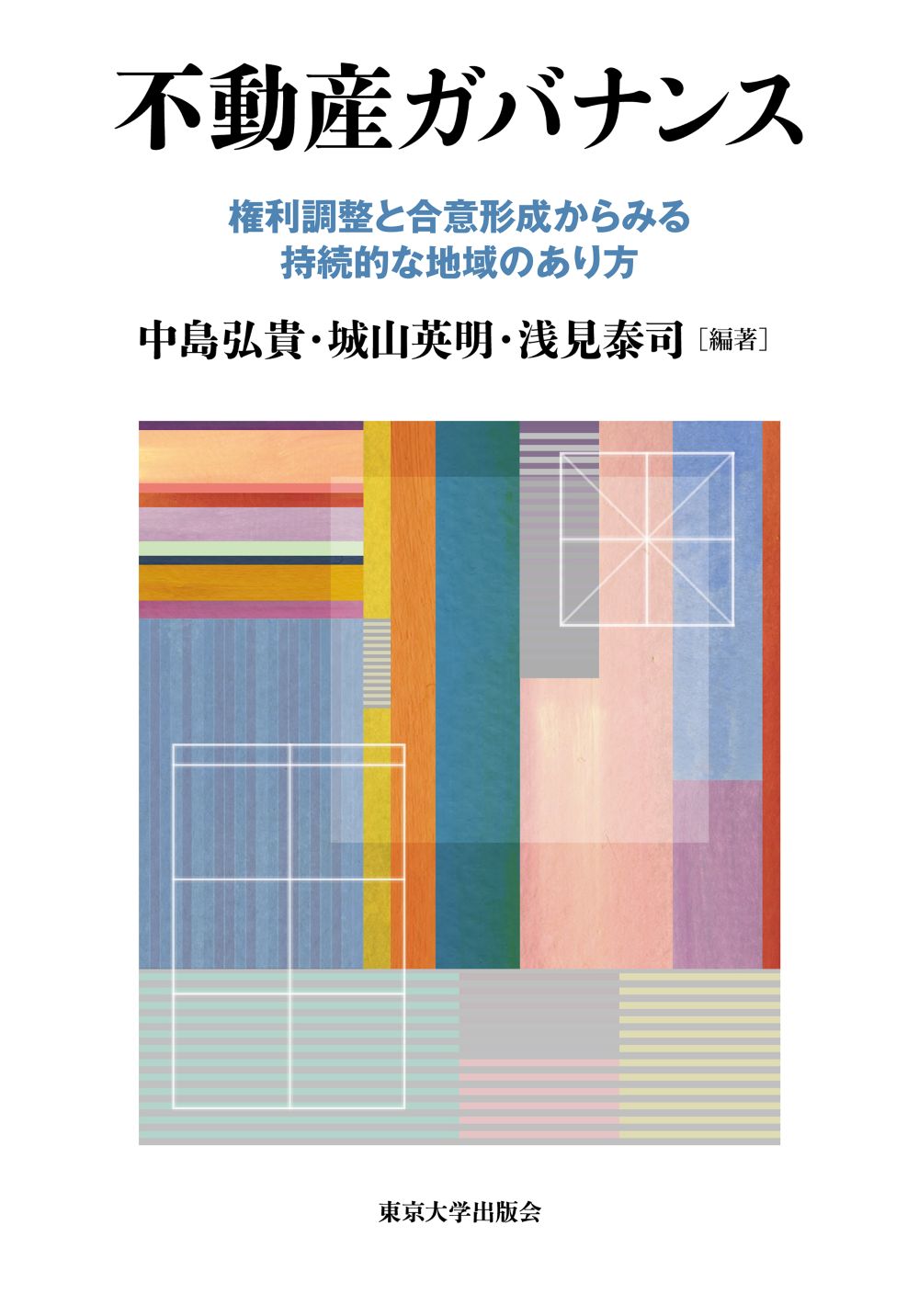
Fudousan Governance (Real Estate Governance - Sustainable Community Design through Rights Adjustment and Consensus Building)
Size
340 pages, A5 format
Language
Japanese
Released
June 03, 2025
ISBN
978-4-13-031212-7
Published by
University of Tokyo Press
Book Info
See Book Availability at Library
Japanese Page
 eBook
eBook
As Japan faces population decline, the demand for real estate is expected to fall. Issues such as vacant homes and land with unknown owners have recently attracted social attention. Real estate affects its surrounding environment in numerous ways, from local concerns such as landscaping and disaster preparedness to global environmental issues such as climate change and biodiversity loss. Management that can address these impacts is increasingly needed; however, the anticipated rise in unused real estate makes it difficult for individual owners to achieve the “appropriate use and management” of real estate needed to solve these problems independently. Against this backdrop, this book defines “real estate governance” as “multi-stakeholder coordination and mechanisms for it, aimed at the appropriate use and management of real estate.” From this perspective, it surveys relevant legislative trends, technological advances, and leading practices, and looks ahead to the future.
This book is composed of three parts:
-- Part I, “Empirical Realities,” outlines the overall landscape of challenges and responses in real estate governance through essays on recent legislative reforms and practices related to land with unknown owners (Chapter 1); technological advances in PropTech that facilitate the circulation and active use of vacant houses and properties in non-metropolitan areas (Chapter 2); real estate that accounts for global environmental impacts, such as carbon-neutral and nature-positive approaches (Chapter 3); and a quantitative analysis of demographics and vacant housing (Chapter 4).
-- Part II, “Tools,” discusses concrete attempts and directions for designing institutions and architectural systems within real estate governance through essays on institutions that encourage active participation of multiple stakeholders, including local communities, private enterprises, local governments, and the national government (Chapter 5); a pioneering cooperative co-housing model in Barcelona that leverages the potential of digital technologies (Chapter 6); institutions for condominium renewal and management that foster community by shifting from a privacy-oriented, private-unit-centric paradigm to a common-area-centric paradigm (Chapter 7); and architectural systems and institutions that enable the separation of a building’s structural frame from its systems and interior fit-outs to contribute to carbon neutrality (Chapter 8).
-- Part III, “Social Systems,” examines the macro-level conditions and challenges that make real estate governance possible through essays on governance for properties that no longer confer value, so-called “negative-value” real estate (Chapter 9); discrete governance linking actors across geographically separated regions, premised on contemporary conceptions of community (Chapter 10); and governance that integrates the collection, use, and cost sharing of real estate information that underpins real estate transactions (Chapter 11).
Although real estate is closely tied to everyday life, it encompasses a range of legal, technological, and practical aspects. Accordingly, the authors of this book are experts and practitioners in various fields, including engineering, law, economics, and public administration. Through their transdisciplinary dialogue, they shed light on fundamental issues surrounding real estate that are rarely adequately addressed in government committees oriented toward specialized, siloed debates and short-term solutions. This book organizes and presents these foundational issues from the perspective of real estate governance.
(Written by ASAMI Yasushi, Project Professor, Center for Spatial Information Science and NAKAJIMA Hiroki, Associate Professor, School of Engineering / 2025)