

 Find a book


Title
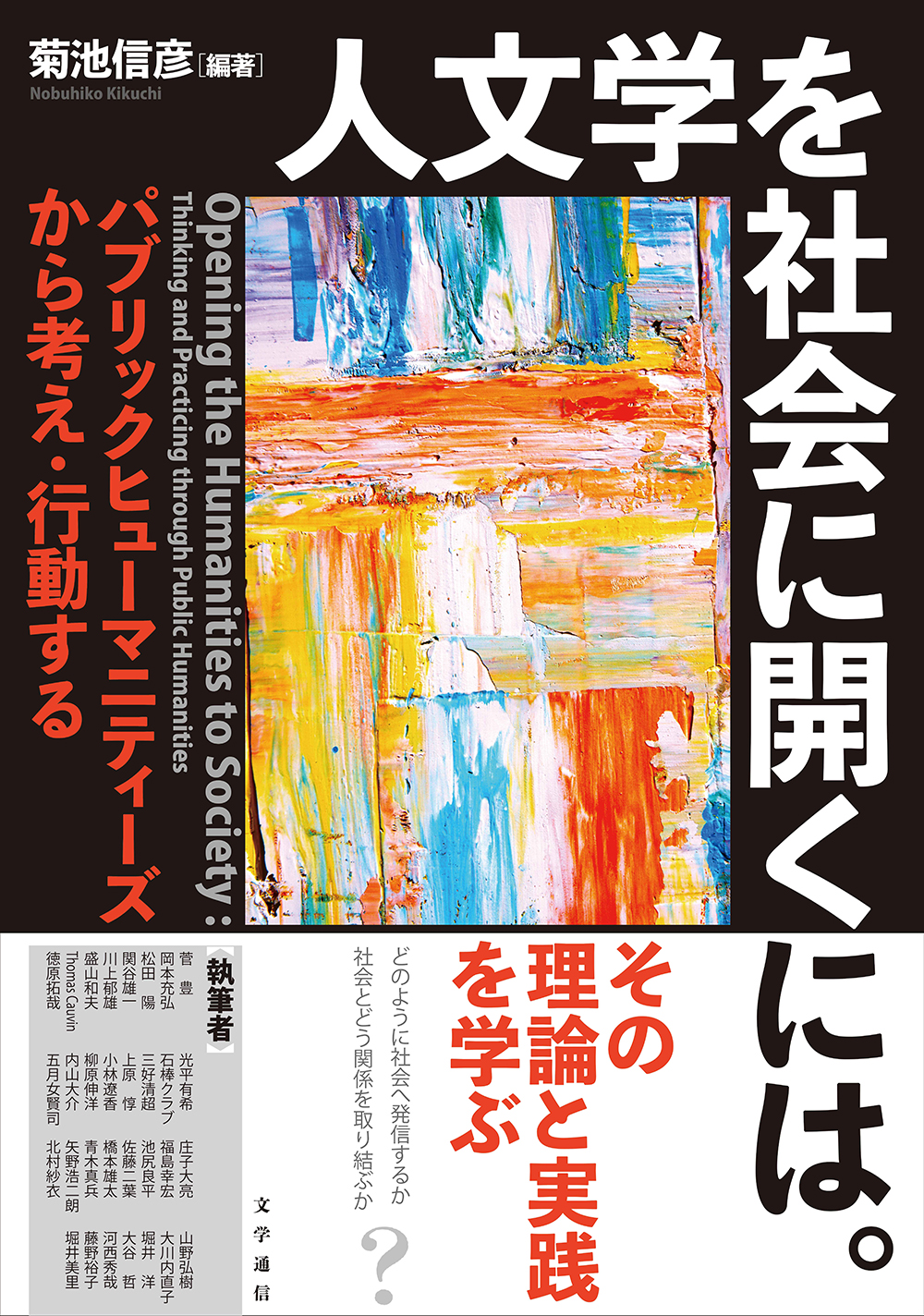
Jinbungaku wo Hirakuniwa (Opening the Humanities to Society: Thinking and Practicing through Public Humanities)
Size
304 pages, A5 format, softcover
Language
Japanese
Released
April, 2025
ISBN
978-4-86766-086-7
Published by
Bungaku Tsushin
Book Info
See Book Availability at Library
Japanese Page
 eBook
eBook
This book does not discuss what the humanities are or how important they are, but how the humanities can and should engage with the contemporary world. As noted in Kikuchi Nobuhiko’s Introduction, the book resists the defensive stance often taken when the humanities are accused of being “useless”. It advocates exploring constructive ways to open the humanities to broader publics. This shift in perspective is both disarming and productive, moving the debate away from justification and towards engagement.
The intellectual background of this stance is a reflection on the long-standing neglect of social practice within the humanities. While refining specialized knowledge through scholarship and pursuing truth remain essential to academic inquiry, it is problematic to confine the humanities solely to specialists. Since the humanities are fundamentally concerned with the question of what it means to be human, their enclosure within academia is both unnatural and unhealthy.
Here, the public humanities serves as a working concept that provides a space to rethink this situation. At present, the humanities remain insufficiently open, and it is precisely for this reason that the term “public” needs to be prefixed as a qualifier. Through dialogue and practice, the book suggests, the humanities can be made more accessible. Once they are truly open to all, the qualifier “public” will no longer be necessary. Yet such a transformation does not appear imminent, which makes the further development of public humanities all the more crucial.
The book is divided into three parts. Parts I and II offer a variety of theoretical frameworks and conceptual insights into the idea of public humanities from different perspectives. These sections lay the groundwork for understanding and approaching the public humanities. Part III, in turn, offers multiple concise case studies that demonstrate how the humanities can be opened to society through practice.
Among the case studies, those employing digital technologies are particularly timely. For instance, Hashimoto Yuta’s Chapter 19 introduces “Collaborative Transcription,” a project that mobilizes digital tools to democratize scholarly practices. Such cases highlight the importance of continuously engaging with the rapidly shifting landscape of digital technology, which reshapes not only scholarly methods but also the very accessibility of humanistic knowledge.
In sum, this book contributes not by defending the humanities in the face of scepticism, but by reorienting the conversation toward their social engagement. It provides both theoretical reflection and concrete practice, inviting scholars and practitioners alike to imagine more open, inclusive, and constructive futures for the humanities.
(Written by MATSUDA Akira, Associate Professor, Graduate School of Humanities and Sociology / 2025)
Table of Contents
SUGA Yutaka / OKAMOTO Michihiro / MATSUDA Akira / SEKIYA Yuichi / SEIYAMA Kazuo / Thomas Cauvin / TOKUHARA Takuya / MITSUHIRA Yuuki / Sekibo Club / YANAGIHARA Nobuhiro / UCHIYAMA Daisuke / SAOTOME Kenji / SYOJI Daisuke / FUKUSHIMA Yukihiro / IKEJIRI Ryohei / SATO Futaba / HASHIMOTO Yuta / AOKI Shinpei / YANO Kojiro / KITAMURA Sae / YAMANO Hiroki / Ookawachi Naoko / HORII Hiroshi / History Festival Committee