

 Find a book


Title
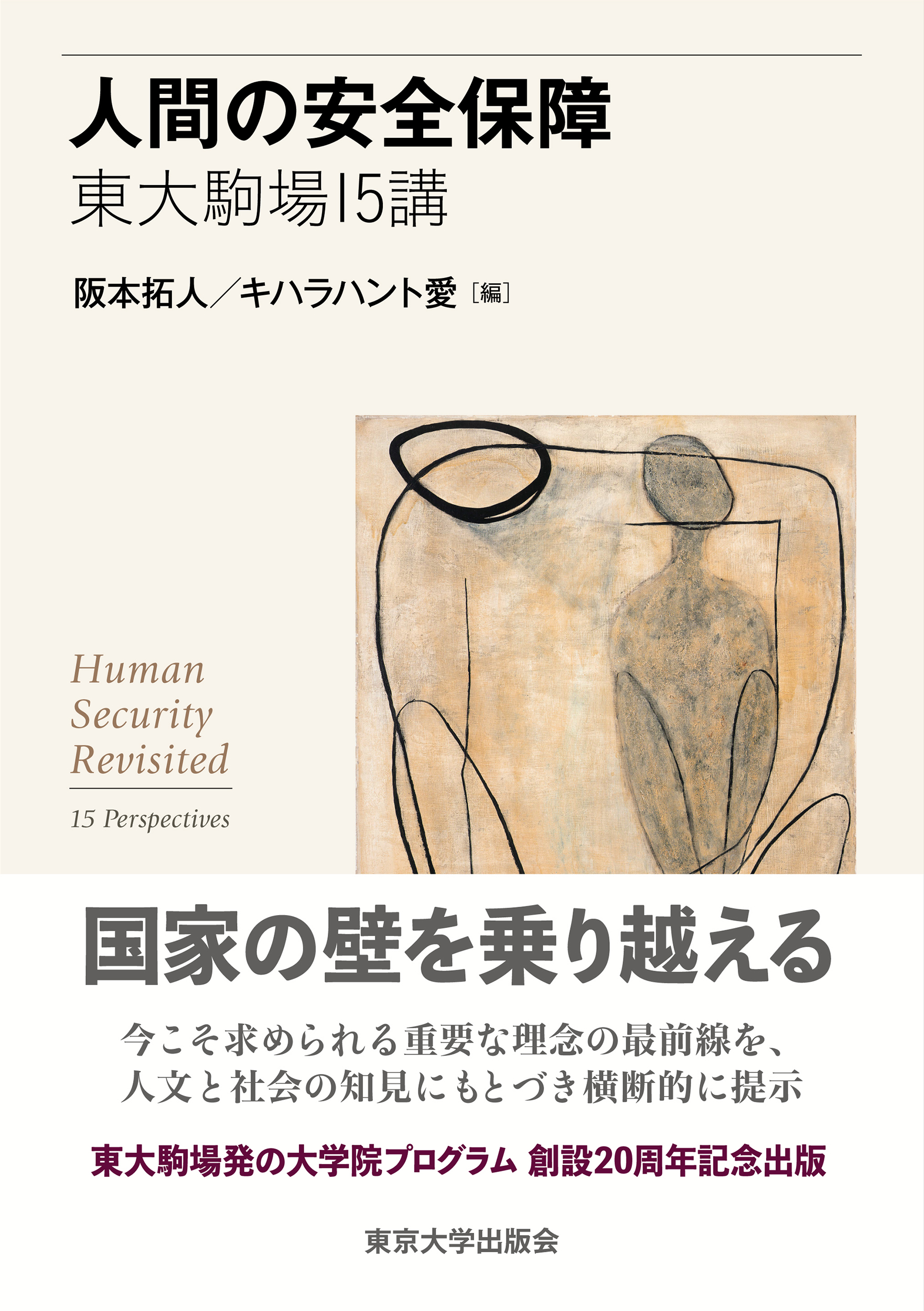
Ningen no Anzenhoshou: Todai Komaba 15-kou (Human Security Revisited: 15 Perspectives)
Size
292 pages, A5 format
Language
Japanese
Released
October 02, 2024
ISBN
978-4-13-003354-1
Published by
University of Tokyo Press
Book Info
See Book Availability at Library
Japanese Page
 eBook
eBook
In international relations, "security" typically refers to the security of states. This book, however, focuses on the security of individuals rather than states—what we call "human security." Rather than military threats from other States, human security addresses a wide range of issues that threaten people's survival, livelihoods, and dignity on a daily basis: violence, poverty, infectious diseases, and discrimination, to name a few. The Graduate Program on Human Security (HSP) at the University of Tokyo's Komaba Campus has been engaged in research and education on these issues for over 20 years. This volume represents its most recent contributions. The authors—all affiliated with HSP as current or former faculty and graduates—bring together expertise in the humanities (philosophy, literature, history) and social sciences (international politics, international law, development economics).
The concept of human security was first introduced to the international community in the mid-1990s, just after the end of the Cold War. Around that time, democratic and market-oriented reforms were promoted around the globe, and international cooperation based on multilateralism, centered around the United Nations, was championed. Three decades later, the international landscape has transformed dramatically. Great power competitions have re-emerged, exclusionary populism has gained a strong ground even in democratic countries, and tolerance for others seems to be eroding in many places. Turning to Gaza, Ukraine, Myanmar, Sudan, or Haiti—wherever we look—we cannot escape from the harsh realities of "human insecurity." After 30 years, our world has not only failed to adequately deliver human security; against mounting headwinds, its achievement seems increasingly distant.
This book confronts these harsh realities surrounding human security while offering diverse perspectives that can help us move forward. The volume presents 15 "lectures," or perspectives, organized into three parts. Part I, "Global Policy Practice and Japan," examines legal norms and policy practices in today's world. Part II, "Dialogue with Diverse Knowledge," situates the concept within broader intellectual currents including philosophy, history, and literature. Part III, "Toward Richer Human Perspectives," aims to contribute to a better understanding and empathy for people. Yet as a glance at the table of contents reveals, the essays do not fit neatly into any rigid categorization. The good side of it is that readers can begin anywhere. The volume concludes with a comprehensive research guide covering major policy documents and academic literature on human security: valuable material for beginners in the field.
In the current troubled world, we hope readers will embrace this book as a "catalog of knowledge" for envisioning and pursuing a more humane world.
(Written by SAKAMOTO Takuto and KIHARA-HUNT Ai, Professors, Graduate School of Arts and Sciences / 2025)
Related Info
“Human Security” Lecture Series (Graduate Program on Human Security (HSP), The University of Tokyo Sep 19 – Dec 12, 2025)
https://www.c.u-tokyo.ac.jp/eng_site/info/news/events/files/202509019-1212_HSP_lecture_poster_En.pdf