

 Find a book


Title
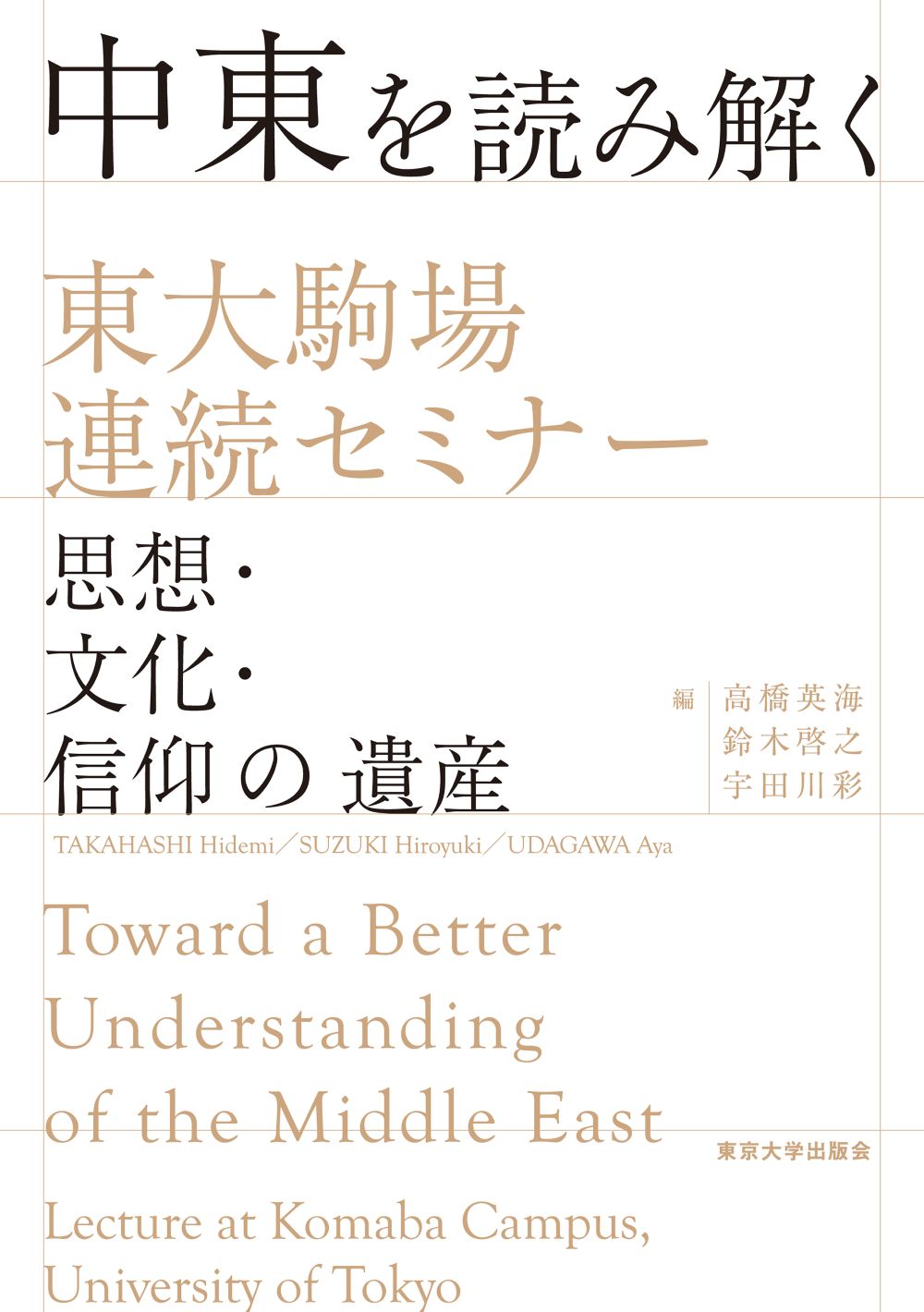
Lecture at Komaba Campus, University of Tokyo Chuto wo Yomitoku (Toward a Better Understanding of the Middle East - Heritage of Thought, Culture, and Faith)
Size
264 pages, A5 format
Language
Japanese
Released
September 25, 2024
ISBN
978-4-13-030213-5
Published by
The University of Tokyo Press
Book Info
See Book Availability at Library
Japanese Page
In 2021, the University of Tokyo Centre for Middle Eastern Studies (UTCMES) held a series of seminars titled “Heritage and the Middle East.” In Japanese, the word “heritage” (i-san) primarily evokes the image of something to be preserved and passed down. World Heritage Sites are perhaps a prime example of this, and even when the term is used to refer to family assets, it evokes something that should be protected from dissipation or loss. On the other hand, the Arabic word for heritage, “turath,” carries meanings that are semantically close not only to tradition (taqlid) and art (fan), but also to customs (adat) and culture (thaqafa) – things rooted in daily life. The aim of this seminar series was to explore the image of societies and people depicted by the keyword “heritage” not only in Arabic-speaking regions, but also in Persian-speaking and Turkish-speaking areas, and of course in Hebrew and other languages of immigrant communities. This book compiles the discussions on “heritage” presented by lecturers from various fields during the seminar series, organized into an introductory format for beginners.
The section titles reflect the editors’ perspectives. This idea came from co-editor Dr. Aya Udagawa, who expressed each section through movement. Rather than following the seminar's speaking order, it uses verbs to express the commonalities observed across regions and methodologies. The four sections are titled: “Connecting, Weaving,” “Traversing Layers of the Past,” “Shaping,” and “Passing On and Expanding.”
Looking back at the contents of this book, I vividly recall seminars conducted online during the COVID-19 pandemic. Part One, “Connecting and Weaving,” features chapters on Jews living in South America, Syrian literature under conflict, and the development of moderate Islamist thought in Egypt. Each chapter discusses the endeavors of people striving to maintain connections to their origins, such as their homeland or sacred texts, despite being distant from them. Part Two, “Traversing the Stratum of the Past,” features Coptic Christians in Egypt, medieval dining tables, and popular beliefs in Iran. This section contains the most dynamic and retrospective chapters of the book. Part III, “Shaping,” examines a Turkish mystical order, Algerian architecture, and cultural heritage preservation in Oman. Like Part IV, “Passing On and Expanding,” this section predominantly addresses more contemporary eras. Indeed, Part IV examines the reception of international law through translation, Islamic education in America, and the heritage of Palestinians in its respective chapters.
Not only do the regions and locations discussed differ, but the chapters in this book also employ various academic methodologies. Using “heritage” as a keyword, I hope the readers will experience the breadth of Middle Eastern studies.
(Written by SUZUKI Hiroyuki, Project Associate Professor, Graduate School of Arts and Sciences / 2025)