

 Find a book


Title
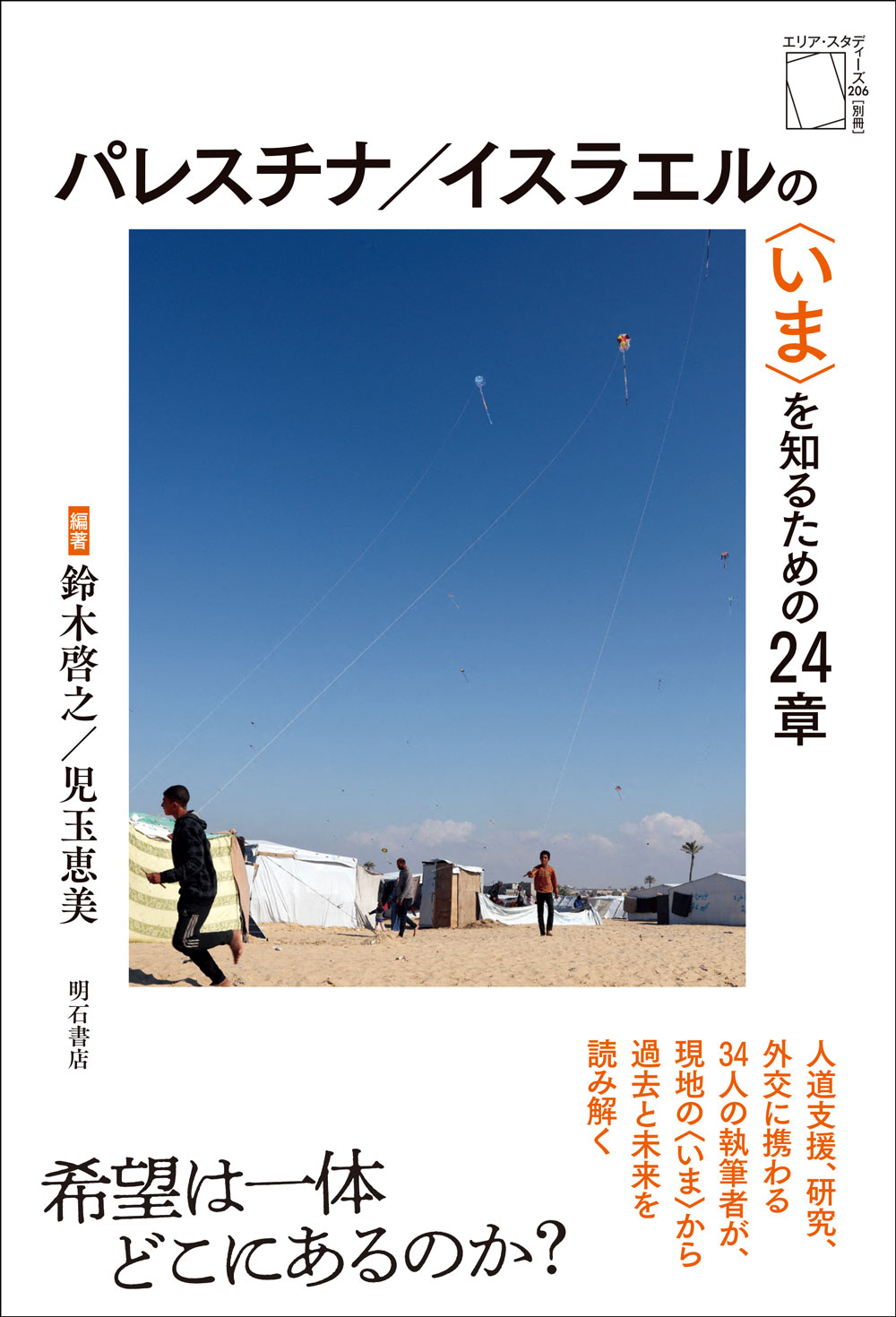
Area Studies 206 extra issue Palestine / Israel no ima wo shirutameno 24 sho (24 Chapters to Understand the Current Situation in Palestine / Israel)
Size
324 pages, 127x188mm
Language
Japanese
Released
May 15, 2024
ISBN
9784750357607
Published by
Akashi Shoten
Book Info
See Book Availability at Library
Japanese Page
 eBook
eBook
The deteriorating situation in Gaza has robbed Palestinians and Israelis of their daily lives. However, was the pre-conflict routine truly a peaceful existence worth reclaiming? Israeli homes and parks equipped with air-raid shelters, traffic jams at Israeli military checkpoints, and life under blockade in the Gaza Strip all reveal the distortion of Palestinian and Israeli society today.
This book is the first volume published as a “special edition” within Akashi Shoten's long-running “Area Studies” series. While 60 Chapters to Understand Palestine (edited by Prof. Akira Usuki and Hiroyuki Suzuki) and 62 Chapters to Understand Israel (edited by Prof. Ryoji Tateyama) have already been published, the publisher's conviction that a new book was necessary to address the situation in Gaza made this volume possible. Indeed, by October 2023, the humanitarian crisis in the Gaza Strip had already reached its “worst level on record.” This book was compiled in a situation that showed no signs of improvement.
This book features contributions from 34 authors in its chapters and columns. Chapters written by practitioners, including NGO members, UN staff, and former diplomat, depict the distorted daily realities in Palestine and Israel spanning approximately 30 years, from the 1990s to the present. These chapters offer valuable insights for readers, particularly interested in the kind of engagement the Japanese government and civil society have pursued with Palestinian/Israeli society, how international support should be structured, and how to engage moving forward. Contributions from Japanese staff members of the United Nations Relief and Works Agency for Palestine Refugees (UNRWA) were written amidst political attacks on UNRWA by the U.S. and Israeli governments. Readers should be mindful of this historical context when interpreting such accounts. Some authors have contributed while engaged in emergency humanitarian projects. I recall being deeply shocked, even as an editor, by writings that seemed to capture the despair felt on the ground.
To understand why the Gaza situation has escalated to what is described as “the worst on record,” the chapters by scholars offer valuable insight. The writings of young scholars who have recently conducted fieldwork or studied abroad capture the pulse of daily life on the ground. Despite the conflict, ordinary life persists in Palestine and Israel. However, the daily life depicted by the authors, in places like Tel Aviv, East Jerusalem, and the West Bank, gives an unshakable impression of being somehow “unusual.” An anonymous Palestinian with Israeli citizenship vividly describes the circumstances that make speaking about Gaza difficult.
This book is far from optimistic. The message on the cover, “Where exactly is hope to be found?” also reflects my own voice as an editor who, while compiling this volume, came to witness the humanitarian crisis in Gaza as a contemporary fact. Through this book, I hope readers will discern the absurdities unfolding in the world today.
(Written by SUZUKI Hiroyuki, Project Associate Professor, Graduate School of Arts and Sciences / 2025)