

 Find a book


Title
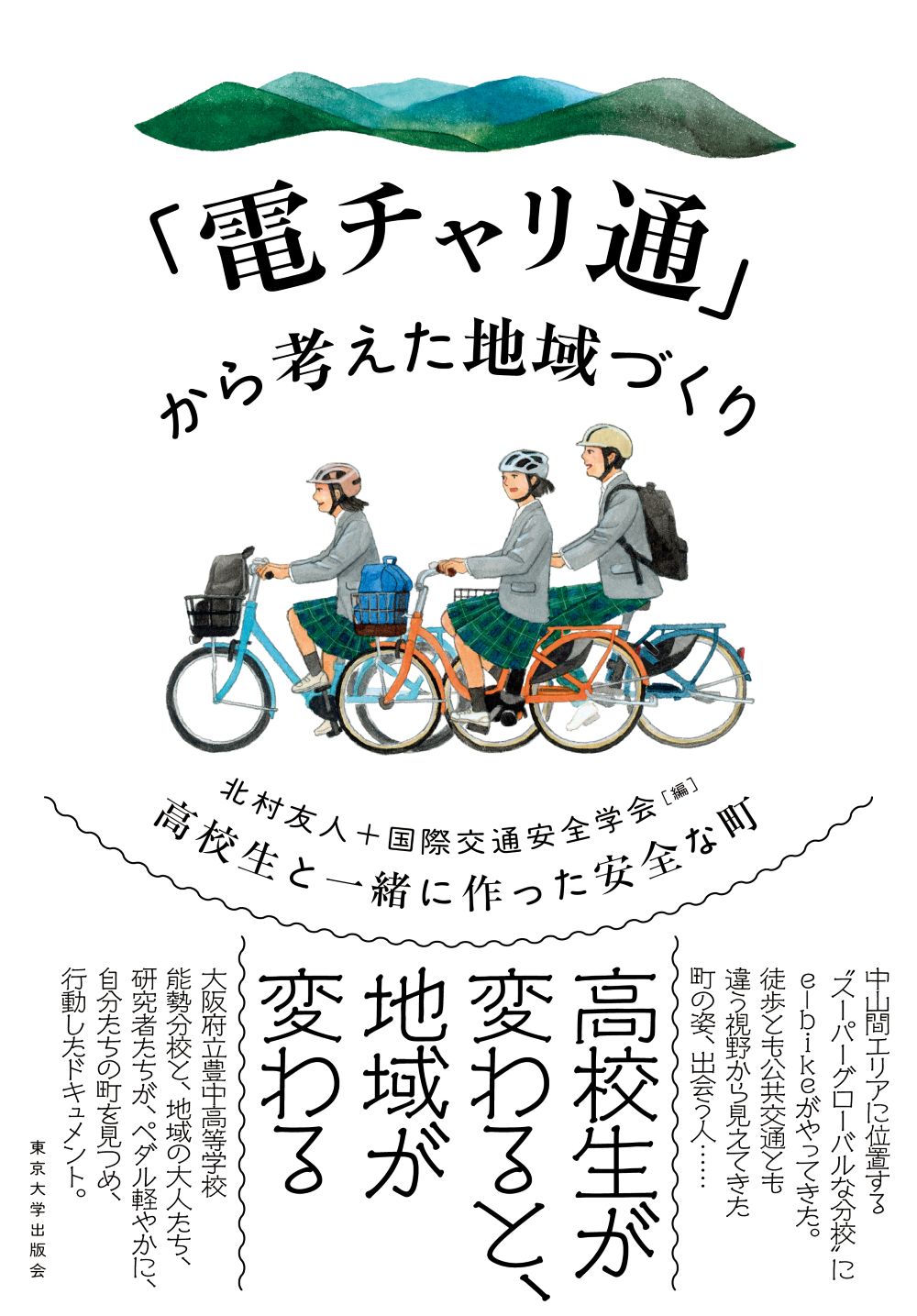
“Den-chari tsu” kara kangaeta chiiki dukuri (Community Development Inspired by “Denchari Commuting” - Creating a Safer Town Together with High School Students)
Size
196 pages, 127x188mm
Language
Japanese
Released
April 12, 2025
ISBN
978-4-13-053202-0
Published by
University of Tokyo Press
Book Info
See Book Availability at Library
Japanese Page
 eBook
eBook
This book presents the results of a research project that I led at the International Association of Traffic and Safety Sciences (IATSS). Starting with the concrete issue of high school students’ commuting difficulties in semi-mountainous regions, this project aims to empirically illustrate the connection between education and society.
The novelty of this book lies in its focus on the practice of “Denchari Commuting” — commuting by electrically assisted bicycles (e-bikes) — while reconstructing it not only as an improvement in transportation, but also as an educational practice. At the Nose Branch School of Osaka Prefectural Toyonaka High School, located in a mountainous rural area, students face severe commuting difficulties due to restrictions on public transportation, specifically regarding in bus services. In response, teachers, students, researchers, local government officials, residents, and private companies collaborated to address this issue. The solution we proposed is “Denchari Commuting.” Such a problem-solving framework, based on collaborations among diverse stakeholders, is rarely observed in conventional educational research.
This project emphasizes the integration of multiple disciplines such as traffic engineering, urban planning, and environmental economics, while evaluating the project’s effects from an educational perspective. This book combines various approaches, including recording and analyzing students’ riding behavior, implementing traffic safety education, and sharing issues with local communities through workshops. Such interdisciplinary methods demonstrate that real-world social problems cannot be solved by a single academic discipline alone, while also suggesting new possibilities for educational research.
Another important purpose of this book is to present a practical model for citizenship education. It presents in detail how high school students have transformed from passive learners to active participants in solving local community issues. By addressing their commuting problems, students began paying attention to local transportation environments and social structures, discussed issues with adults through workshops, and proposed concrete improvement measures. This process fosters practical learning that goes beyond the mere acquisition of knowledge and cultivates the ability to participate proactively in society. To help readers understand this more concretely, the book also includes comments by the participating high school students themselves. Their essays honestly describe what they felt and thought throughout the project, allowing readers to vividly imagine the reality of the initiative.
Furthermore, in terms of social significance, this book suggests the possibility of a new educational approach to the structural problems facing rural Japan, such as population decline, aging society, and the deterioration of public transportation. In particular, while discussions about “transportation-disadvantaged people” have traditionally centered on elderly populations, this project introduces the perspective of the younger generation: high school students. It also demonstrates how students’ activities can encourage changes in community awareness and how micro-level challenges may lead to broader social transformation.
Thus, I believe this book possesses both originality and significance as a practical study connecting education and society. Should it serve as a guide for understanding how learning can begin from familiar local issues and contribute to society—and shed light on the social role that academic endeavors can play—all those involved in the project would consider it a great honor.
(Written by KITAMURA Yuto, Professor, Graduate School of Education / 2026)