

 Find a book


Title
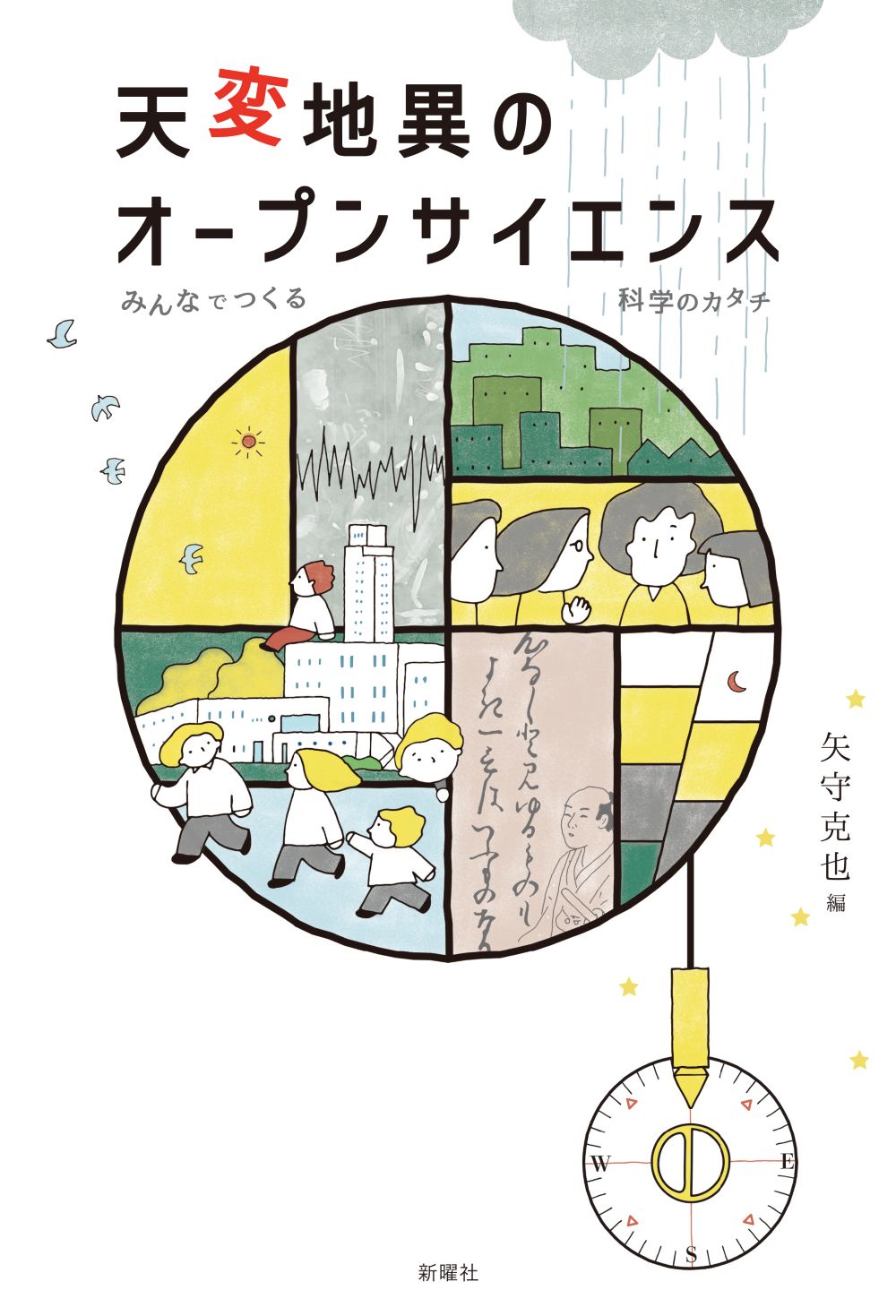
Tenpen-Chii no Open Science (Open Science of Natural Catastrophes - The Shape of Science Created with Citizens)
Size
244 pages, 127x 188cm
Language
Japanese
Released
April 04, 2025
ISBN
9784788518797
Published by
Shinyosha
Book Info
See Book Availability at Library
Japanese Page
This book is the result of a Grant-in-Aid for Scientific Research (Challenging Research–Pioneering) project (JSPS KAKENHI, Grant Numbers JP18H05319 and JP20K20338), for which the editor, Katsuya Yamori, served as the principal investigator. From the outset, we aimed to compile our project into a book and held regular meetings for members to discuss their individual practices and related topics. These meetings took place at Kyoto University Abuyama Observatory, also the field site for Chapters 5 and 6, as well as online during the COVID-19 pandemic. The contributing authors, as research members, came from diverse research fields and approaches, each with distinct characteristics, and I always looked forward to these meetings and the dinners that followed.
In Chapter 8, which I authored, I introduced Minna de Honkoku, a online platform for transcribing Japanese historical materials and classical texts. When the project launched in 2017, our goal was to transcribe 500 classical Japanese books held by the Earthquake Research Institute. The transcription was completed by March 2019, with a system update in July that year, we adopted IIIF (International Image Interoperability Framework), a protocal for sharing digital archive images. This update facilitated collaboration with other institutions and expanded transcription efforts beyond earthquake-related materials. We also implemented AI-based character recognition features. In August 2025, we further updated the system, allowing users to freely register materials for transcription and enhancing AI-assisted transcription features. The project has since attracted over 11,000 registered participants, who together have transcribed more than 6 million characters.
Yamori encouraged me not only to describe the project’s content but also to convey the impressions and reflections of the participants and ourselves as organizers.
Minna de Honkoku has since gained attention as an open-science initiative in the field of historical disasters, particularly as an example of open collaboration and citizen participation. Although I have been involved in this project as a member of the organizing and development team since its launch, I have never formally studied open science. Rather, I learned by observing Yuta Hashimoto (National Museum of Japanese History), also a member of the organizing and development team who built the system with an awareness of the open science movement. Through trial and error, we created what might be called open science, and I came to feel that this experience could also be applied to disaster prevention and mitigation efforts.
When I shared these vague thoughts during research meetings, I received a variety of comments from the perspectives of disaster research and science and technology studies, prompting me to reconsider Minna de Honkoku. The discussion also mentioned in Chapters 1 and 10.
I hope this book serves as a catalyst for open science, disaster prevention and mitigation practices, and research that incorporates these ideas.
(Written by KANO Yasuyuki, Associate Professor, Earthquake Research Institute / 2026)