

 Find a book


Title
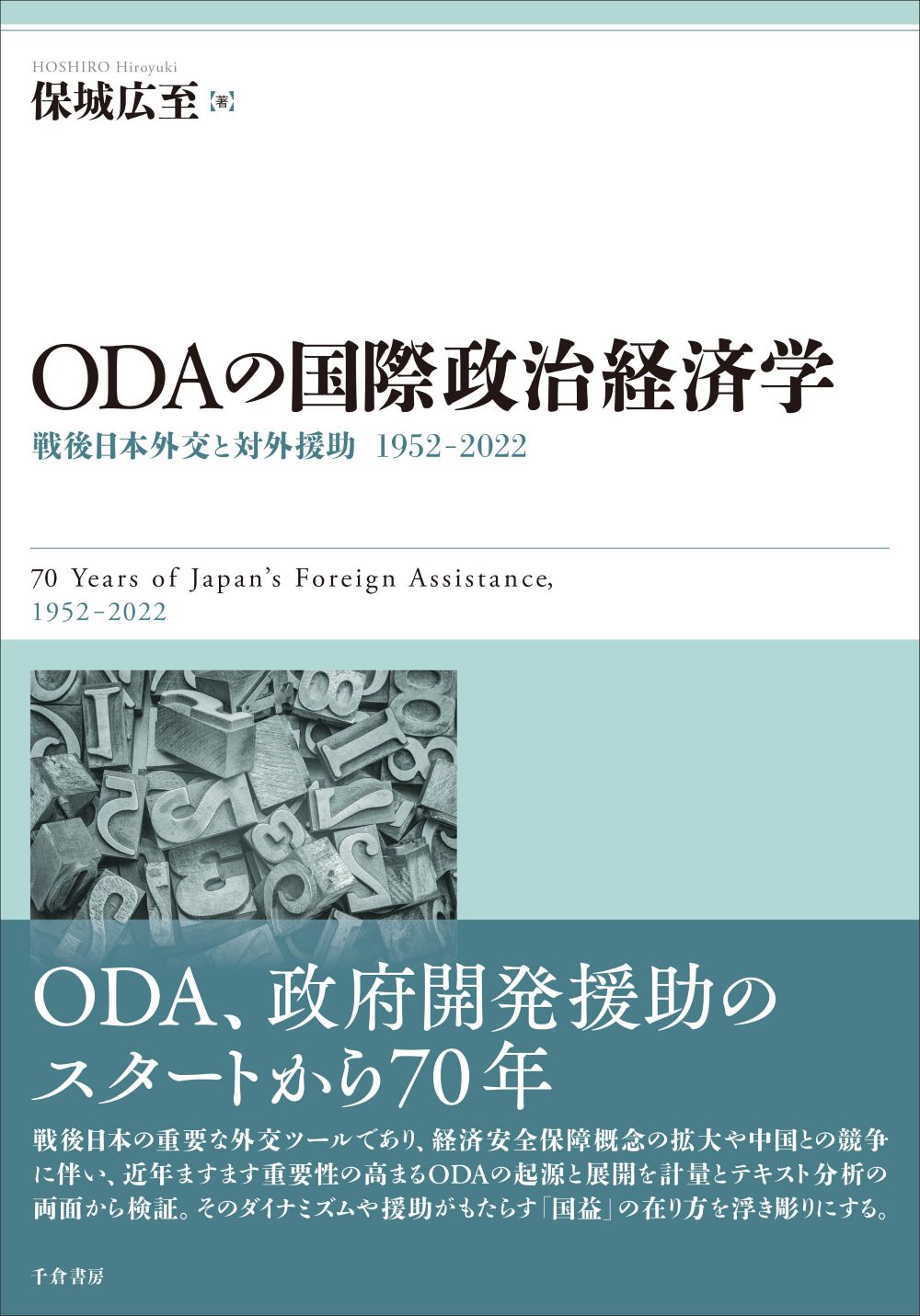
ODA no kokusai seiji keizai-gaku (70 years of Japan's foreign assistance, 1952-2022)
Size
348 pages, A5 format
Language
Japanese
Released
December 10, 2024
ISBN
978-4-8051-1330-1
Published by
Chikura Publishing Company
Book Info
See Book Availability at Library
Japanese Page
Japan’s Official Development Assistance (ODA) began as part of its postwar reparations. With its entry into the Colombo Plan in 1954, Japan embarked on a path of technical cooperation and yen loans to Southeast Asia, re-emerging on an international stage as a donor nation. Backed by rapid economic growth, Japan’s ODA expanded steadily, and by the 1980s and the 1990s, the country became the world’s largest aid donor. This position drew global attention, as well as criticism—was Japan’s aid too “commercial,” too focused on its own national interests?
This book aims to answer this question. It explores the evolution of Japan’s ODA over seven decades, by combining historical analysis, statistical modeling, and a textual study of official documents. It aims to transcend familiar images and misconceptions to reveal what shaped Japan’s aid policy and how it was implemented.
Foreign aid always has two aspects. On the one hand, it can serve altruistic goals, supporting poverty reduction and economic development in recipient countries. On the other hand, it can serve donors’ interests by strengthening diplomatic ties, opening export markets, and securing resources. Japan’s ODA has often been portrayed as leaning toward the latter. However, international comparisons indicate that Japan is not an outlier. Unlike Sweden’s “humanitarian” model or America’s “security-driven” approach, Japan has pursued a distinctive balance—sometimes commercial, sometimes cooperative, and always shaped by its unique circumstances.
A central insight from the book is that policy intentions and actual aid allocation often diverge. Aid meant to secure oil resources has not always achieved its goal. Grand diplomatic slogans, such as those of the Fukuda Doctrine, did not necessarily translate into real shifts in aid distribution. Instead, a complex dynamic shaped by domestic politics, global power relations, and the priorities of the recipient countries themselves emerges.
The narrative traces Japan’s ODA from postwar reparations and Colombo Plan projects, through the expansionary years of the 1970s and the 1980s, to the institutionalization of aid with the ODA Charters of the 1990s and the 2000s, and finally to today’s era of explicitly “national interest–oriented” aid and competition with China in Asia. Across these episodes, ODA appears not as charity, but as a vital instrument of statecraft—an economic tool that carries real political weight.
This book uncovers both drama and contradictions in Japan’s role as a global donor, by combining archival research with quantitative evidence. It reveals how aid has been used, contested, and redefined for over seventy years and what this reveals about Japan’s place in the international system.
For scholars, practitioners, and general readers alike, this account provides a fresh perspective on the policy field that is often hidden in technical debates. This reminds us that foreign aid is not only about money or projects but also about diplomacy, power, and the shifting role of a nation in world politics.
(Written by HOSHIRO Hiroyuki, Professor, Institute of Social Science / 2025)
Related Info
Reviewed by Raymond Yamamoto (Aarhus University) (Social Science Japan Journal Volume 28, Issue 28, Summer 2025, September 18, 2025)
https://doi.org/10.1093/ssjj/jyaf033
Social Contribution:
Kajima Foundation holds its 46th research presentation conference (KAJIMA foundation November 8, 2023)
https://www.kajima.co.jp/english/sustainability/social_topics/contents/topics_2023_10.html
Related Articles:
Japan’s Foreign Aid Policy: Has It Changed? Thirty Years of ODA Charters (Social Science Japan Journal Volume 25, Issue 2, Summer 2022, Pages 297–330 June 30, 2022)
https://doi.org/10.1093/ssjj/jyac010
Do diplomatic visits promote official development aid? Evidence from Japan (Political Science Volume 72, Issue 3, pages 207-227 August 23, 2021)
https://doi.org/10.1080/00323187.2021.1948344