

 Find a book


Title
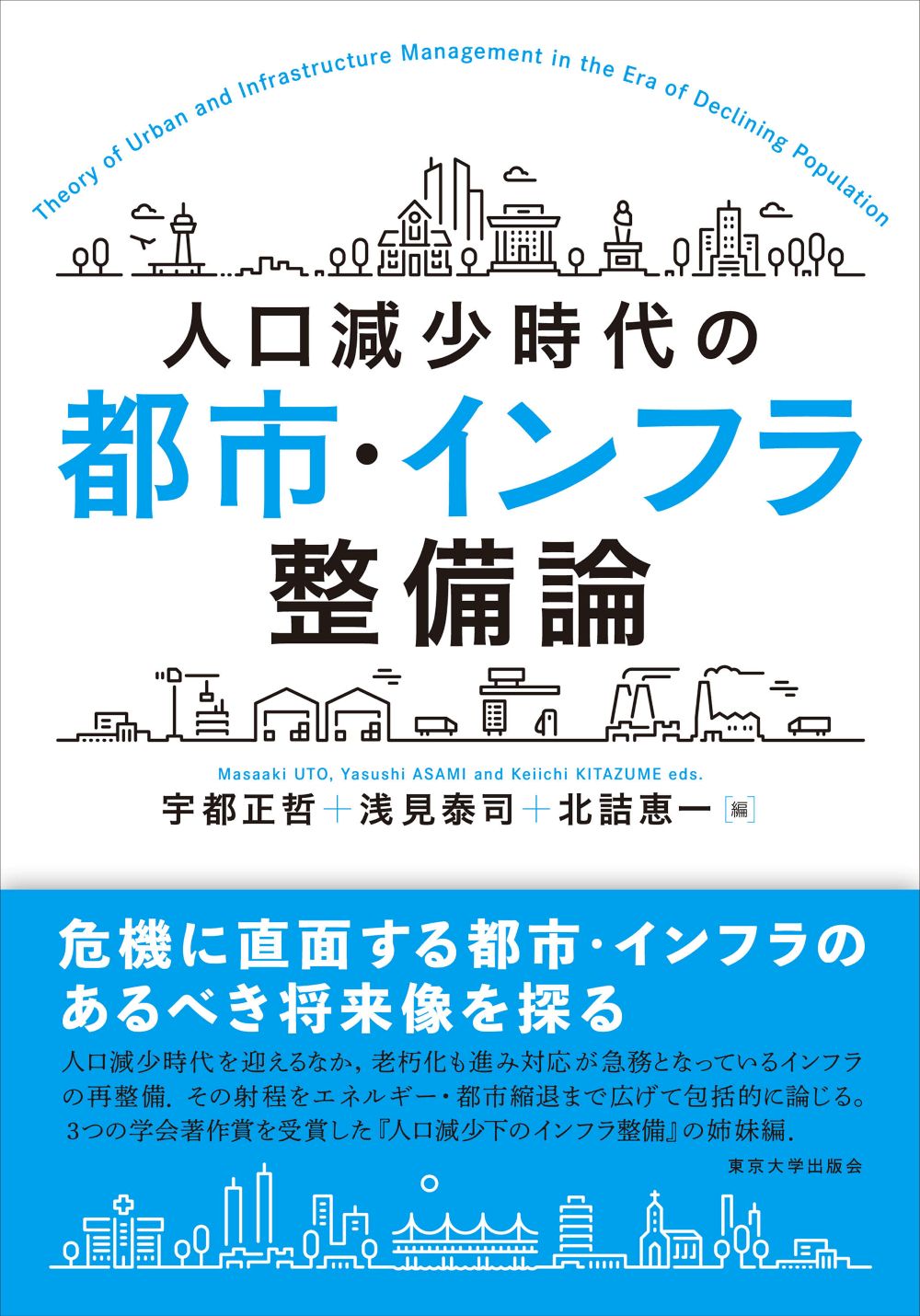
Jinko Gensho Jidai no Toshi, Infra Seibiron (Urban and Infrastructure Development in an Era of Population Decline)
Size
304 pages, A5 format
Language
Japanese
Released
September 18, 2024
ISBN
978-4-13-062847-1
Published by
The University of Tokyo Press
Book Info
See Book Availability at Library
Japanese Page
 eBook
eBook
As Japan has entered an era of severe population decline, this book comprehensively examines the ideal and future vision for urban and infrastructure development through the collaboration of experts from various fields from three perspectives: sustainability, fairness, and efficiency, and five perspectives: planning, technology, finance, agency, and risk-sharing.
Chapter 1, “Changes in the Social Environment Surrounding Cities and Infrastructure,” examines recent environmental changes and policy developments. Particularly, it briefly summarizes recent ecological changes, such as the infrastructure crisis, intensifying international competition, urban shrinkage, backlash against public-private partnerships, frequent disasters, the emergence of X-aaS, and efforts toward a decarbonized society.
Chapter 2, “The Desired Form of Cities and Infrastructure,” discusses ideal forms of cities and infrastructure. It is challenging to present a picture of an ideal city. Instead, it calls for illustrating the functions of an ideal city and enhancing urban planning tools to achieve this. Regarding infrastructure, the book argues that rather than solving everything with hardware alone, leveraging pricing mechanisms and information technology is necessary.
Chapter 3, “Three Aspects of Debating Cities and Infrastructure in an Era of Declining Population,” examines the concepts of sustainability, equity, and efficiency and discusses how to think about infrastructure in this context. Although multi-axis considerations can lead to trade-offs, it is essential to base them on sustainability.
Chapter 4, “Five Perspectives on Urban and Infrastructure Development in an Era of Declining Population,” discusses how to approach urban and infrastructure development in this era from five perspectives: planning, technology, finance, ownership, and risk-sharing. In terms of planning, while focusing on maintenance and management, we must simultaneously consider and implement decisions regarding which infrastructure to retain, how to attract people to the infrastructure, and how to remove unnecessary infrastructure. In terms of technology, we must shift from construction technologies to protection and integration technologies and provide technical support for appropriate downsizing. Infrastructure finance, which has traditionally focused primarily on long-term financing, needs to shift to a more diverse financing mix, recognizing the benefits of short-term financing. In terms of subject theory, infrastructure projects that adopted the principle of public management have only entrusted operational tasks to private companies. However, in the future, it will be necessary to view the right to manage public property and exercise public authority from a functional rather than a subjective perspective, thereby enabling more flexible project implementation. From a risk-sharing perspective, appropriate risk allocation is necessary in public-private partnerships. This book discusses the types of risks and how they should be shared.
Chapter 5, “Urban and Infrastructure Development in an Era of Population Decline,” summarizes the discussions up to Chapter 4, and it discusses hypothetical trends in cities and infrastructure. It represents the compactification of cities, innovation through the entry of different industries, the service industry, and the monetization of infrastructure.
(Written by ASAMI Yasushi, Project Professor, Center for Spatial Information Science / 2025)
Related Info
Japan Association of Real Estate Sciences Book Award (Academic Division) (JARES 2024)
https://www.jares.or.jp/award/winner_roncho_2024.html