

 Find a book


Title
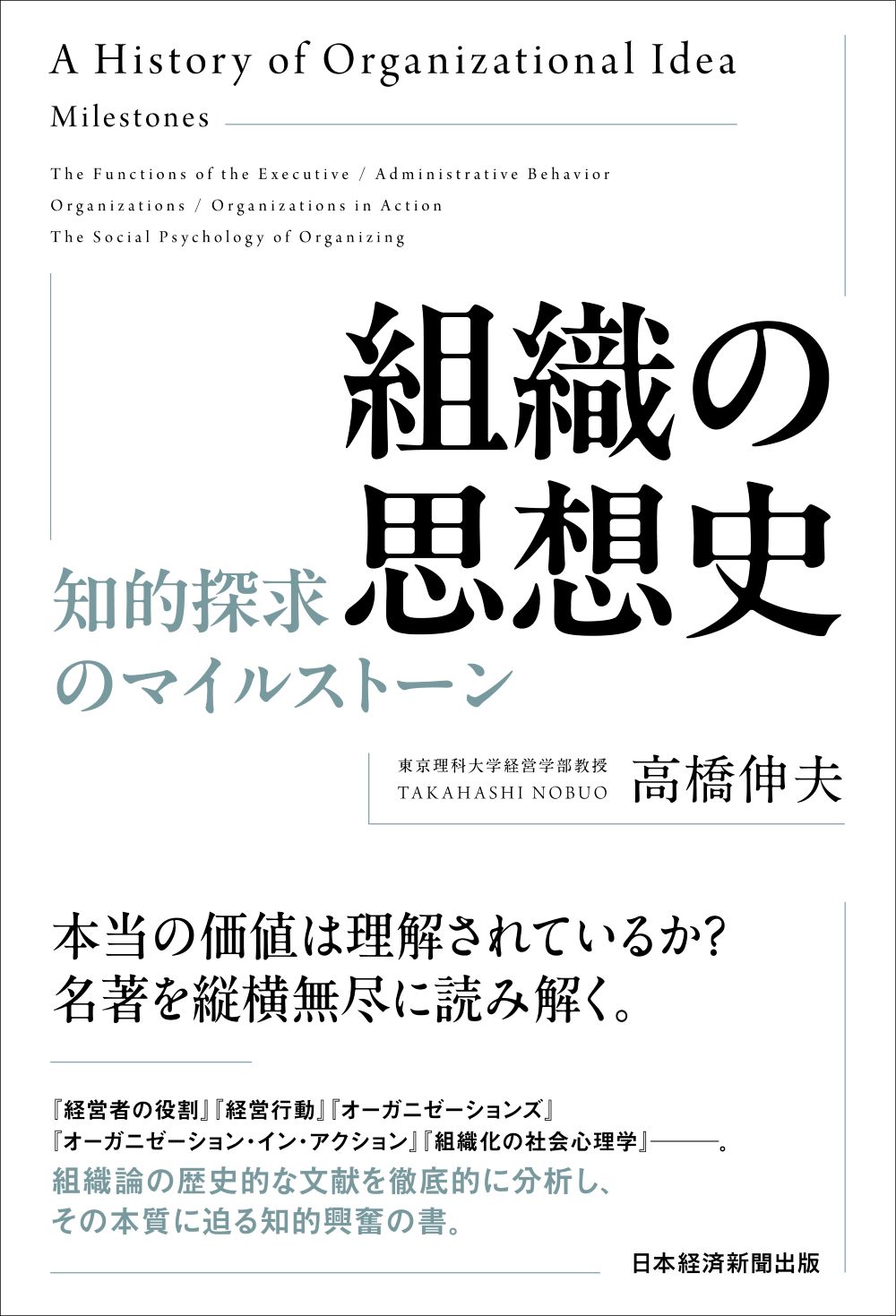
Soshiki no shisō-shi (A History of Organizational Idea - Milestones)
Size
388 pages, 127x188mm
Language
Japanese
Released
January 22, 2025
ISBN
9784296117659
Published by
Nikkei Business Publications, Inc.
Book Info
See Book Availability at Library
Japanese Page
There exists an academic field known as Organizational Theory. In Japan, the Academic Association for Organizational Science was established in 1959 to explore this field. Today, it boasts of the largest membership among management-related academic societies in Japan.
The major concepts of Organizational Theory were largely established, and its framework was constructed in the 20th century. Development has continued into the 21st century, making it extremely difficult to write a textbook that comprehensively covers the entirety of the field. The interdisciplinary nature of Organizational Theory makes it difficult to define its boundaries.
However, returning to the fundamental research question—“what is an organization?”—revealed that, along the path of inquiry, difficult-to-read classics appeared in almost every decade like milestones:
1. The Functions of the Executive (Chester I. Barnard, 1938)
2. Administrative Behavior (Herbert A. Simon, 1947)
3. Organizations (James G. March and Herbert A. Simon, 1958)
4. Organizations in Action (James D. Thompson, 1967)
5. The Social Psychology of Organizing (2nd ed.) (Karl E. Weick, 1979)
This book deeply examines these five classics—which could be called “milestones in Organizational Theory” that emerged in the 20th century—from a contemporary perspective and answers the question, “What is an organization?” Barnard’s work played a significant role in this regard. There is no doubt that Barnard’s ideas, as a professional manager, laid the foundation for the conceptualization and systematization of subsequent university researchers (especially Simon). For instance, regarding the idea of “bounded rationality,” which came to represent Nobel laureate Simon, Barnard’s work already contained a description that was arguably clearer than Simon’s: “we also imputed to the individual the restricted but important capacity of choice” (Barnard, 1938, p.38). This book traces the evolution of Organizational Theory, starting with Barnard, and spanning nearly half a century, as if passing a baton.
What is an organization? As we have seen, the answers to this question can be organized around common purpose and purposiveness. Simon believed that a purposive organization with a common purpose, as Barnard thought, should have economic rationality based on a hierarchy of ends with a common purpose at the top, despite being fragile. In contrast, Thompson thought that if an organization is purposive, there must be a core technology or technical rationality at the core of the organization. However, people do not have a common purpose from the beginning. According to Weick, once a stable interlocked behavior cycle is established, people with varying purposes can use it, enabling the assembly of a larger module. The result is a shift toward a common purpose.
Reading this book should reveal how much of our previous superficial understanding of these five classics has been mistaken or misguided. However, at their core, the five classics remained consistent. They persistently explored the question, “What is an organization?”
(Written by TAKAHASHI Nobuo, Professor Emeritus, Graduate School of Economics / 2026)