

 Find a book


Title
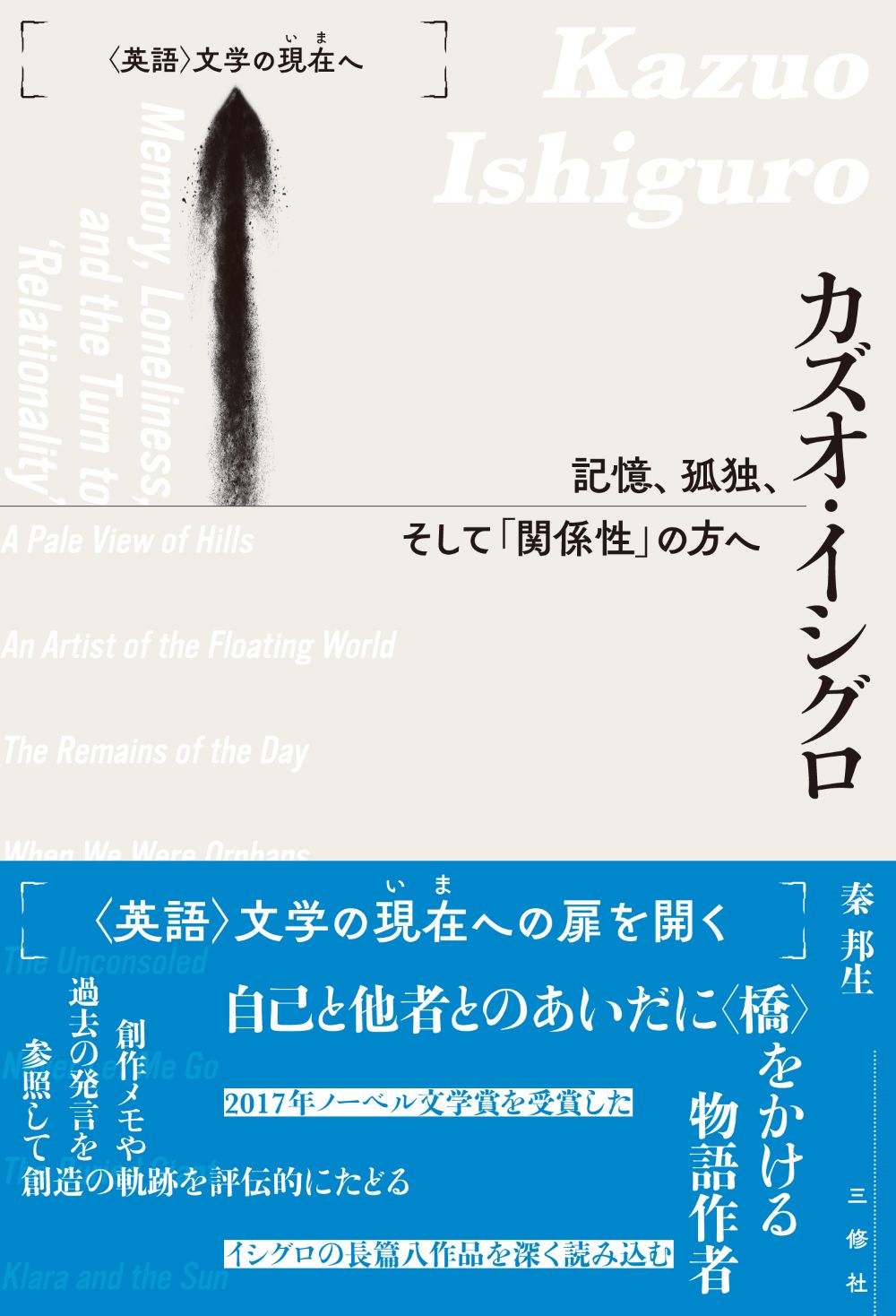
Anglophone Literature: Into the Present Kazuo Ishiguro (Memory, Loneliness, and the Turn to ‘Relationality’)
Size
448 pages, 127x188mm, softcover
Language
Japanese
Released
November 15, 2025
ISBN
978-4-384-06042-3
Published by
Sanshusha
Book Info
See Book Availability at Library
Japanese Page
This volume, Kazuo Ishiguro: Memory, Loneliness and the Turn to ‘Relationality’, is an attempt to provide a comprehensive portrait of the career of Kazuo Ishiguro, the 2017 Nobel Laureate in Literature. It examines his eight full-length novels published from his debut through to the present year of 2026. Born in Nagasaki and moving to the UK at the age of five to become a writer in English, Ishiguro’s life and work have resonated deeply with readers in Japan and beyond—not only through celebrated film adaptations such as The Remains of the Day, Never Let Me Go, and A Pale View of Hills, but also through his accessible and widely read Japanese translations.
By drawing on an extensive range of primary and secondary materials, this book aims to offer fresh insights to both newcomers and long-time admirers of his work. The first pillar of my research is Ishiguro’s own voice, captured in numerous interviews across periodicals, video, and audio. With the release of each new work, Ishiguro has spoken with remarkable candor about his creative philosophy, social perspectives, and personal history. By using these statements as an interpretive framework, this book goes beyond a close reading of individual novels to present a critical biography of his life and career.
The second key resource utilized here is the archival material Ishiguro sold to the Harry Ransom Center at the University of Texas at Austin in 2015. This book places particular emphasis on the vast array of notes he composed during his writing process, seeking to illuminate the origins and evolution of his narratives. Ishiguro is a writer acutely conscious of the traditions of the art of storytelling. Focusing on the rich notes spanning from his second novel, An Artist of the Floating World, to his sixth, Never Let Me Go, this book explores his unique literary identity through “intertextuality.” It traces intertextual connections to classical Western literature—from Greek epics to Dostoevsky and Kafka—as well as detective fiction and the Japanese cinema of Akira Kurosawa and Kenji Mizoguchi. For instance, those curious about the spiritual kinship between The Odyssey and Never Let Me Go will find a dedicated analysis in Chapter 6.
The structure of the book is straightforward and methodical. The introduction provides a brief biography of Ishiguro’s life prior to his debut, followed by an overview of five recurring themes that anchor this study:
1. Memory and the Narrator
2. The conflict between Loneliness and Relationality
3. The problem of “Setting”
4. The gaze toward marginalized individuals
5. The persona of the moralist
Subsequent chapters are dedicated to each of his eight full-length novels, providing a careful treatment that ranges from plot summaries to close readings of motifs and structure. Readers are encouraged to engage with the book flexibly, perhaps starting with chapters on their favorite works or skipping those they have yet to read.
It is my hope that this book will be a valuable companion for all, from those just beginning their journey with Ishiguro to the most seasoned of readers.
(Written by SHIN Kunio, Professor, Graduate School of Arts and Sciences / 2026)
Table of Contents
Chapter 1. A Pale View of Hills: “Beginnings” and the Landscapes of Mourning
Chapter 2. An Artist of the Floating World: The Aesthetic of “Masculinity” and Its Failures
Chapter 3. The Remains of the Day: The Ideals of the “Little People”
Chapter 4. The Unconsoled: A Tale of Ordinary Traumas
Chapter 5. When We Were Orphans: Beyond the “Bubble”
Chapter 6. Never Let Me Go: A Community of the Envious
Chapter 7. The Buried Giant: The Late Style
Chapter 8. Klara and the Sun: Fiction and the Act of Forgiving
Works Cited
Kazuo Ishiguro: A Guide to Further Reading
Afterword