

 Find a book


Title
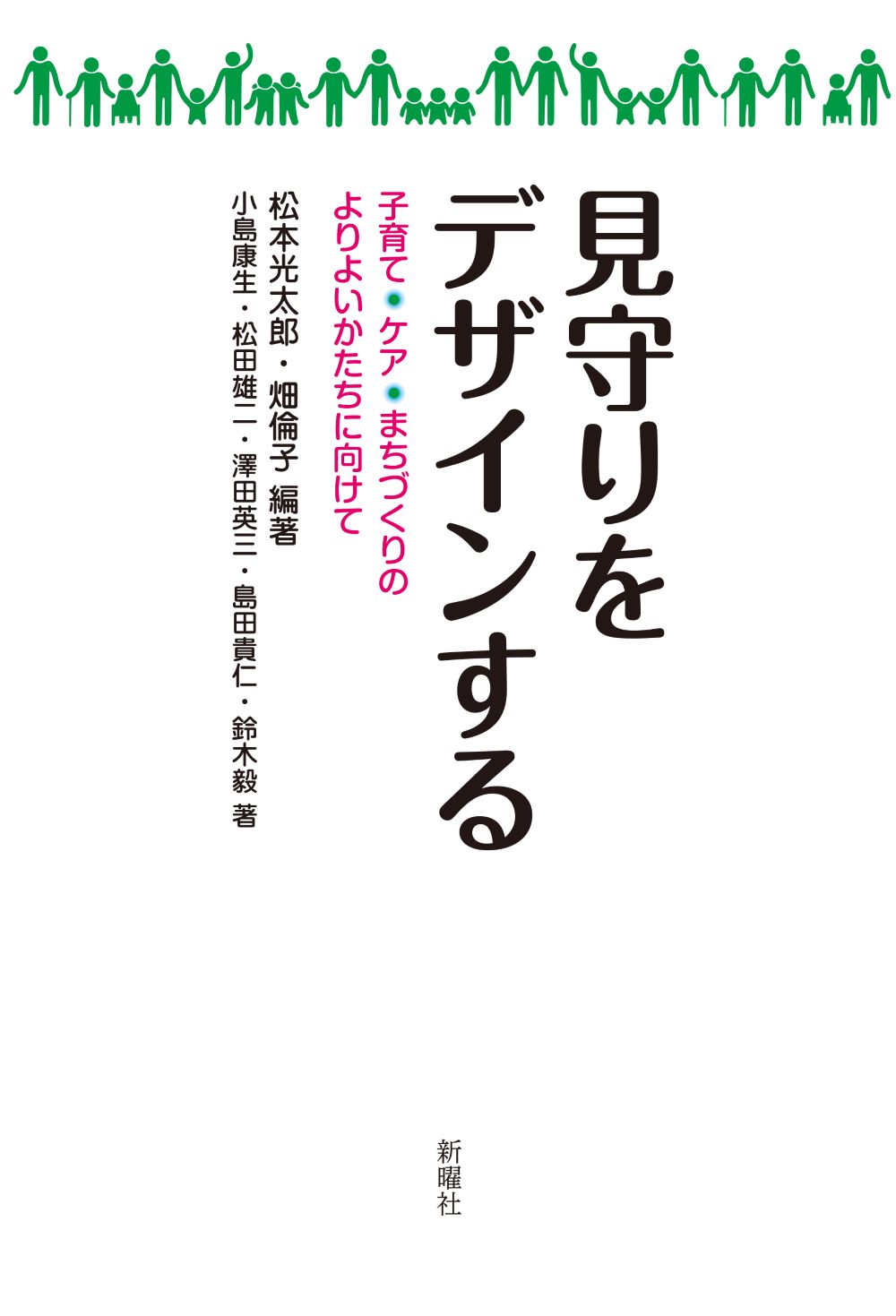
Mimamori wo design suru (Designing Mimamori - Toward Better Practices in Child-Rearing, Care, and Community Building)
Size
248 pages, 127x188mm
Language
Japanese
Released
November 25, 2025
ISBN
9784788519015
Published by
Shinyosha
Book Info
See Book Availability at Library
Japanese Page
We use the Japanese word mimamori (“watching over”) in a wide variety of contexts. The word itself—literally meaning “to watch” and “to protect”—evokes the gentle attitude and warm attention of someone who stays close by. At the same time, mimamori is practiced in many different settings. Parents watch over their children, staff in residential care facilities watch over older residents, community members watch over neighborhoods to prevent crime, and correctional officers watch over inmates in prisons. More recently, mimamori has increasingly been carried out using technology, such as cameras and sensor-based monitoring systems. Thus, the concept of mimamori extends far beyond its literal meaning and encompasses a broad range of situations and methods. This book seeks to take a broader view of these practices and reconsider fundamental questions: From what perspectives and by what methods should mimamori be carried out? What kinds of environments are appropriate for it? More fundamentally, what is the nature of mimamori itself? By examining on these questions from the perspective of practitioners and researchers, this volume aims to provide an overarching view on the practice of mimamori.
This book was written by seven members of the Man–Environment Research Association (MERA), a small interdisciplinary academic society centered on psychology and architecture. Chapter 1 focuses on the supervision of preschool children in the home and examines how parents watch over young children to prevent accidents in environments originally designed for adults. Chapter 2 turns to school-aged children and explores how mimamori extends beyond the home as children gradually become more mobile in their communities, including through a comparison of Japan and Austria.
Chapter 3 examines disability support facilities by comparing staff behavior before and after the introduction of remote monitoring technologies, demonstrating how changes in monitoring methods have transformed the relationship between private and public space. Chapter 4 addresses mimamori in residential care facilities for older adults, drawing on fieldwork to describe the shift from direct, face-to-face observation to indirect monitoring through increasingly widespread support systems.
Chapter 5 revisits the informal “diagonal relationships” —relationships with disinterested third parties, such as adults in the neighborhood or relatives who live far away, that are neither “vertical relationships” with parents, teachers, or others involving guidance and evaluation, nor “horizontal relationships” with friends and peers characterized by equality and similarity—that once characterized local communities and discusses the similarities and differences between mimamori and “surveillance,” drawing on examples such as technology enabled indirect surveillance in prisons. Chapter 6 examines the respective roles of human observers and technological tools in preventing crime and delinquency in communities through a series of practical examples.
Chapter 7 takes a broader view of contemporary society, considering how changes in housing and urban environments—such as enhanced security measures in detached houses and the increasing use of auto-locking systems in apartment buildings—have reduced opportunities for interaction between individuals and the wider world. In response, it proposes a design concept of iru–mimamoru (“being–watching over”) as a means of re-establishing these connections. Finally, the concluding roundtable discussion reflects on the themes addressed in each chapter and explores how the contributors understand the concept of mimamori from their respective disciplinary perspectives.
Through these seven chapters and the concluding discussion, we hope that readers will gain new insights into how mimamori can be designed to meet the needs and realities of contemporary society.
(Written by MATSUDA Yuji, Professor, School of Engineering / 2026)