

 Find a book


Title
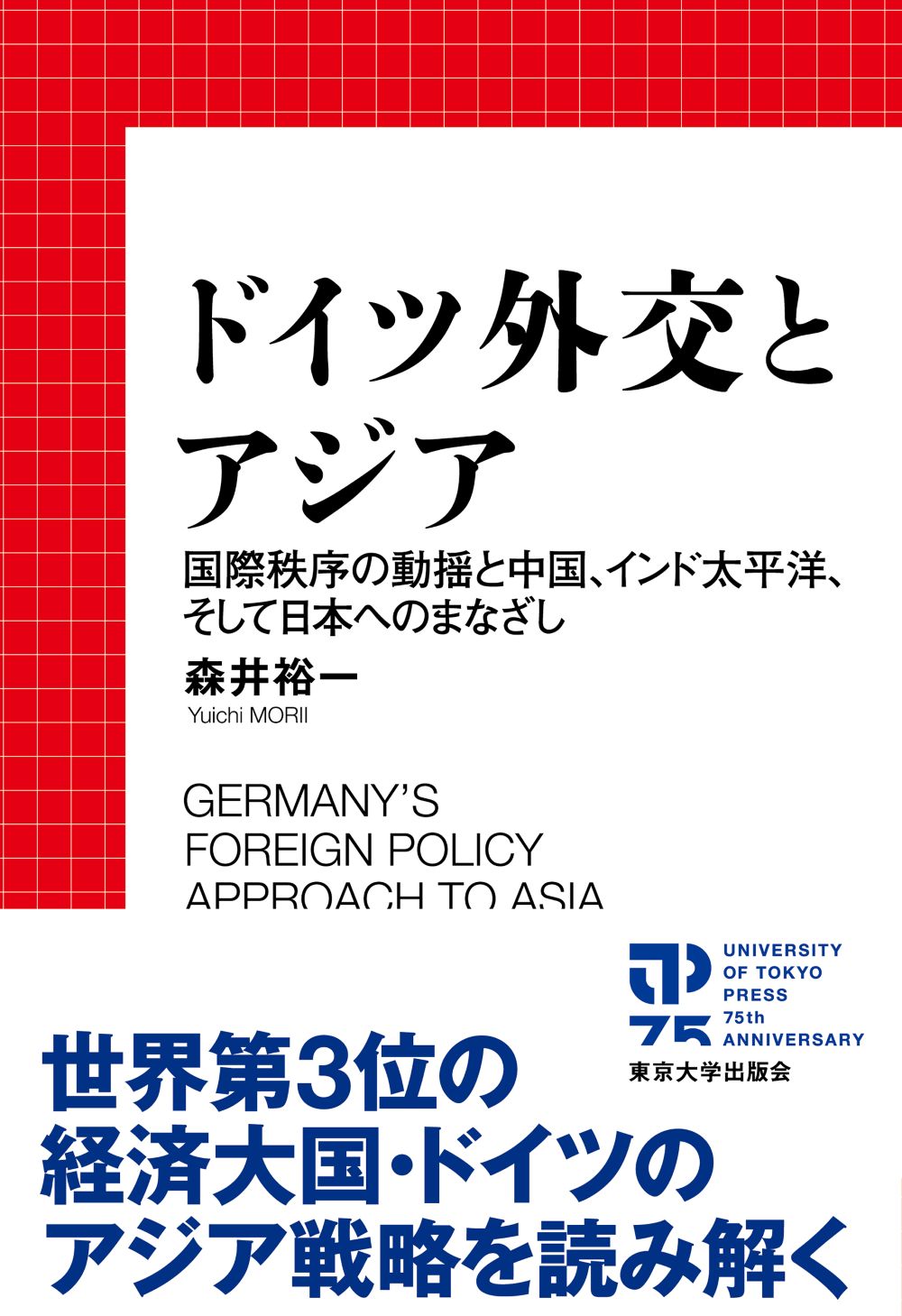
Doitsu Gaiko to Asia (Germany’s Foreign Policy Approach to Asia in a Changing International Environment - China, the Indo-Pacific, and Japan)
Size
256 pages, 127x188mm
Language
Japanese
Released
February 27, 2026
ISBN
978-4-13-030198-5
Published by
University of Tokyo Press
Book Info
See Book Availability at Library
Japanese Page
 eBook
This book examines how Germany has sought to redefine its relations with China, Japan, and the broader Indo-Pacific region at a time when the postwar liberal international order is facing unprecedented challenges.
Germany is neither a superpower like the US nor a small or middle-sized state. Supported by its strong economic capacity, it has long pursued diplomacy as a middle power, contributing to maintaining the international order through multilateral institutions such as the European Union (EU) and United Nations. However, Russia’s invasion of Ukraine, China’s growing influence, and increasing uncertainty in US foreign policy have profoundly reshaped the international environment. This book explores how these changes are reflected in Germany’s policy toward Asia.
For many years, Germany regarded China as an attractive market and expanded economic ties, expecting that closer engagement might encourage convergence on values such as democracy and human rights. Those expectations were not met, while security concerns associated with economic dependence became increasingly evident. Germany has therefore adopted a “de-risking” strategy, aimed at reducing excessive dependence and mitigating vulnerabilities arising from economic interdependence. This strategy does not seek to decouple from China but rather to maintain economic relations while managing associated risks.
Japan, although unable to replace China as an economic partner or market, has become an increasingly important strategic ally for Germany because of shared commitments to democracy, the rule of law, and human rights. Building on the EU–Japan Economic Partnership Agreement, bilateral cooperation has expanded beyond economic relations to include political dialogue, security, and defense cooperation.
Germany has also developed a broader Indo-Pacific policy, viewing the region as a new strategic arena for its diplomacy. To support a free and open maritime order and uphold the rule of law, Germany has strengthened its political and security engagement in the region. Rather than acting alone, however, it has pursued these objectives primarily through the development and implementation of the EU’s Indo-Pacific Strategy.
Germany continues to regard the US and North Atlantic Treaty Organization as indispensable pillars of its security. Nonetheless, growing uncertainty surrounding US foreign policy—particularly during the Trump administration—has reinforced Germany’s recognition of the need to strengthen the EU’s strategic autonomy and institutional capacity to act.
This book therefore analyzes the evolution of German foreign policy, considering the country’s status as a middle power, through four interrelated dimensions: redefinition of relations with China, strengthening of cooperation with Japan, increased engagement in the Indo-Pacific, and enhancement of the EU’s institutional capacity that underpins these policies. Like Japan, Germany cannot shape the international order alone but relies on multilateral cooperation. It is hoped that this analysis of Germany’s diplomacy will also provide useful insights for understanding Japan’s foreign policy in an era of profound transformation in the international order.
(Written by MORII Yuichi, Professor, Graduate School of Arts and Sciences / 2026)