


Miraculous gate lives on into the future Akamon Gate (Part 2)
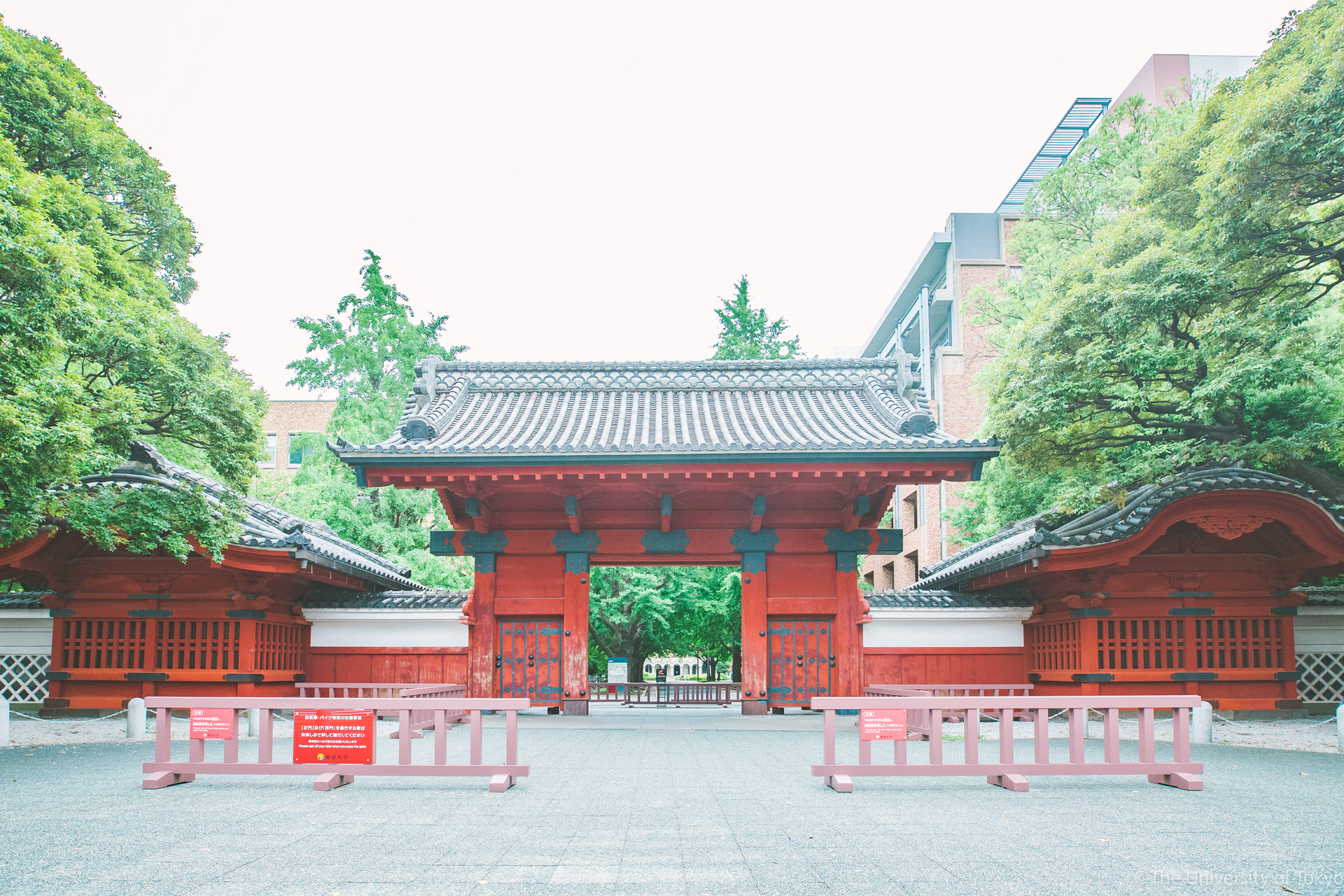
In 1877, the University of Tokyo was established at its site in the Hongo area of present-day Bunkyo ward in Tokyo. A red gate, erected half a century earlier during the Edo period, remained on the property, which previously belonged to the Maeda clan of the Kaga Domain that had built the portal for Princess Yo-hime, a daughter of the Tokugawa shogun at the time. The university inherited the red gate, known as Akamon, when it established its campus on the site.
During the time of the Tokugawa shogunate, a gate built for a Tokugawa princess would be demolished upon her death. Princess Yo-hime died in May of 1868, the year following the return of political authority from the shogunate to the imperial court, and just a month after the Tokugawa family surrendered Edo Castle to the forces of the new Meiji government. With the fall of the shogunate, the Tokugawa family no longer exercised authority over the capital, Edo (now Tokyo), and there was no one to order for the gate to be torn down. Because Princess Yo-hime lived just long enough to outlive the shogunate, this distinguished gate avoided destruction and was able to survive. Around that time, a fire also broke out in the Hongo area, where Akamon stands, burning down many of the surrounding residences, but the gate survived. After Akamon became part of the university, Tokyo was devastated by a slew of fires, caused by the 1923 Great Kanto Earthquake, air raids during World War II and other events. Despite that, Akamon has remained standing, thanks to the continued efforts of the university community.
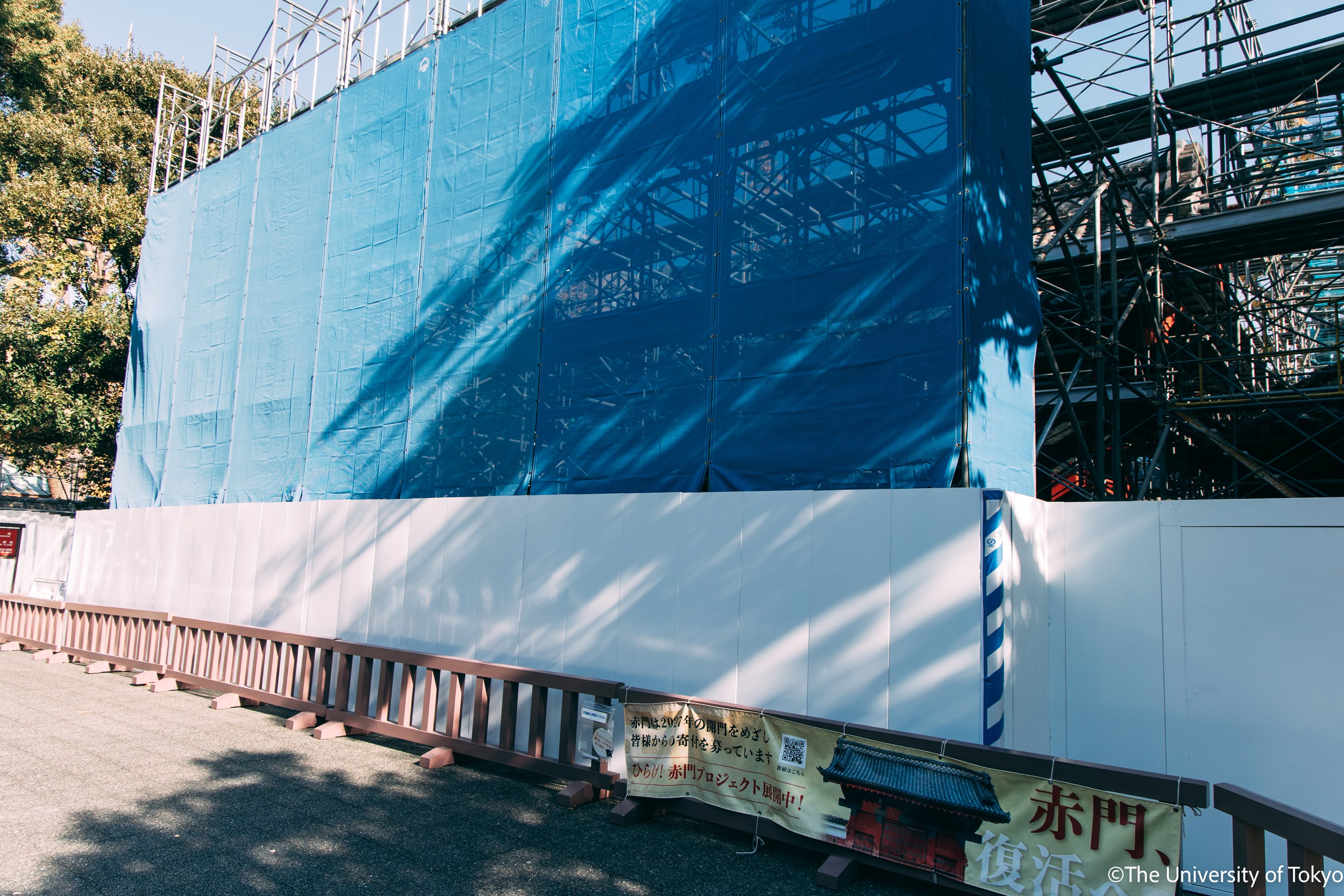
Today, Akamon is shrouded in scaffolding and protective coverings, making it impossible to see the gate in its entirety. Seismic reinforcement work is currently underway to ensure the structure can withstand earthquakes.
We spoke with Professor Kaori Fujita, a specialist in structural aspects of traditional timber architecture who investigated the gate’s structure and was involved in developing its restoration plan, on what aspects of the gate are of greatest concern.
“When it comes to a building’s ability to withstand earthquakes, weight is a crucial factor,” said Fujita. “Above all, the weight of the roof is the most significant factor. The heavier the roof, the greater the seismic force exerted on the structure.”
Retrofit for major quakes
Akamon was built at some distance from Princess Yo-hime’s residence, rather than directly in front of it. In Japanese, such a gate is called a hanare-mon (detached gate).
At the front of Akamon are four pillars supporting the roof, aligned in a straight row. These are known as the main pillars. In addition, two supporting pillars stand at the rear. The roof itself is set back slightly from the line of main pillars. This structural arrangement is called yakui-mon.
Akamon’s pillars are arranged 8.06 meters across and 3.27 meters in depth, forming a long, narrow rectangle when viewed from above. The pillars rest on stone bases and support the roof above. Because of this elongated shape, the structure offers less resistance to shaking along its shorter side. Moreover, the roof, which rises to a height of 8.8 meters, is heavy from the weight of its clay tiles. In the event of a major earthquake, there is great risk of the gate collapsing.
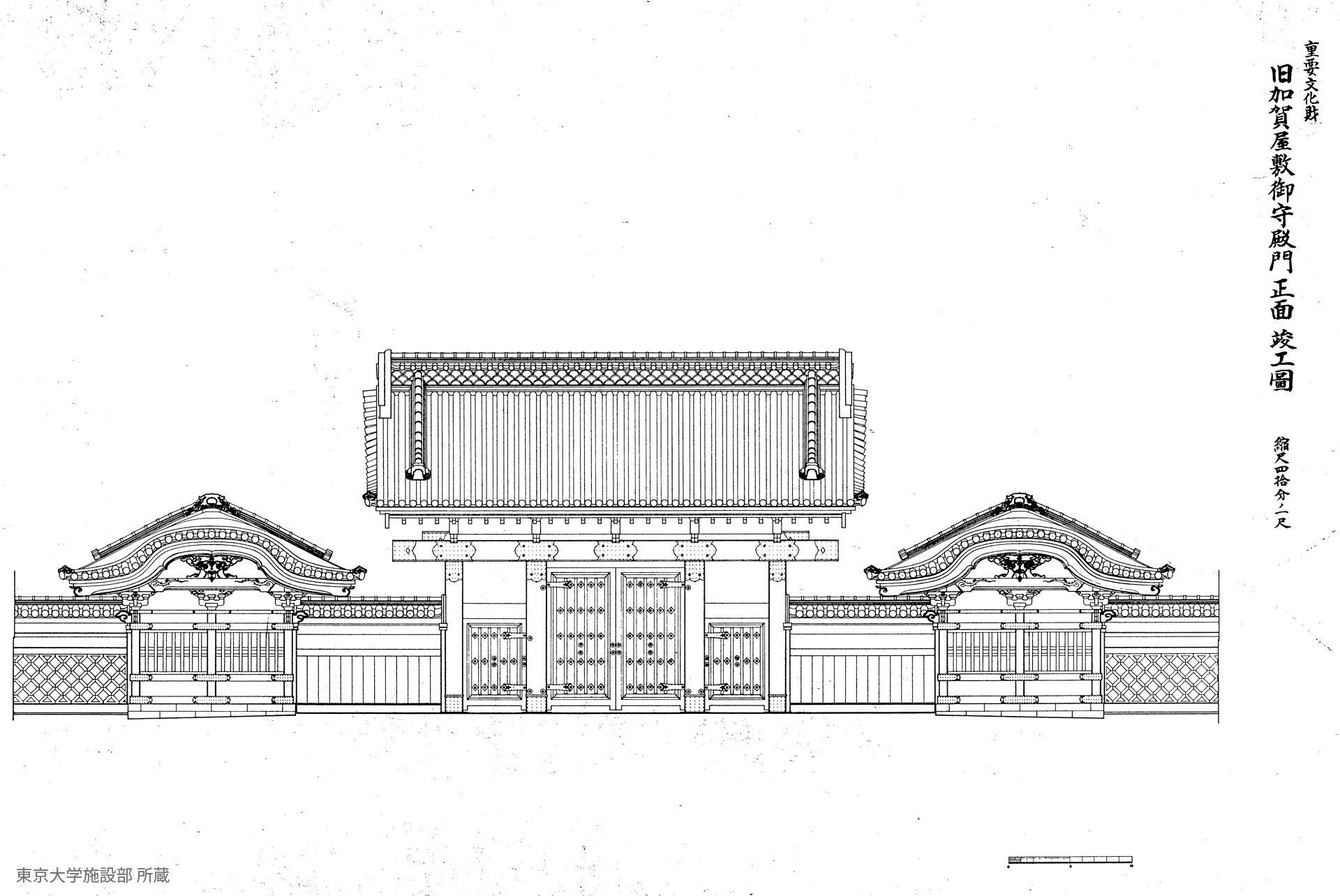
“As part of the restoration work, all of the roof tiles will first be removed,” Fujita explained. “Beneath the tiles are layers of mud and plaster used to secure them. A lot of this material will be removed, retaining just a portion to reduce the overall weight of the roof. Some of the wood has also deteriorated and therefore will be replaced. After that, the tiles will be put back in place.” The roof, currently estimated to weigh about 30 tons, is expected to become roughly 5 tons lighter as a result of the work, according to Fujita.
In addition, she said, “Counterweights will be embedded beneath the structure. Bolts extending from these counterweights will anchor the horizontal beams that connect the gate’s pillars from below, preventing the structure from lifting during an earthquake.” This measure will improve the gate’s resistance to shaking.
Furthermore, the joints where the gate’s pillars are vertically connected will be reinforced by wrapping them with carbon fiber sheets. Bansho, the guard posts on either side of the gate, will also be reinforced with durable plywood. Diagrams illustrating these seismic reinforcement measures can be found on the UTokyo Foundation webpage on the reinforcement project .
.
According to Fujita, earlier investigations revealed some interesting findings on the roof tiles.
“The roof is the part of a building that deteriorates most easily, so the repeated repairs carried out over the years reflect different historical periods,” she explained. “We can see tiles bearing the hollyhock crest, those from after the site became part of the university, and others associated with the Maeda family. It is fascinating to see tiles from different eras coexisting on the same roof.”
Among the roof tiles are a variety of crests reflecting different periods of Akamon’s history: The triple hollyhock crest of the Tokugawa family, which is Princess Yo-hime’s natal family, was used at the time of the gate’s construction; the character gaku (學) (associated with learning) was adopted after the site became part of the university in the Meiji period; and since the Taisho period (1912-26), plum-blossom designs associated with the Maeda family are believed to have been added as a mark of respect.
Since it is a structure dating from the Edo period, Akamon was built employing traditional Japanese joinery techniques, in which wooden joints are carved and fitted together. Beneath the roof, a framework of wooden components is assembled, including taruki rafters that support the roof and hanegi, leverage beams that lift and brace the rafters from below. Metal fittings are also used to secure these wooden elements. Meanwhile, the gate’s front doors are not made from single thick planks. Instead, internal crosspieces are used and boards fastened onto them to create thickness. The black metal fittings visible in the front give the gate the powerful appearance typical of samurai architecture, but these are actually decorative nail covers. Through a combination of traditional techniques and materials available at the time during different periods, a wide range of thoughtful innovations can be seen throughout the structure.
Vestiges of past craftsmanship left behind
Fujita reflected on what she described as almost a miracle. “About 200 years have passed since Akamon was built, and in the century leading up to the present, it survived the Great Kanto Earthquake. Many buildings on campus either collapsed or were destroyed by fire, yet Akamon endured. While the extent of damage left in the wake of fires can depend on factors such as wind direction, the gate withstood the earthquake itself. We could describe its survival as truly miraculous.”
Wooden structures require regular maintenance, including repairs such as replacing damaged sections of pillars. Since the Meiji period, the University of Tokyo has carried out seven rounds of restoration work, both large and small, on Akamon. These have included correcting the tilt of the roof, applying fresh coats of paint and replacing wooden components. The current project marks the eighth restoration.
“Because Akamon is painted red, traces of past repairs are not immediately apparent. However, our current investigation revealed that every pillar has in fact been repaired, even the two rear supporting pillars, which had been cut and replaced. This shows just how much the gate has been cared for and maintained over time. While it is important to understand how Akamon was originally built, the efforts that have gone into preserving it are equally significant. Preserving cultural property requires funding, and such assets can thereby be regarded as a nuisance. All the more reason to admire the dedication of those before us who continued to protect Akamon. I truly respect their commitment,” Fujita said with pride.
As an architecture specialist, Fujita shared a delightful discovery during the current investigations. “The lower sections of pillars are more prone to disrepair, so those parts were cut and replaced in repairs carried out since the Meiji period, in a process known as netsugi. Some old wooden sections that had been discarded were discovered in the space under the roof. Ink inscriptions on them even included the names of former professors from the university’s Department of Architecture. To find components that show how carefully the structure was maintained, and to know that they have survived to this day, I think that is something truly wonderful.” She spoke warmly of the joy passed down from those who came before us.
In Part 3 of the Akamon series, we speak with a professor of architectural history to learn about the trees and forests of Japan that lie behind the country’s magnificent wooden architecture.
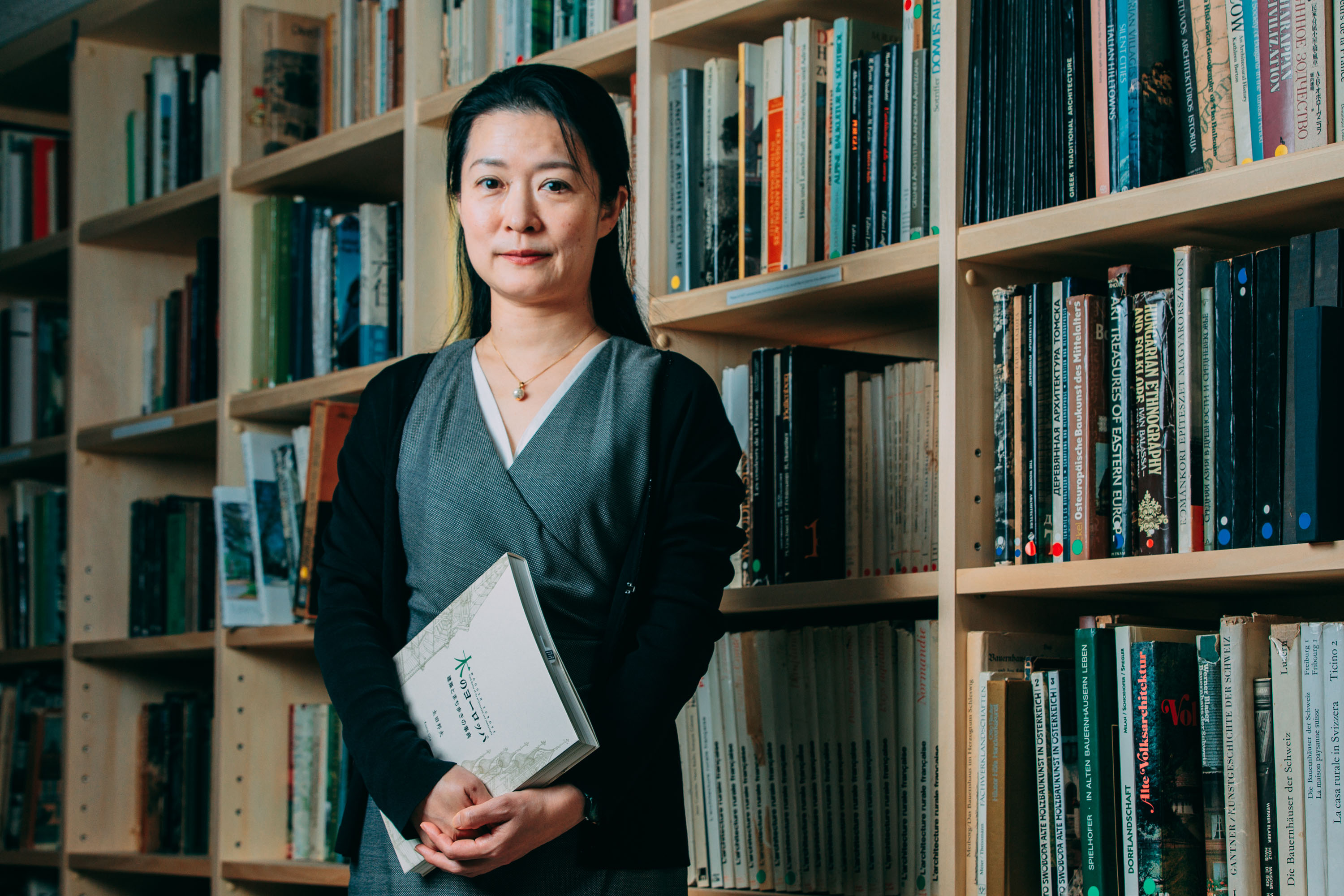
Kaori Fujita
Professor, Graduate School of Engineering
Specializes in structural characteristics and seismic performance of traditional timber architecture. Graduated from Department of Architecture, Faculty of Engineering, then received Ph.D. in engineering from Graduate School of Engineering, the University of Tokyo. Assumed current position in 2019, after serving as associate professor from 2007. Published books include Zusetsu: Nihon Mokuzo-Kenchiku Jiten (“An illustrated encyclopedia of Japanese timber architecture: History of building construction”) (Asakura Publishing Co., Ltd., 2018), as editor and contributor. Journal papers include “Long-Term Earthquake Response Monitoring of Nineteenth-Century Timber Temple Kencho-ji, Japan” (International Journal of Architectural Heritage, 2023), among others.
Interview: Yasushi Nakashima