



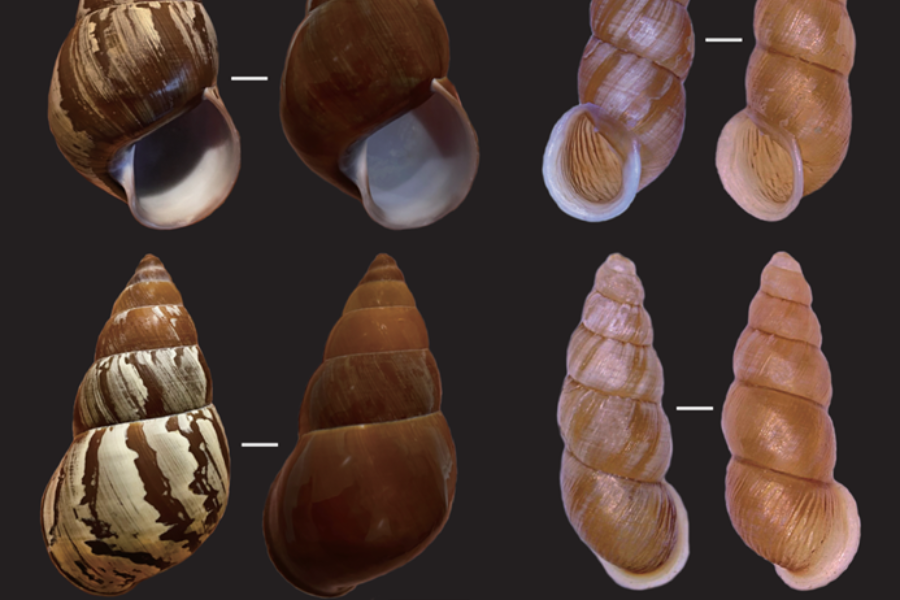
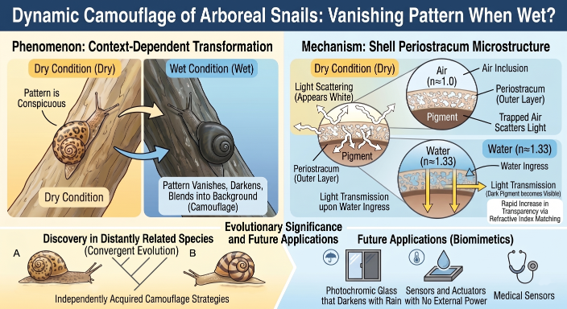
How does a stripy tree snail hide from hungry birds? The Hypselostyla camelopardalis from the Philippines and Reinia variegata from Japan have both evolved a form of dynamic camouflage to survive. Their light-colored patterns vanish in the rain and the shell turns dark brown, similar to damp tree bark. Researchers from the University Museum at the University of Tokyo have uncovered the mechanism behind this rare molluscan transformation. The outmost layer of the snails’ shell is porous like a sponge. When water fills the holes, it changes how light bounces off, making a second darker layer of shell beneath more visible. This has potential applications for smart sensors and materials that react to humidity, without the need for external power.
A leopard can’t change its spots, but some snails can change their stripes! Now we know how, thanks to new research at the University of Tokyo.
Dynamic camouflage is when an animal can change its color, pattern or texture to blend in with its surroundings. Perhaps the best-known examples are from cuttlefish, octopuses and squid, whose dramatic transformations to mimic sand, rocks or coral make for an impressive show, if you can spot them.
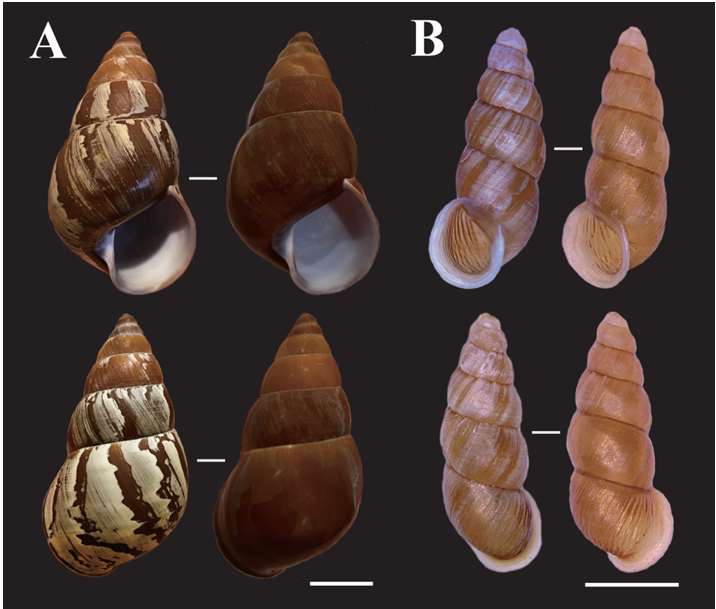
Two species of snails – one in the Philippines and one in Japan – have intrigued researchers by evolving the same method of dynamic camouflage. This was surprising because it happened independently, as the snails are only distantly related from a genetic perspective and geographically far from each other, and because shell colors and patterns were thought to be fixed features.
“The Philippine Hypselostyla camelopardalis and the Japanese Reinia variegata are tree-dwelling snails which both exhibit a reversible form of ‘hydrochromism.’ Their mottled shell patterns completely disappear upon wetting, causing the shell to darken uniformly, and then rapidly reappear as they dry,” explained Taro Yoshimura, a researcher in evolutionary paleontology at the University Museum.
“We now understand the physical mechanism driving this phenomenon: a process known as refractive index matching. The two-layered structure of the outermost organic membrane of the shell (called the periostracum) has spongelike nano- to microscale voids that absorb moisture. The water-filled pores suppress light scattering, allowing light to pass through the membrane and reveal the dark pigments of the crystalline shell layer below.”
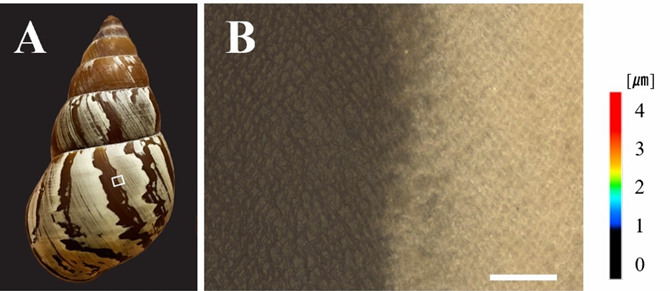
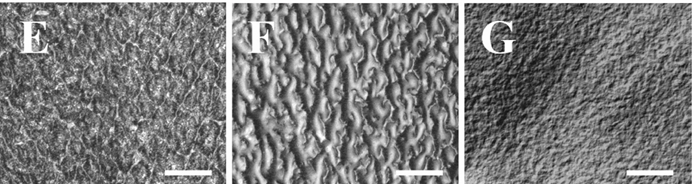
Yoshimura and co-author Associate Professor Takenori Sasaki studied snail shells from the museum collection at the University of Tokyo, using three approaches to uncover their unique properties.
The bilayered structure of the surface, with its porous outer layer and dense, darker inner layer, was revealed using a field-emission scanning electron microscope. After much trial and error, according to Yoshimura, they tracked the ultrafast hydration process using a confocal laser scanning microscope. Finally, they measured the dramatic change in light transmittance using a spectrophotometer, from roughly 37% when dry to around 85% when wet.
“Conventionally, molluscan shell coloration and patterning have been considered static features, strictly determined by pigments embedded within the calcified crystalline layers. Our study fundamentally challenges this established paradigm, altering their appearance in real time based on ambient humidity,” said Yoshimura. “Witnessing how natural selection can drive entirely different organisms toward the exact same elegant evolutionary solution was an incredibly exciting discovery.”
This research into the mechanism behind dynamic camouflage could be useful for many sectors, from smart materials for the home to autonomous environmental or medical sensors, and for other industries. Yoshimura hopes to collaborate with experts across engineering fields to apply their discoveries.
“The greatest advantage of the snails’ mechanism is that it alters their optical properties autonomously in response to ambient moisture, without any external power source,” said Yoshimura. “My ultimate hope is to bridge the gap between evolutionary biology and material science, translating nature's zero-energy physical tricks into the practical development and commercialization of next-generation smart materials.”