


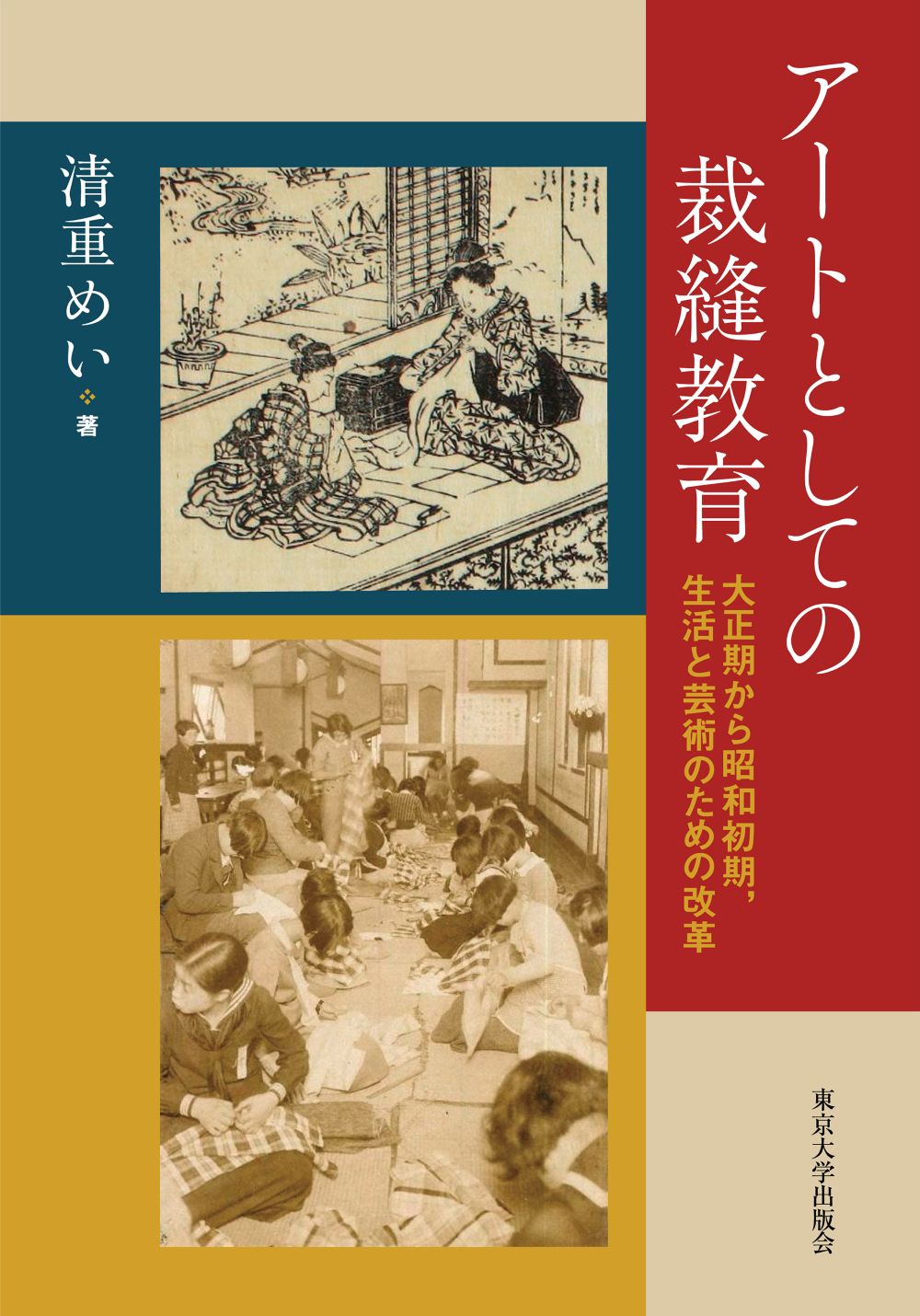
Title
Art toshiteno Saihōkyōiku (Sewing Education as Art - Reforms for Life and Art from the Taisho to Early Showa Periods)
Size
264 pages, A5 format
Language
Japanese
Released
February 02, 2026
ISBN
978-4-13-056247-8
Published by
University of Tokyo Press
Book Info
See Book Availability at Library
Japanese Page
 eBook
eBook
Sewing education persists, even today, in home economics classes in schools. However, the number of hours decreases with the number of subject hours. Pre-World War II sewing education was highly valued as a core component of girls' education. Today, fast fashion has become common and the practice of making clothes at home has drastically diminished. Did sewing education, which was required before World War II, become unnecessary? In fact, even before World War II, the significance of sewing education was questioned amid societal changes. By examining these pre-World War II trends, this book explores the true value of sewing education.
The originality of this book lies in [1] its depiction of reform trends surrounding sewing education from the Taisho period to the early Showa period, and [2] its reinterpretation of sewing education as “art.”
The history of sewing education has often focused on depicting changes in institutional frameworks and textbook content. However, unlike home economics courses, sewing courses did not undergo any major institutional changes from 1911 to 1941. This limits the scope of studies relying solely on institutional change. Therefore, this book clarifies the state of affairs at that time based on primary sources, such as essays and practice records by sewing education practitioners and theorists. Specifically, efforts to reform sewing education were categorized into four types: (1) Emphasis on Moral Cultivation, (2) Transition to Western-style dressmaking Education, (3) Shift to Clothing Lifestyle Management, and (4) Inclusion in Art Education. While (1) to (3) had been addressed sporadically in previous research, this study newly identified (4) and attempted a comprehensive reconstruction after reexamining (1) to (3).
This book reexamines sewing education as an “art” through an analysis of four sewing education reforms and the specific educational practices of Jiyu Gakuen. Jiyu Gakuen was a girls' secondary school founded in 1921 in Nishi Ikebukuro by Motoko and Yoshikazu HANI. It is positioned in educational history as a part of the Taisho New Education Movement and continues today in Higashikurume. In examining the educational practices of Jiyu Gakuen, it became clear that sewing education was incorporated within “arts and crafts education.” Within the reforms outlined in points (2) and (3) above, attention to Western “fashion” and “clothing culture” also helped identify an aesthetic perspective within sewing education, which meant that sewing was included within the narrower concept of “art.” Furthermore, the broader concept of “art” means technique and sensibility, overlapping with point (1) above. The value of this book lies in its reinterpretation of sewing education not merely as learning traditional techniques but also as a subject possessing the broader educational significance of “art.”
Today, it is difficult to view sewing education as an instruction for acquiring skills that are directly applicable to daily life. However, the discussions and practices surrounding its value prior to World War II were far too rich to be dismissed as merely part of girls’ education. I hope this book encourages readers to consider what sewing education truly means.
(Written by: KIYOSHIGE Mei / August 14, 2026)
Related Info
The 6th UTokyo Jiritsu Award for Early Career Academics (The University of Tokyo 2025)
https://www.u-tokyo.ac.jp/ja/research/systems-data/n03_kankojosei.html
National Association for the Study of Educational Methods Research Encouragement Award (2023)
KIYOSHIGE Mei. “Theory of Creative Sewing Education by Ryosuke HOMMA in the 1930s:
in Relation to Creative Drawing Education” (Research journal of educational methods, Vol.47, 2022, pp.35-45)
https://www.nasem.jp/研究奨励賞について/