


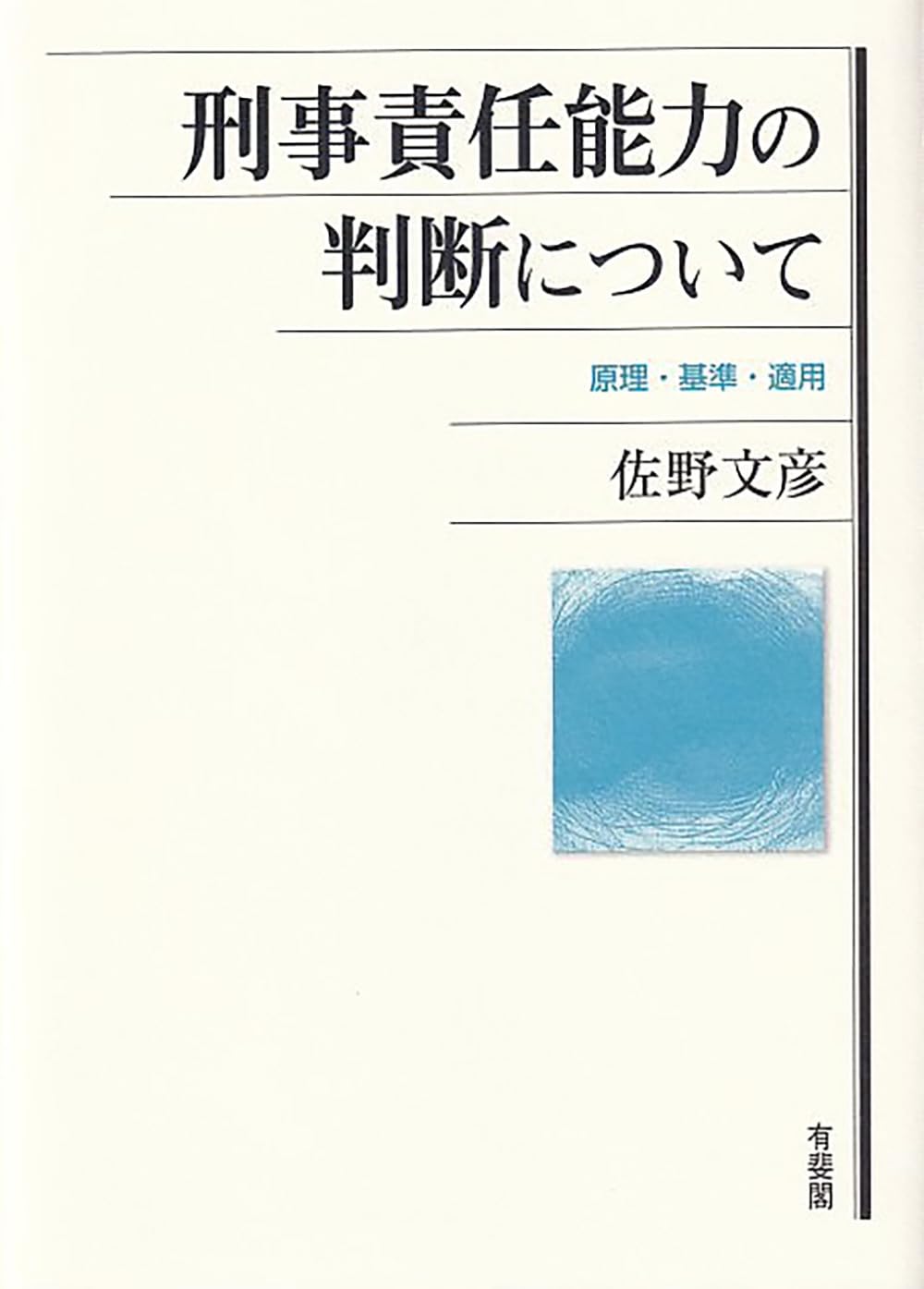
Title
Keijisekininnnouryoku no Handann nitsuite (On Criminal Responsibility and Mental Disorder - Principle, Criteria and Application)
Size
460 pages, A5 format, hardcover
Language
Japanese
Released
March, 2025
ISBN
978-4-641-13969-5
Published by
Yuhikaku Publishing Co., Ltd.
Book Info
See Book Availability at Library
Japanese Page
 eBook
eBook
Under what conditions should an individual who has committed a crime under the influence of a mental disorder be excused from criminal responsibility? This question, so-called “criminal insanity” in Anglo-American law, has consistently attracted acute societal concern. In capital cases, such as the Kyoto Animation case, this issue becomes pivotal because a finding of diminished responsibility excludes capital punishment, and insanity necessitates a verdict of not guilty. Thus, it is both a central juridical contest and a focus of broader public discourse.
Since the introduction of the lay judge (saiban-in) system in Japan, discussions on criminal insanity have gained traction in legal theory and practice. The contrast between a mid-Heisei era academic theory (“the influential theory”) and interpretive guidelines from recent judicial studies is central to this discussion. The former posits that criminal blameworthiness presupposes the ability to refrain from committing the act (principle); therefore, the actor who was either incapable of knowing the illegality of the act or could not refrain from committing the act is excused (criteria). Conversely, the latter has proposed a distinct evaluative framework, particularly in cases involving schizophrenia, namely, whether the act was committed as a consequence of the mental disorder or of normal mental functioning (criteria and application), and this framework is reported to have achieved significant traction within judicial reasoning.
While some scholars argue that these two approaches are functionally equivalent, this book contends that equivalence is illusory because the principles and criteria of the former are not commensurable with the criteria and application articulated in the latter. Recent theoretical and practical developments have acknowledged this incongruity. Furthermore, when critically scrutinized, each approach reveals a range of internal conceptual and normative difficulties.
This monograph endeavors to elucidate a coherent framework grounded in the systematic alignment of principle, criteria, and application. It historically situates the current impasse within the broader evolution of Japanese academic theory and case law and undertakes a comparative analysis of pertinent doctrines and case law in German and American law in search of trajectories to resolve the persistent ambiguities.
The subtitle is Principle, Criteria, and Application. The proposition that any legal framework must exhibit internal coherence across these levels can be considered axiomatic. However, rendering it explicit and placing it at the core of the inquiry, I believe, serves to clarify what is often perceived as one of the most conceptually intractable areas in criminal law. I hope that this clarity will render the discourse accessible to scholars and practitioners whose primary engagement does not lie in the domain of criminal insanity.
Criminal law alone cannot exhaustively address the issues of criminal responsibility and mental disorders within its disciplinary boundaries. At the principal level, it implicates foundational issues in philosophy, whereas at the application level, it demands engagement with psychiatry. For example, the question of whether a biologically oriented understanding of mental disorders should influence the concept of criminal insanity is intertwined with traditional German psychiatry, such as that initiated by Jaspers, and with the evaluation of operational diagnostic criteria. Similarly, philosophical discourses concerning free will and the philosophy of mind are directly relevant. One may also cite the philosophy of mental disorders and the ethics of blame as indispensable interlocutors in this inquiry. This monograph, although situated within the doctrinal terrain of criminal law, encompasses an awareness of a broader intellectual context. I hope that this work succeeds in engaging the interests of readers beyond criminal insanity and criminal law.
(Written by: SANO Fumihiko / March 23, 2026)
Related Info
The 5th UTokyo Jiritsu Award for Early Career Academics (The University of Tokyo 2024)
https://www.u-tokyo.ac.jp/ja/research/systems-data/n03_kankojosei.html