


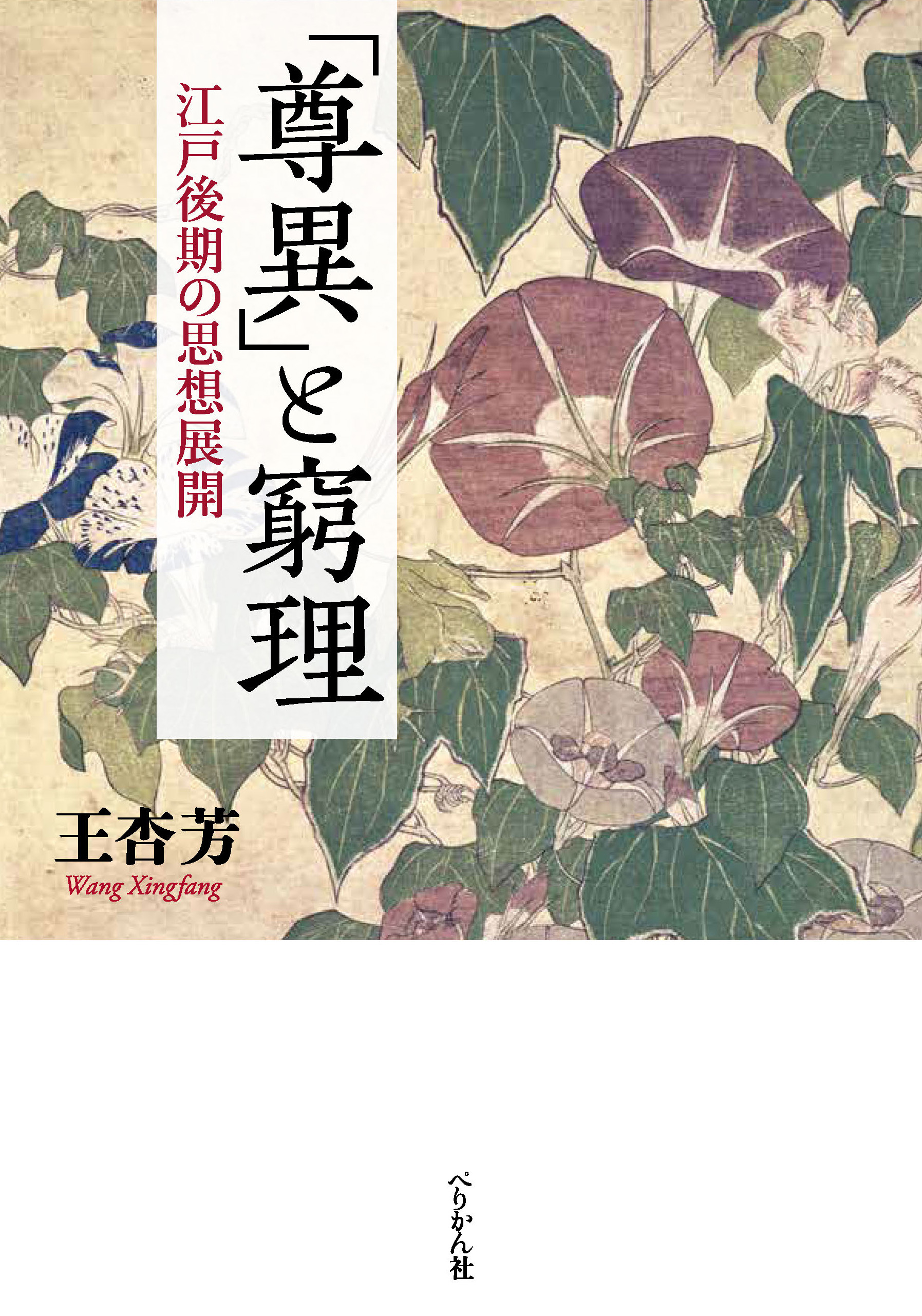
Title
Son’i to kyūri (Respect for Difference and the Investigation of Principle - The intellectual history of the late Edo period)
Size
264 pages, A5 format
Language
Japanese
Released
April, 2026
ISBN
978-4-8315-1725-8
Published by
Perikansha Publishing Inc.
Book Info
See Book Availability at Library
Japanese Page
Inoue Kinga, an eighteenth-century Japanese Confucian, wrote: “A person is not always right, and others are not always wrong. If a person dislikes others simply because of their own fallibility, then they are already being foolish. How much worse it is to reject what is right in others because of one’s own faults. If everyone were exactly the same, then even if there were millions of people, there would effectively be only one person. What good would that do?”
In the first part, Kinga criticizes the folly of condemning others while remaining in the uncertain position that oneself may not be right and others may not be wrong. He goes even further in denouncing the greater folly of reproaching others who are in fact correct because of one’s own mistaken views. And in the latter part, he emphasizes that if everyone were the same, all people would ultimately be no more than “one person,” and there would be no meaning in that. To put it simply, Kinga points out the importance of not rejecting those who differ from oneself, but rather affirming such differences and engaging with others positively and openly.
In fact, Kinga was not the only person keenly aware of human differences. An attitude that actively values and seeks to appreciate difference can be found prior to Kinga, and long before the members of the Meirokusha in the Meiji era. For example, such a stance is already evident in the thought of Confucian scholars such as Itō Jinsai and Ogyū Sorai.
This book focuses on this idea of “respecting difference” (son’i)—that is, recognizing difference and finding value in what is distinct from oneself—and analyzes Japanese Confucian philosophy from the eighteenth century onward from this perspective.
At the same time, however, alongside this son’i, there was also a powerful intellectual current that may be described as anti-son’i. The book also examines this issue, namely the Neo-Confucian critique of “heterodox doctrines” (igaku) based on the concept of ri, the belief in a single universal principle to be made clear, which in turn denies the value of difference. By the late Edo period, the significance of seeking the principle of things (kyūri ) had once again come to be strongly emphasized within this context.
The development of both son’i and kyūri was closely tied to Edo-period Confucian scholars’ understanding of China and to the historical transformation of those perceptions. The book also makes an attempt to elucidate this aspect. A distinctive feature of this book is its presentation of an intellectual history with multiple intertwined trajectories. Moreover, the author also believes that intellectual history centered on son’i can contribute to rethinking the relationship between individuals and society in today’s world, where tolerance and diversity are increasingly valued, and to fostering coexistence through mutual understanding.
(Written by: WANG Xingfang / October 15, 2026)
Related Info
The 6th UTokyo Jiritsu Award for Early Career Academics (The University of Tokyo, 2025)
https://www.u-tokyo.ac.jp/ja/research/systems-data/n03_kankojosei.html